
Forging Freedom: How Morning Discipline Buys You Evening Peace
By Drew | Iron and Lime Fitness
Last Updated: December 2025
Iron and Lime Fitness is independent and supported by readers. We may earn a small commission at no cost to you if you buy through an affiliate link.
Category: Lifestyle / Mindset Reading Time: 8 Minutes
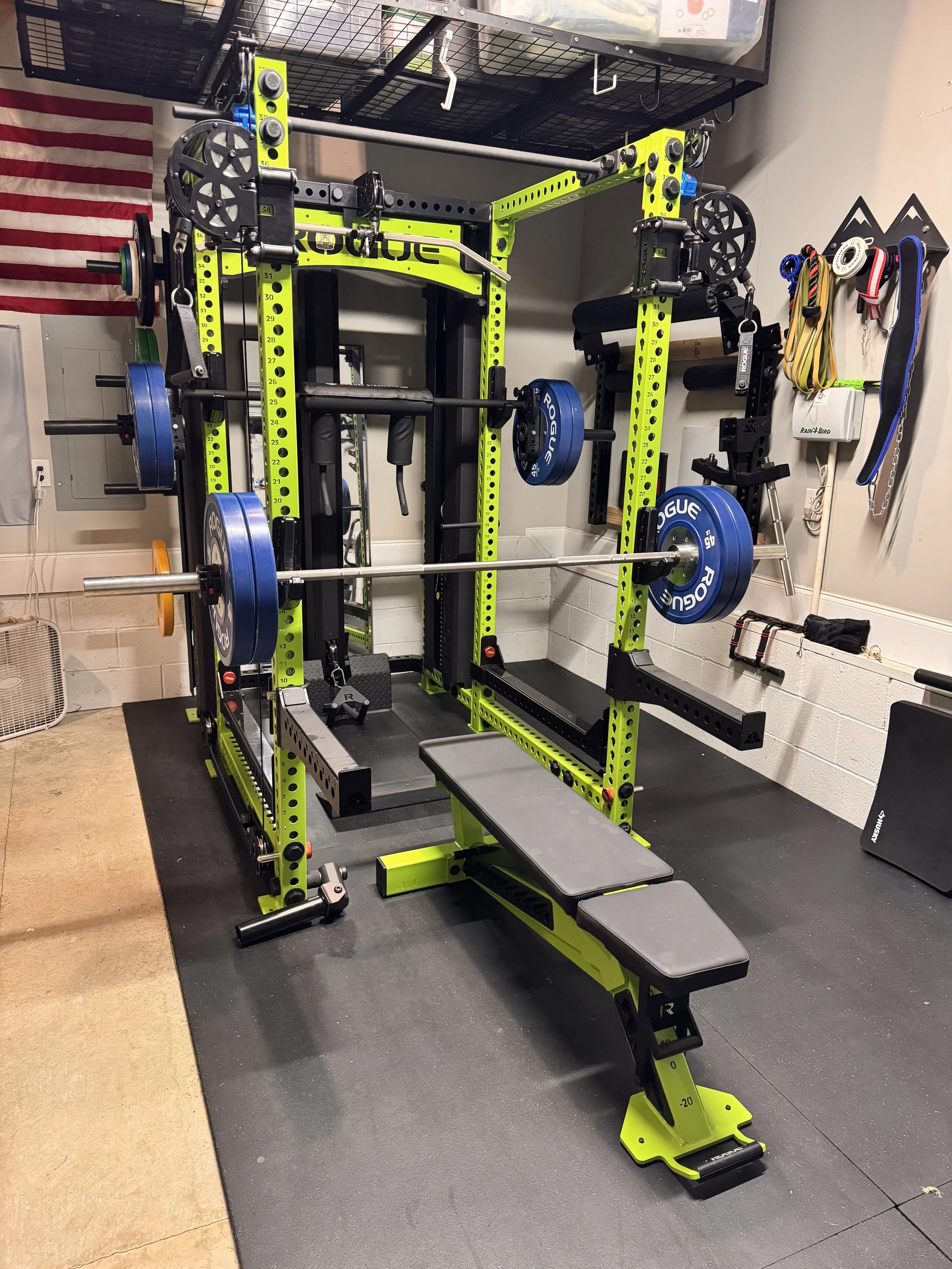
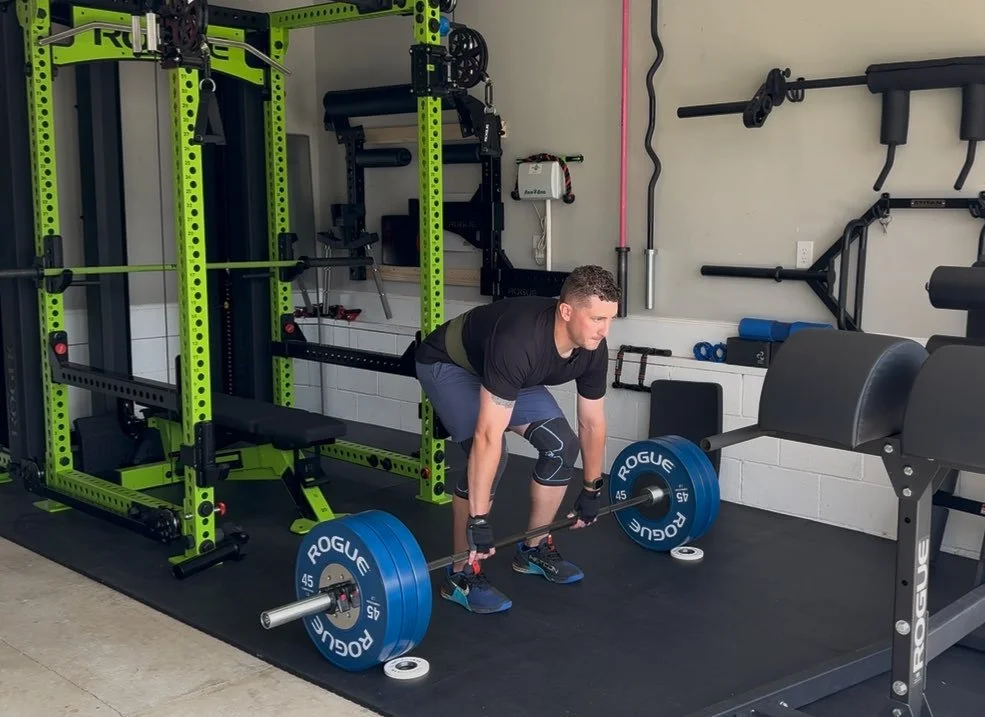
Freedom is one of the most abused words in modern culture. Waking up at 0430 has changed my life in my 30s, yes, there are days where I snooze until 0500, but even on those days, I still get in the garage by 0515 and embrace a workout and that is the key to freedom. We are told freedom looks like sleeping in, keeping options open, avoiding commitments, and doing whatever feels good in the moment. No alarms. No structure. No pressure.
That version of freedom is a lie. And most people figure it out too late. Because if you have ever lived without structure for more than a few weeks, you know exactly where it leads. Low energy. Short temper. Soft edges. A constant feeling of being behind even when nothing is technically required of you. That is not freedom. That is drift.
Real freedom is quieter. Heavier. Earned.

My kiddos on the beach.
Real freedom is the ability to handle responsibility without resentment. It is the capacity to show up calm, capable, and present for the people who depend on you. And that kind of freedom is not given. It is bought. Spending so many years in the Army taught me one thing from day one, if you can’t achieve consistency and accountability on an individual basis, you will never be able to instill those qualities in those you lead. In life outside the military, you are the leader for your children and your family. As parents, good leadership transcends to successful children. The currency is discipline.
At Iron and Lime Fitness, we do not treat training as a hobby or an aesthetic pursuit. The physical work done in the garage is not about chasing a pump or impressing strangers online. It is about front-loading hardship so the rest of life feels lighter by comparison.
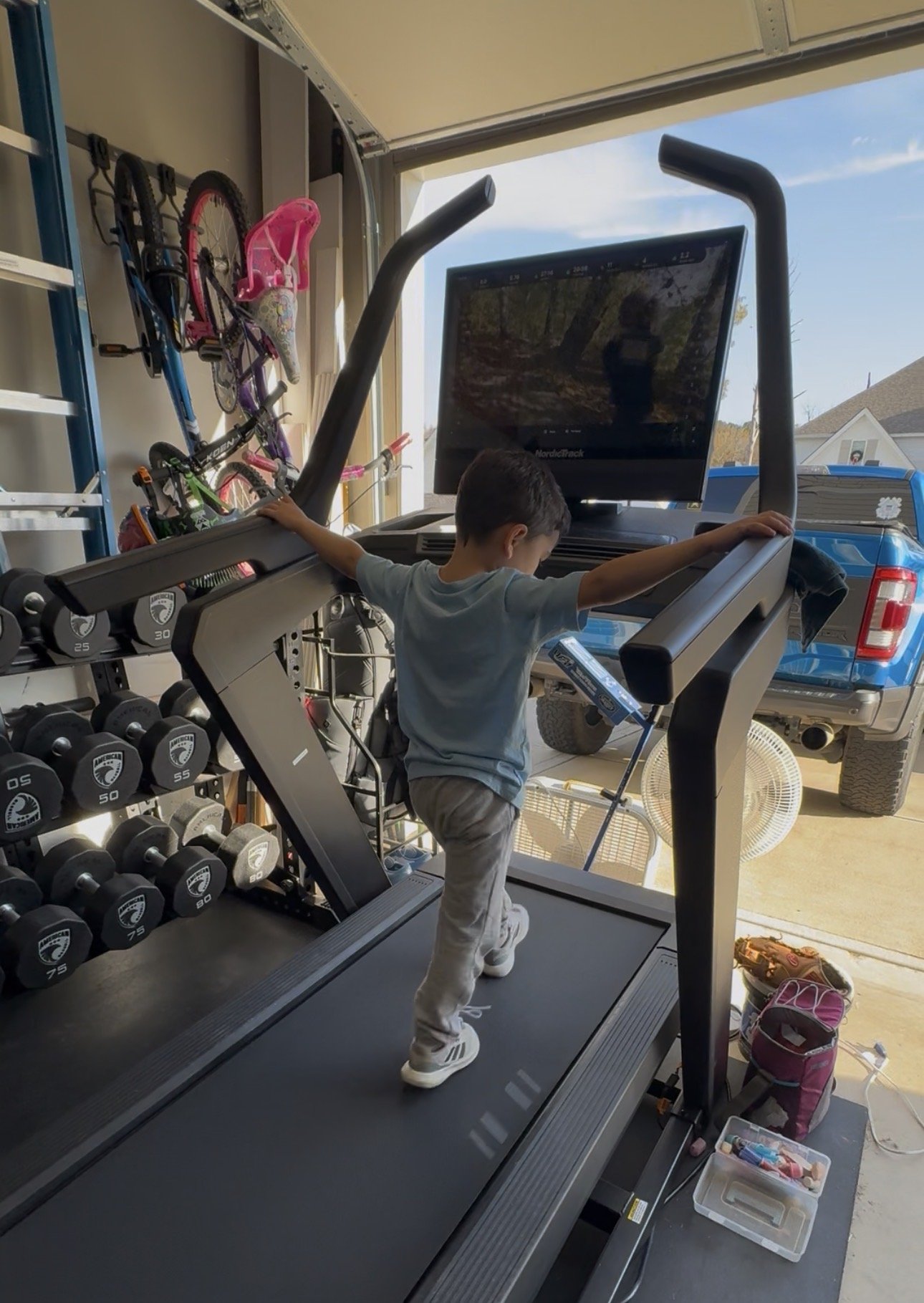
When you wake up before the house and kids do and lift cold iron while the world is still quiet, you are making a trade. You are choosing controlled discomfort now so you can have patience, clarity, and margin later. The best part about this level of discipline is that your family will notice. Your kids will began to feel a drive to wake up and start their day walking on the treadmill while you lift. The best part of all, physical fitness and a healthy lifestyle will start to become their normal expectations. That is the kind of education that many parents should be proud to pass on.
When I got to Basic Training in 2008, there were people there that had never been taught physical fitness, how to make a bed, how to feed themselves properly, or even how to conduct personal hygiene. While this was a crazy concept to me as a young 18 year old, I now understand it a little more. People need to be shown what right looks like as early as possible. Kids won’t always do what you tell them, but they will usually copy patterns over a long enough period of time.
This is how morning workout discipline buys you evening fulfillment in life.
The Garage Gym Mindset: A Sanctuary, Not a Storage Unit
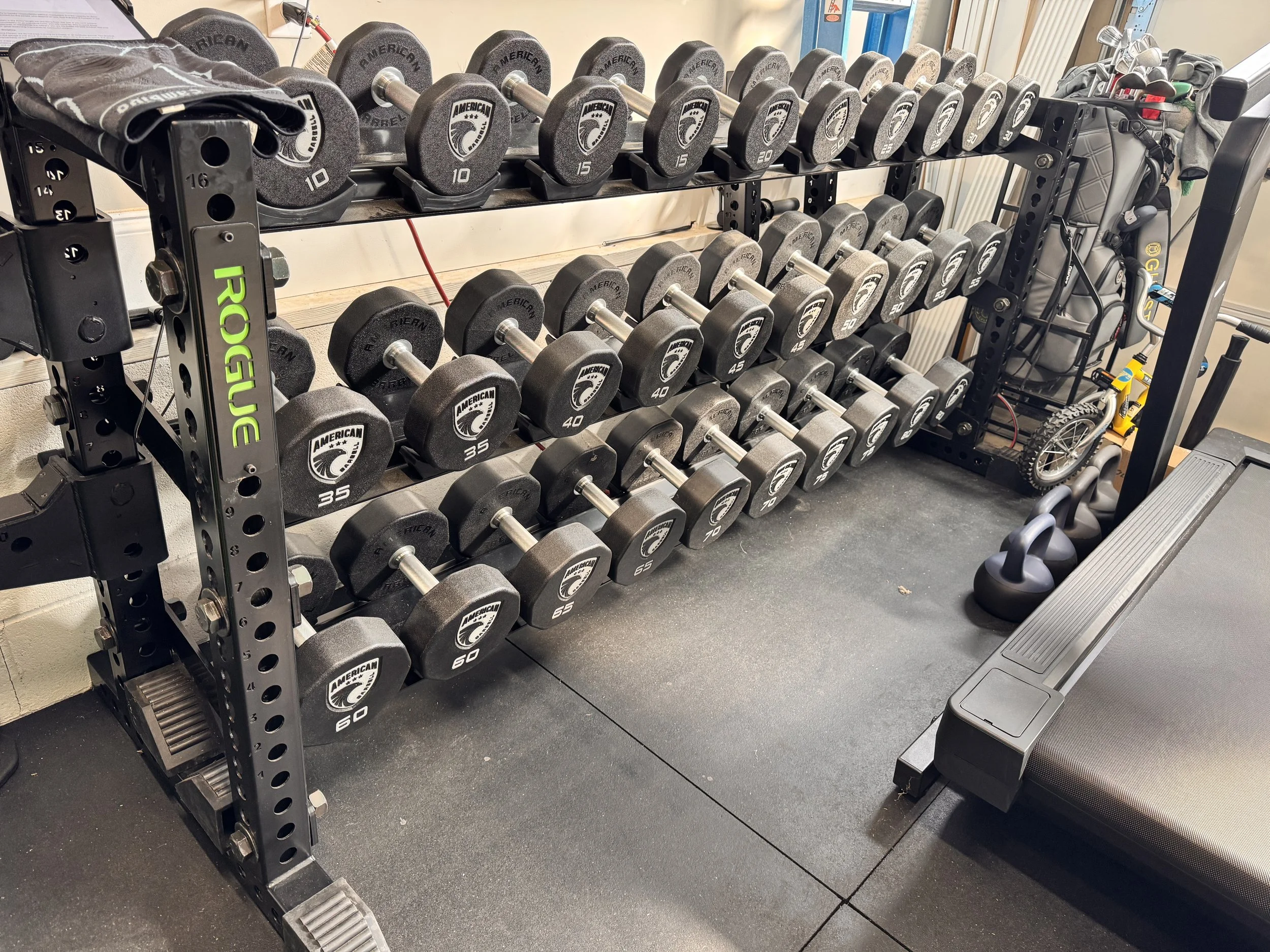
Rogue 3 Tier Monster Dumbbell Rack
For adults with real responsibility, solitude is rare. Between work demands, family obligations, and the low-grade noise of modern life, uninterrupted silence is almost nonexistent. That is why the garage gym matters more than people realize. It is not just a place where weights live. It is a boundary. When you step into the garage in the early morning, you enter a controlled environment. No emails. No meetings. No one asking you to solve their problem right now. Just gravity and the decision to oppose it. That matters. For 45 to 75 minutes, you are not reacting. You are acting. You are not consuming. You are producing effort. You are not scattered. You are focused. That state is rare, and it is powerful.
The No-Phone Rule for Mental Clarity
If you want your garage to function as a sanctuary instead of just another noisy room in your house, you have to protect it deliberately. The gym does not become sacred by accident. It becomes sacred because you decide what is allowed inside. And the biggest intruder is the phone.
I am not anti-technology. I track lifts. I run timers. I play music. Sometimes I jot notes between sets. The phone has a place. But if you are not careful, it stops being a tool and starts being a portal. Text messages. Email. Group chats. News alerts. Social media. Suddenly your 60-minute training session turns into fragmented attention and half-effort sets.
Put it on Do Not Disturb.
That single decision changes the tone of the room. Music is fine. Workout notes are fine. Even a quick log update is fine. What is not fine is constant notification drip. Every vibration pulls you out of the lift and back into the noise of the world. And if the garage is supposed to be your edge sharpening room, you cannot sharpen steel while answering texts.
Now let’s talk about the one most of us struggle with (especially when I know that I need to film content for the channel)
The scroll. No social media between sets. I am not preaching from a mountaintop here. I have been guilty of it plenty. One quick check turns into three minutes. Three minutes turns into ten. Your rest period drifts. Your intensity drops. Your mind shifts from effort to entertainment. Moderation matters. Discipline matters more.
If you can glance at something and move on without falling into a rabbit hole, fine. But if you know you are the type who gets pulled in, cut it off entirely. Protect the space. This is not about productivity hacks or maximizing output. It is about mental hygiene. The garage is where you process the day physically. Your nervous system discharges stress under the bar. Your breathing settles. Your focus narrows. You move from scattered to structured. By the time you walk back into the house, the hard work has already been done. You are not re-entering as an exhausted employee or an overstimulated parent. You are not carrying mental clutter from emails or notifications. You walk back inside calmer. Steadier. Harder to shake. You show up as the adult in the room. And that is worth protecting.
Strength Training for Emotional Regulation
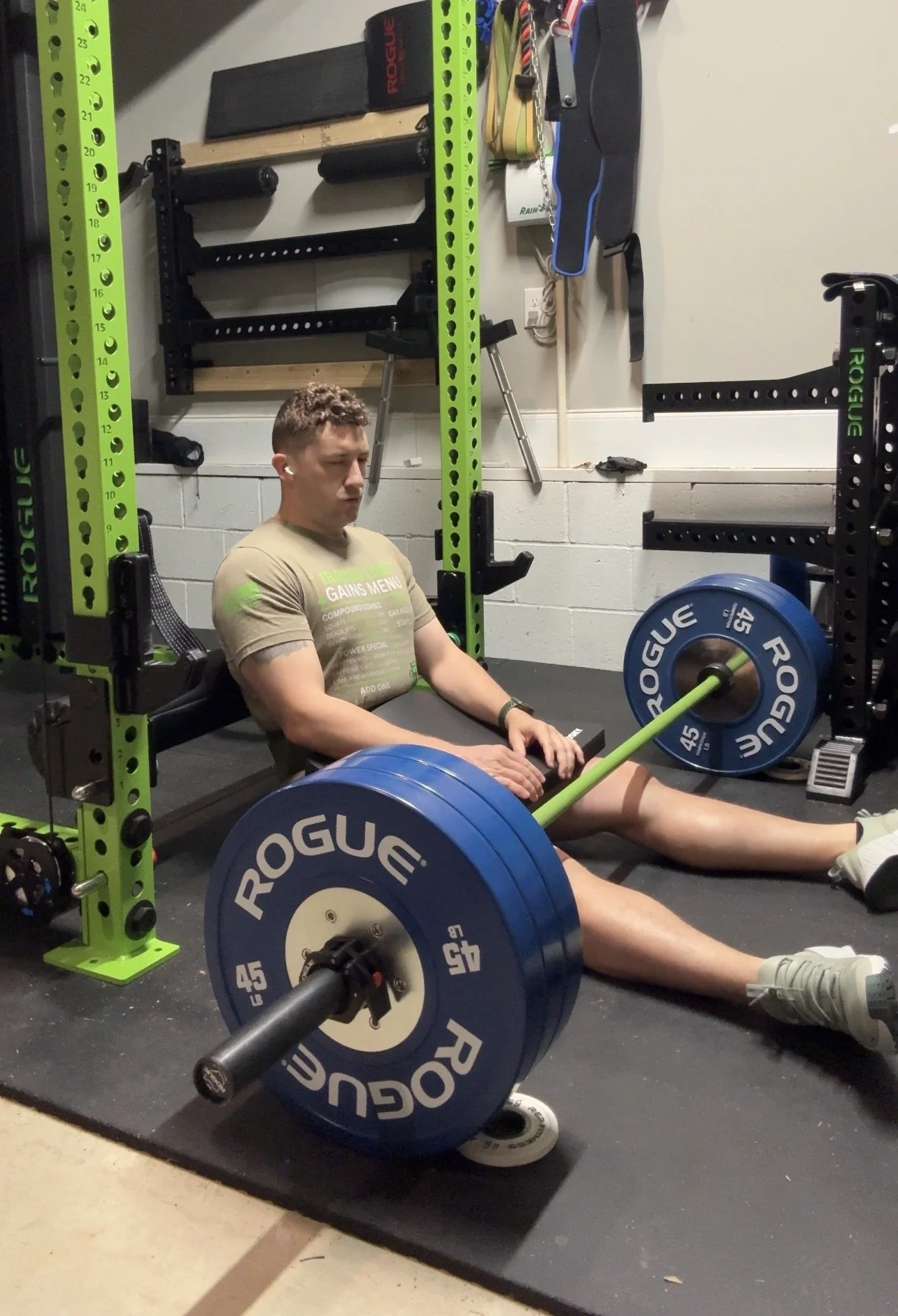
There is a reason people who train consistently tend to be more even-keeled. It is not just about aesthetics or discipline. It is neurological. Heavy training changes your state. Stress accumulates whether you acknowledge it or not. Deadlines stack up. Traffic grinds on you. Financial pressure hums in the background. Leadership responsibilities sit on your shoulders. Sleep debt compounds. You can pretend you are fine, but your nervous system keeps score. That energy does not disappear. It has to go somewhere.
When you put a bar on your back or pull heavy weight from the floor, you are not just moving iron. You are giving that stored tension a controlled outlet. Your breathing changes. Your heart rate spikes and then settles. Your focus narrows to something simple and binary: lift the weight or do not. It is mechanical, yes. But it is also neurological recalibration. If that stress does not get discharged physically, it leaks out emotionally. And it rarely leaks in productive places. It leaks in tone. In patience. In overreactions to small things. We have all seen it. The short fuse. The snap over something trivial because the cup was already full before the moment even arrived.
I am fortunate in that I do not have much of a temper. That is not something I struggle with. But I have noticed something honest about myself. If I go multiple days without training, my patience thins. Not dramatically. Not explosively. Just enough to notice. I become a little less steady. A little quicker to feel irritated. And that is not fair to the people I care about most. They did not create the stress. They do not deserve the overflow.
For me, training is not optional therapy. It is maintenance. It is how I keep the edge sharp without turning it on the wrong targets. It is how I walk back into the house regulated instead of carrying the residue of the day with me. Heavy lifting does not just build strength. It builds stability. And stability at home matters more than any number on a barbell.
The "Empty Cup" Problem
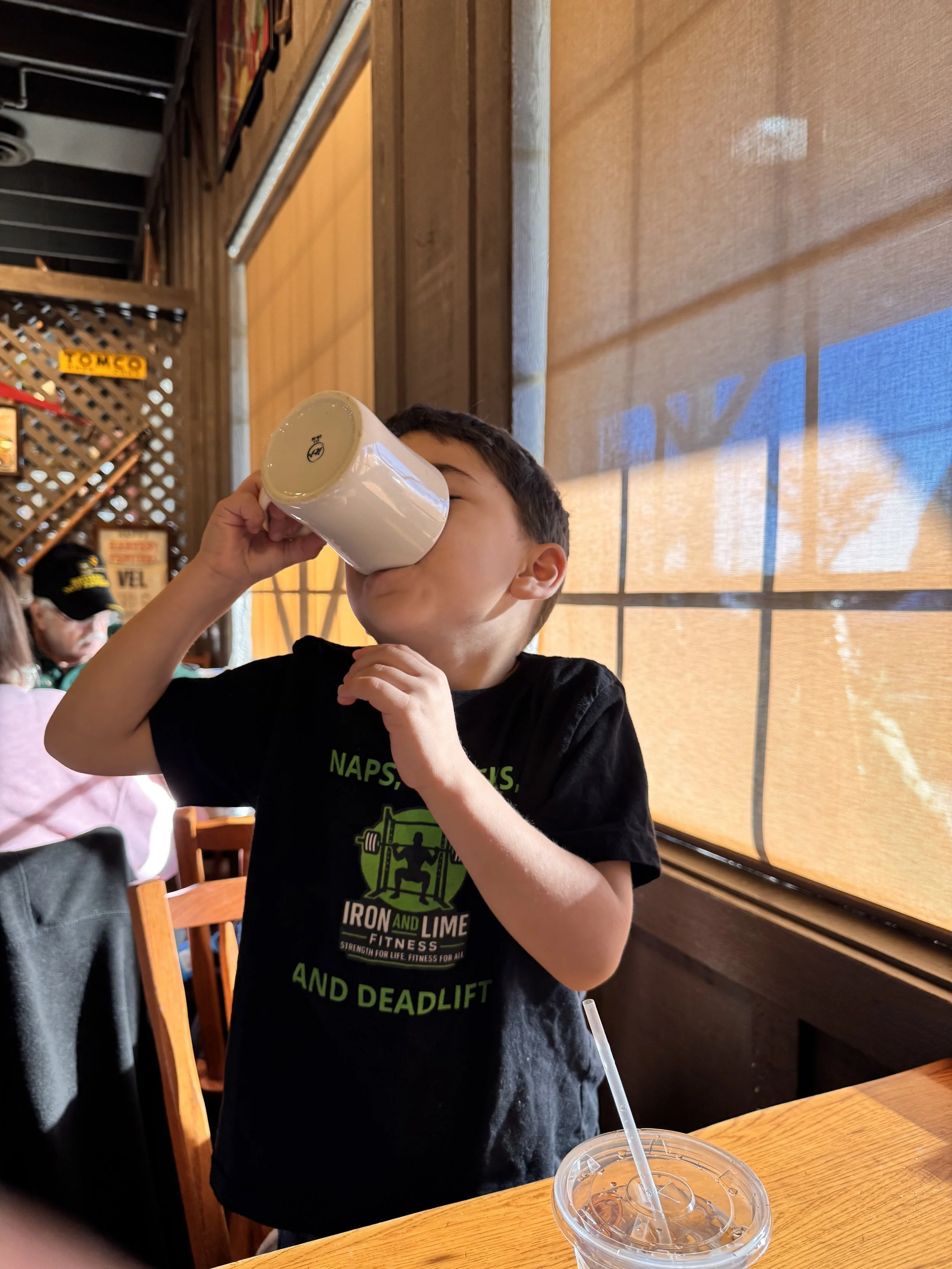
My main man rocking the Iron and Lime Swag
There is something nobody talks about enough. When your body feels weak, stiff, under-recovered, or sluggish, your tolerance shrinks. Your margin for chaos gets thinner. You wake up already behind. Your joints feel tight. Your posture is off. Your energy is low. That physical state bleeds into your mental state. You are operating from an empty cup, and when you are empty, everything feels heavier than it actually is.
The spilled milk.
The late email.
The minor inconvenience.
It is not the event. It is the depleted system responding to it. Consistent training changes that baseline. High-intensity lifting helps regulate cortisol. You spike stress in a controlled environment and then allow your body to come back down. That cycle teaches your nervous system how to handle pressure without staying stuck in it. You are not eliminating stress. You are training your body to metabolize it.
There is also something powerful about physical fatigue. Productive fatigue. The kind you earn under the bar. When your body is physically worked, your mind often settles. Tension leaves your shoulders. Your breathing deepens. You feel grounded instead of scattered. Resilience in the body tends to mirror resilience in behavior. When you regularly push through hard sets, discomfort stops feeling threatening. You become familiar with strain. You understand that effort does not equal danger. That familiarity carries over. You do not flinch as easily in normal life because you have already practiced composure under load.
Even sore muscles play a role. They are a reminder that you are building something. That you showed up. That progress is happening, even if it is incremental. That quiet confidence stabilizes you. That 5:00 AM squat session is not about legs. It is about buying patience for later. It is about creating space between stimulus and response. It is about walking into the evening steadier than you would have been otherwise. Harder to annoy. Slower to react. More measured.
Strong people are not just harder to kill.
They are harder to rattle.
And in a house full of people who rely on you, that might be the more important trait.
Prioritizing Fitness: Why Early Morning Workouts Win
“I don’t have time” is almost never the truth. What people usually mean is, “I have not decided this matters enough to protect.” Time is allocated according to priority. Always. The calendar does not lie. If something consistently gets squeezed out, it is not because the day was magically filled to 100 percent capacity. It is because in the rack and stack of your life, it did not make the cut.
That is not an insult. It is reality.
It is the same dynamic you see in relationships. When someone says they are too busy to text back or hang out, it is rarely because they did not glance at their phone. It is because in their priority hierarchy, you were not high enough that day. That may sting, but it is honest. What is not okay is letting that define your self-worth. And the same logic applies to training. If you continually push your workouts to the margins, you are sending yourself a message. You are telling yourself that your health, your strength, your longevity, and your mental stability are negotiable. That they can wait. That they are optional.
They are not.
Training in adulthood is not about hype or motivation. It is about logistics. If you rely on how you feel, you will lose. Feelings are volatile. Energy fluctuates. After a full day of work, family responsibilities, decisions, and unexpected friction, your willpower is already taxed. Decision fatigue is real. By 6:00 or 7:00 PM, most people are operating on fumes. Waiting until the end of the day means you are competing against exhaustion, against family needs, against social obligations, against the simple desire to sit down and shut your brain off.
That is a bad strategy.
Early morning training eliminates competition. At 5:00 AM, the world is quiet. The phone is silent. No one needs you yet. You are not negotiating with a tired version of yourself. You are making one hard decision once, instead of renegotiating it all day long. You wake up. You train. It is done. No drama. No debate. No emotional calculus. And there is something powerful about winning the day before most people hit snooze for the third time. The discipline compounds. The confidence compounds. You re-enter the house already having kept a promise to yourself.
That changes how you move through the rest of the day. It is not about chasing aesthetic goals. It is about establishing control over something that is fully within your power. You are worth protecting. You are worth prioritizing.
And the simplest way to prove that to yourself is to set the alarm, step into the garage before sunrise, and handle your business before the world starts making demands.
The Logic of the 4:30 AM Alarm
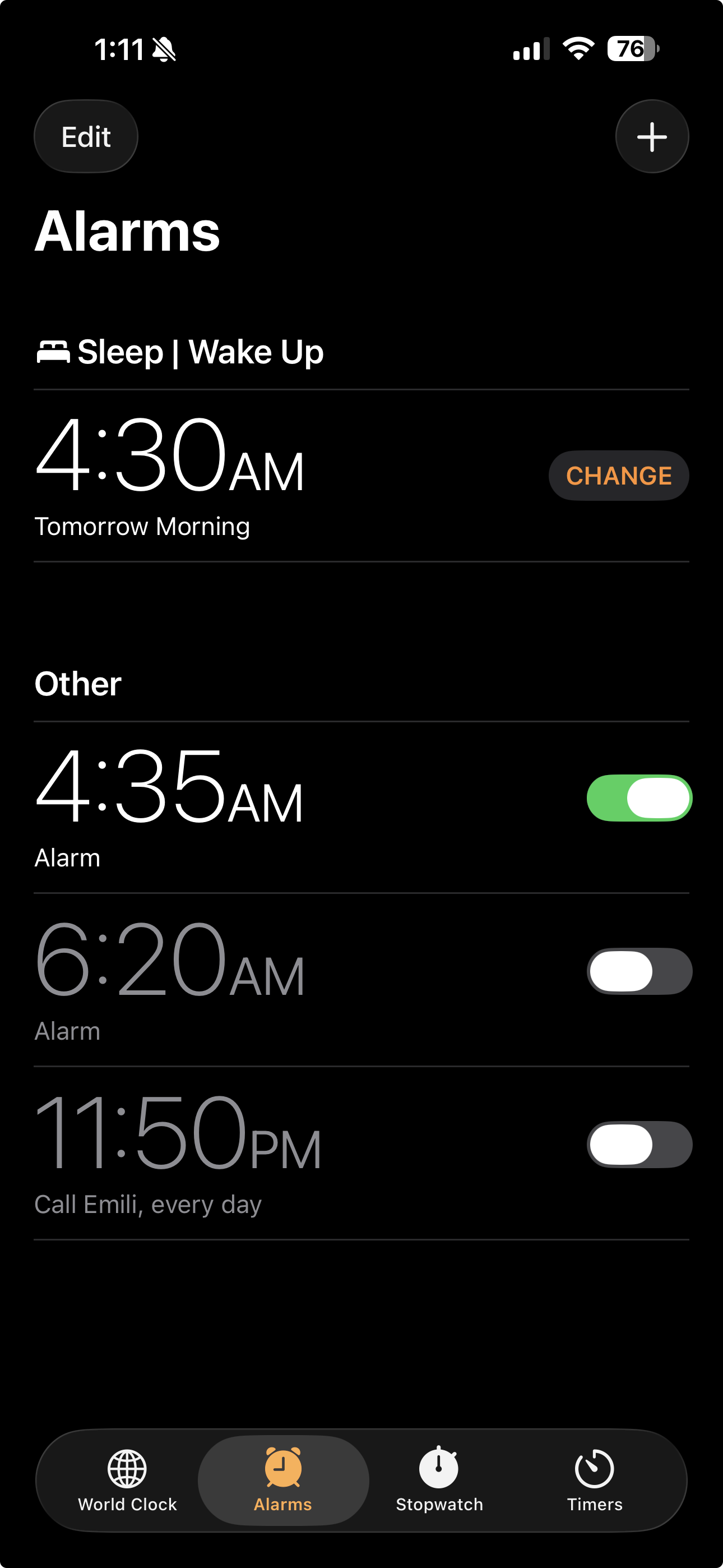
There is nothing mystical about 4:30 AM. It is not a productivity hack. It is not a badge of honor. It is simply a strategic decision. Early mornings remove friction.
No competing demands.
No incoming texts.
No meetings sliding long.
No kids needing breakfast.
No last-minute “can you just…” requests.
At that hour, the world is not asking you for anything. The house is quiet. Mostly. It becomes slightly less quiet once the plates start clanging in the garage. But even then, the atmosphere is different. The air feels still. There is no noise pollution from the day yet. It feels like borrowed time.
And it belongs to you.
There is also something underrated about eliminating decision fatigue. When you train early, you do not negotiate. You do not debate whether you feel like it. You wake up and execute. There is no willpower contest because you removed the variables that would require willpower later. By 5:00 PM, life is messy. By 4:30 AM, it is simple. Yes, the trade-off is real.
Early mornings require early nights. You will miss some shows. You will shut it down while other people are still scrolling. I know when 9 PM rolls around and I start glancing at Jess, she can see it coming. I am calculating sleep cycles in my head. She is calculating one more episode. But in my defense, 0430 comes early. That is not sacrifice. It is correction. You are exchanging passive entertainment for capability. You are trading late-night scrolling for early-morning clarity. You are choosing control over convenience.
Most people protect their evenings like they are sacred. I would argue your mornings are more valuable. When you handle your training before sunrise, you walk into the rest of the day already steadier. Already sharper. Already disciplined. The hard thing is done.
And once the hard thing is done, the rest of the day feels lighter.
How to Make Discipline Automatic
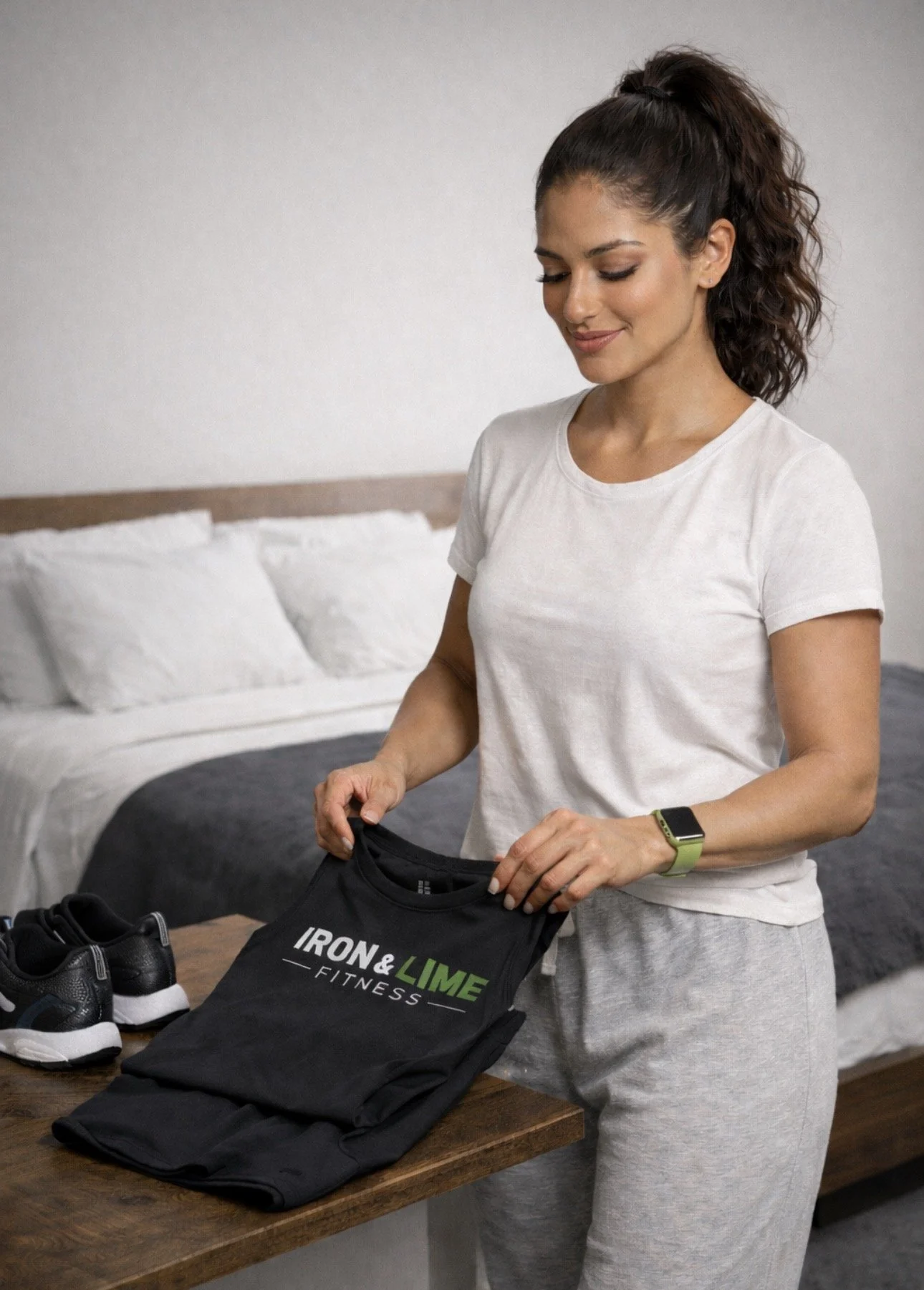
Discipline is not about being tougher than everyone else. It is about removing negotiation. The more decisions required between your alarm going off and your first rep, the more opportunities you give yourself to quit. Discipline works best when it eliminates choice. When the path is already laid out and the only remaining action is execution.
Lay your clothes out the night before. Not in a pile. Not somewhere you have to search for them. Set them exactly where your feet hit the floor. Make it stupidly simple.
Prep your water. Mix your pre-workout if you use it. Put the shaker on the counter. If you drink coffee instead, set it up so you only have to press a button. Remove every micro-decision that would otherwise create friction at 4:30 in the morning.
Charge your headphones.
That sounds small, but small annoyances at that hour feel bigger than they are. A dead battery becomes an excuse. A missing sock becomes hesitation. A cluttered path becomes delay. You want a straight line from bed to barbell. The goal is to eliminate every unnecessary step between waking up and starting your warm-up. Because the brain is lazy when it is tired. It looks for outs. It looks for justification. If you make the process frictionless, you leave it nothing to argue with. This is not about hype. It is not about motivation. It is about systems, because systems will help you succeed.
The less thinking required, the more consistent the outcome. And consistency is the real engine of progress. Intensity feels impressive. Consistency builds results. You do not need one heroic workout. You need hundreds of boring, predictable ones stacked on top of each other. Make discipline automatic.
Then let time do the rest.
Balancing Fitness and Family Without Guilt
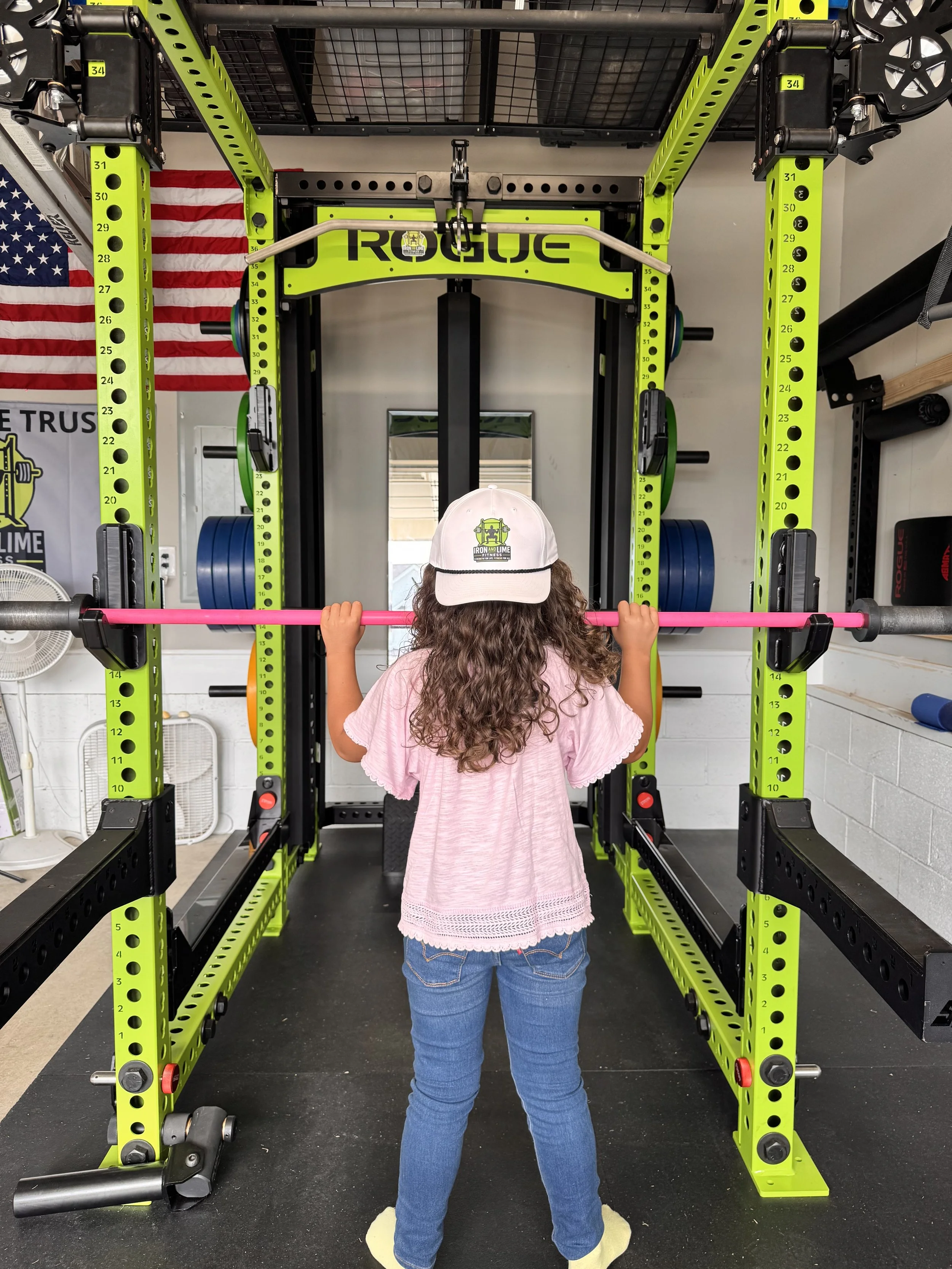
One of the biggest mental traps for parents is believing that training steals time from the family. That mindset is backward. You are not choosing fitness over your family. You are choosing the version of yourself that your family actually deserves. When you skip training out of guilt, what you are often protecting is optics, not outcomes. You are physically present, but you are more tired. More irritable. Less patient. Less sharp. That is not a win. That is a trade that looks noble but costs more than people admit. Children do not absorb lectures. They absorb patterns.
You can tell them to take care of their health. You can tell them discipline matters. You can tell them hard work builds confidence. But what they will remember is whether you lived it. If they see you move your body consistently, respect your health, and do hard things without whining about it, that becomes their baseline for adulthood. It becomes normal to wake up early. Normal to sweat. Normal to choose effort over ease. That is not selfish. That is leadership.
And something interesting happens when kids grow up around training. They want in. They see the garage light on. They hear the plates moving. They get curious. They wander out and ask questions. They mimic movements with light weights or bands. They start associating fitness with energy, not punishment. That is the opportunity.
Make it fun. Let them hang around. Let them try things safely. Turn it into a shared experience instead of a secret ritual. Fitness should not feel like an obligation hanging over the house. It should feel like a normal, active part of life. You are not stealing time from them. You are building a culture inside your home. And culture lasts longer than any single workout ever will.
Practical Ways to Blend Training and Life
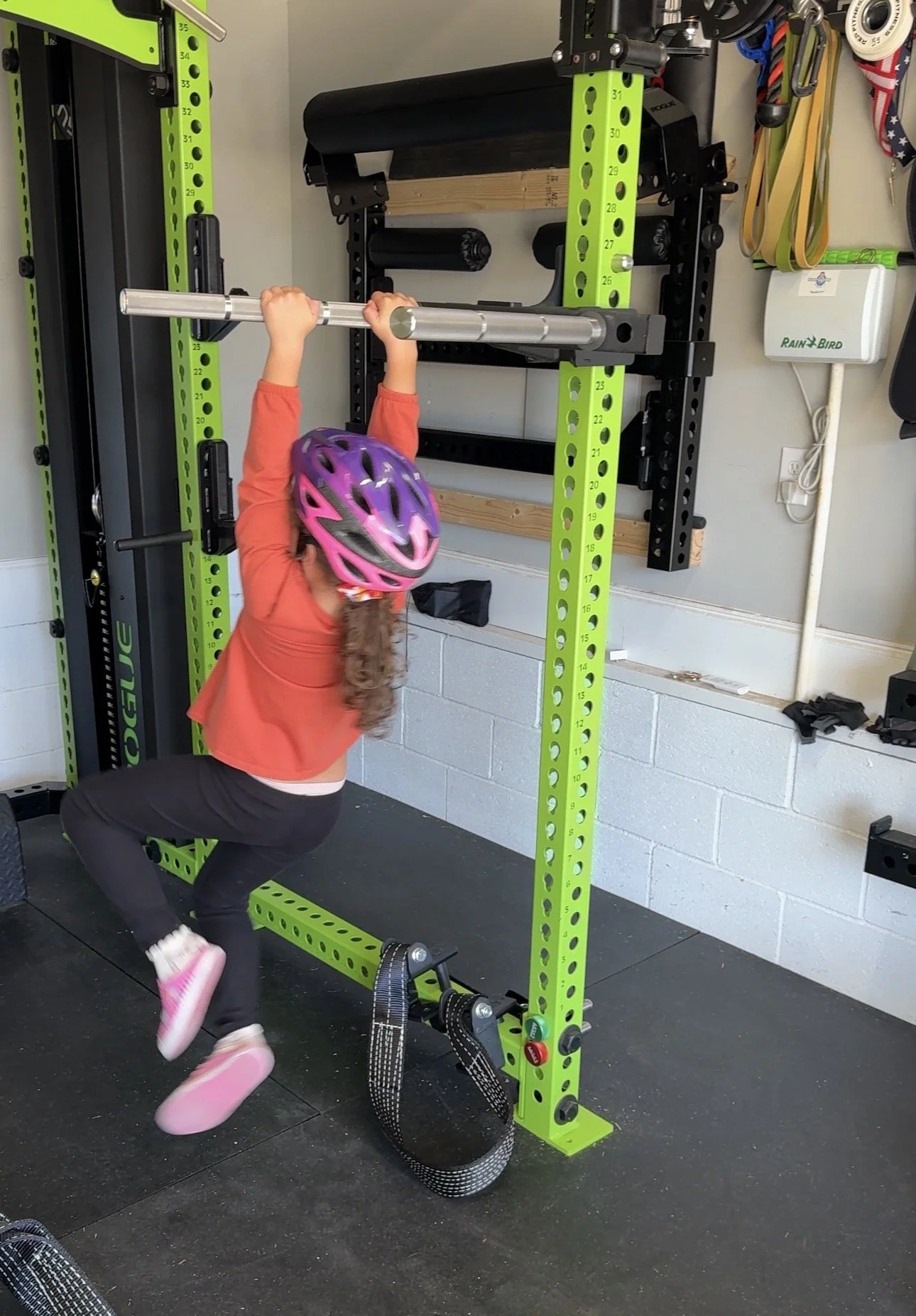
This does not require perfection. It does not require curated Pinterest setups or a garage that looks like a showroom. It requires intention.
Start simple.
Train with the garage door open when you can. Let the house see it. Let your kids walk by and notice that effort is happening. That the day does not start with scrolling. That adults in this house move their bodies. Visibility matters. When training is hidden, it feels separate. When it is visible, it feels normal.
Lean into parallel play. If they want to be nearby, let them. Set clear boundaries for safety, but do not shut them out. Give them a light band. A PVC pipe. Let them walk on the treadmill at a slow pace while you finish accessories. And when they reach for a dumbbell, that is your moment to teach. Show them how to hinge. How to lift with their legs. How to respect weight instead of fearing it. Proper mechanics learned young are not just cute moments, they are long-term health insurance.
On weekends, make movement part of family time instead of something separate from it. Ruck with a pack. Push a stroller. Take a short walk after dinner, even if it is just to the mailbox and back. Teach them that movement is medicine, especially after a big meal. It does not have to be intense. It has to be consistent.
Most importantly, let them see the full picture.
Let them see you miss a lift and reset. Let them see you grind through something uncomfortable. Let them see that effort matters even when the outcome is not perfect. Those moments are more formative than any perfectly executed set. They learn that struggle is not a signal to quit. It is part of the process.
When fitness becomes woven into the household rhythm instead of treated like a selfish escape, the tension disappears. It stops feeling like you are stealing time. It starts feeling like you are building something.
Not just muscle.
Standards.
Functional Goals: From Aesthetics to Capability
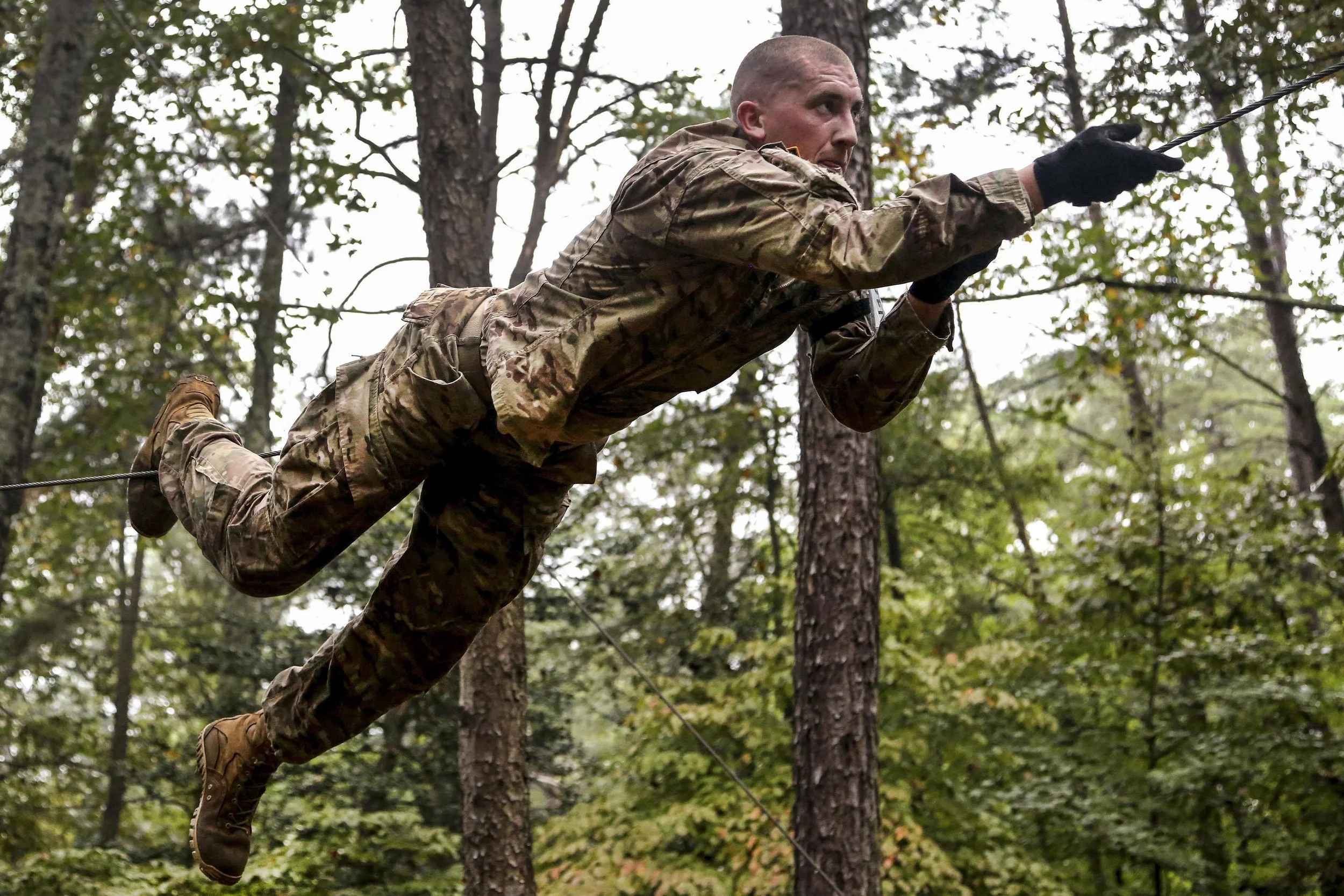
Goals evolve.
In your twenties, training is often about aesthetics. Bigger arms. Leaner waist. Looking good at the beach or in a uniform. There is nothing inherently wrong with that. Wanting to look strong is normal. It can even be motivating. But it is incomplete. As responsibilities increase, the purpose behind training shifts. You are no longer lifting just to impress strangers or chase a mirror reflection. You are lifting because capability matters. Because durability matters. Because your body is no longer a temporary accessory. It is infrastructure.
If my time in the Army has taught me anything, it is this: how you handle your health in your youth directly affects your quality of life later. The people who ignored recovery, mobility, and strength when they were younger often pay for it in their thirties and forties. Chronic aches. Limited mobility. Lower tolerance for stress. Reduced work capacity. Fitness is either an investment or a debt.
When you train with a long horizon, the metrics change. You start asking different questions. Can I carry weight without pain? Can I sprint when needed? Can I lift awkward objects safely? Can I stay strong enough to handle whatever life throws at me without becoming fragile? Aesthetics fade. Capability compounds. The goal becomes staying operational. Being able to pick up your kids without thinking about your back. Being able to move furniture without dreading it. Being able to pass fitness standards without panic. Being able to age without shrinking into discomfort.
This is where training becomes less about vanity and more about responsibility. You are not trying to look twenty-five forever. You are trying to feel capable at forty-five, fifty-five, and beyond. And that requires a different mindset. You stop chasing temporary peaks. You start building long-term durability.
Capability matters more than appearance.
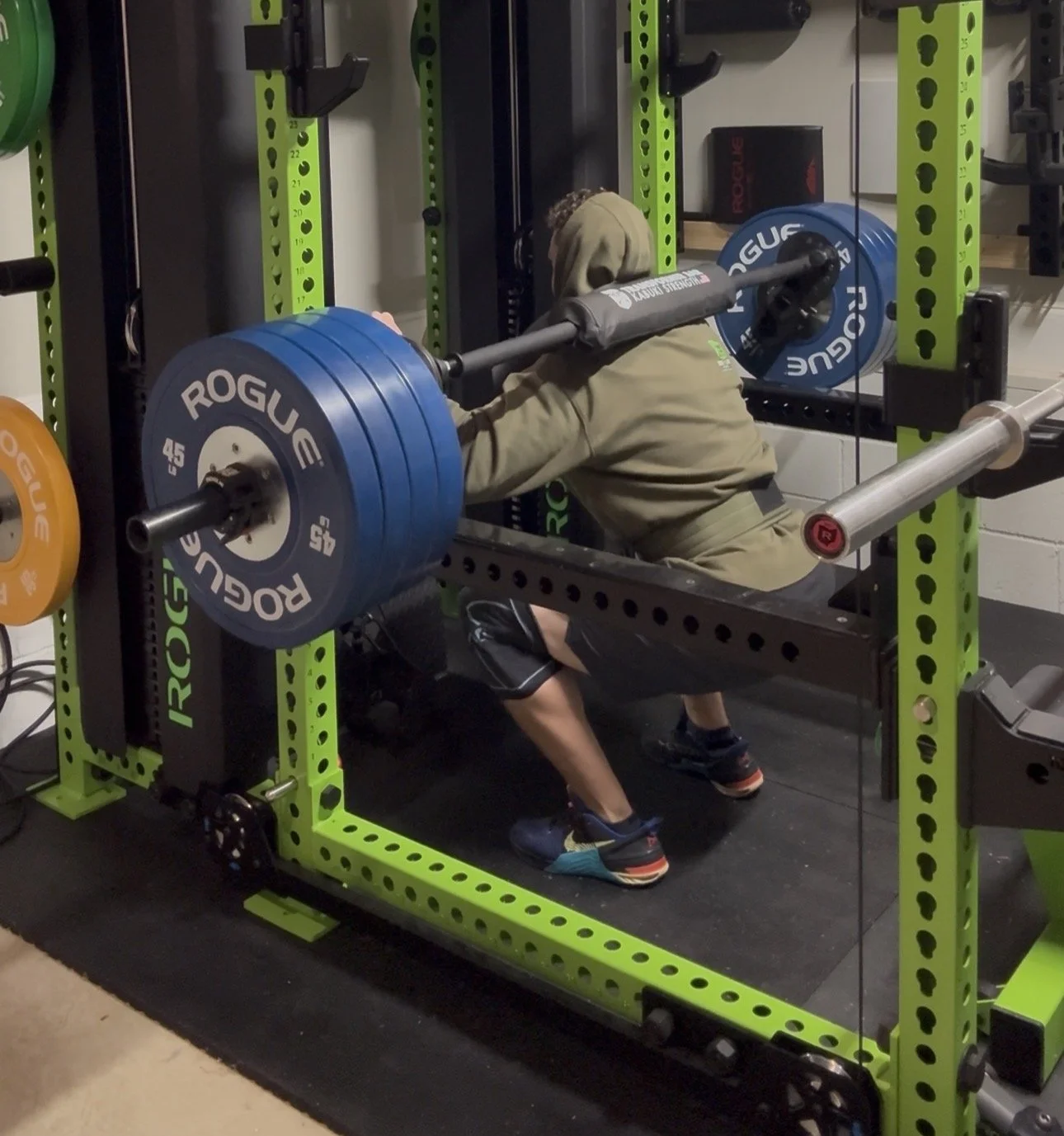
Looking strong and being strong are not always the same thing. One photographs well. The other shows up when it counts. Real freedom is the ability to say yes without hesitation.
Yes, I can lift that.
Yes, I can help.
Yes, I can carry this.
Yes, I can keep up.
Yes, my body can handle this.
That is confidence without noise. No flexing. No proving. Just quiet certainty rooted in preparation. A strong body expands your options. You can take on physical tasks without calculating risk every time. You can volunteer to move something heavy. You can play hard with your kids. You can handle a long day on your feet. You can endure discomfort without immediately looking for relief. A weak or neglected body narrows those options. You start declining things. Avoiding effort. Calculating pain before action. Life becomes something you manage instead of something you engage with fully.
Vanity metrics come and go. Body fat percentages fluctuate. Lighting changes everything. But capability compounds. Every year of consistent strength work builds a reserve. A buffer. A margin. That margin is what protects you when life gets heavy. And life will get heavy. When it does, you will not care what your arms measure. You will care whether you are capable.
The Bottom Line
You do not train to escape your life. You train to carry it better. The barbell is honest. It does not care how busy your schedule is. It does not care how tired you feel. It does not negotiate. It responds to one thing only: consistent effort applied over time. That principle does not just build muscle. It builds character. It builds reliability. It builds proof that you can do hard things repeatedly without drama.
And that lesson transfers everywhere.
Set the alarm. Take the pre-workout shot. Brew the coffee. Lace the shoes. Step into the quiet before the world starts making demands. Handle your business while the house is still sleeping and your mind is clear. Forge discipline early so you can enjoy freedom later.
Evening peace is not accidental. It is earned before sunrise. When you have already trained, already kept a promise to yourself, already discharged the stress of the day before it accumulates, you walk back into the house different. Calmer. More measured. Harder to shake. That is not motivational fluff. That is cause and effect. And if the process feels overwhelming, if the programming side feels like one more thing to think about, you do not have to solve that alone.
The goal is not hype. The goal is structure. Because structure builds discipline. And discipline builds freedom.
Strength for Life. Fitness for All.
It’s the Iron and Lime way.
-Drew