
Why I Switched from Rogue to Surplus Strength: The Best Safety Spotter Arms for Garage Gyms (6 Months of Use)
By Drew | Iron and Lime Fitness
Last Updated: January 2026
Iron and Lime Fitness is independent and supported by readers. We may earn a small commission at no cost to you if you buy through an affiliate link.
A Garage Gym Safety Upgrade That Earns Its Keep
If you train in a home gym long enough, you learn a simple, unglamorous truth. The most important equipment you own is not the flashy centerpiece. It is not the monolith you angle perfectly for Instagram. It is not the bar that gets all the comments. It is the equipment you stop noticing. It is the quiet Toyota Camry with 150,000 miles that has carried your family through every season of life without complaint. It is the Weber grill that has been turning out dependable steaks since before the world shut down. It is not sexy. It is not viral. It is dependable.
And in a garage gym, dependable is everything. Because most of us are not training with a crowd. We are not surrounded by spotters. We are lifting before sunrise, when the house is still asleep, or after a long day when energy is already taxed. In those moments, safety is not theoretical. It is personal.
Spotter arms live in that category. They are not glamorous. You do not buy them for aesthetics. You buy them because eventually you will miss a rep. You will grind too long. You will misjudge fatigue. And when that happens, the only thing between you and a very bad day is the steel bolted to your rack. I have been running the Stealth Spotter Arms from Surplus Strength for six months, closing in on seven, inside the Iron and Lime garage gym. This is not a first-impression take. Not a polished unboxing. This is what remains after missed reps, early mornings, chalk dust, coffee spills, and real life have had time to expose weaknesses.
This is what survives stress-testing. I did not switch casually. I ditched my standard Rogue spotter arms. I waited through the lead time. I spent real money. And I did it for one reason: I wanted the best insurance policy I could bolt onto my rack. Here is why I believe these arms earn their keep.
Check out the Youtube video below
The Problem: When Safety Becomes a Chore
Safety in a garage gym is not the same as safety in a commercial facility. In a commercial gym, there are people everywhere. Someone can slide in for a spot. There are extra benches. Extra racks. Extra margin for error.
In a garage gym, there is you.
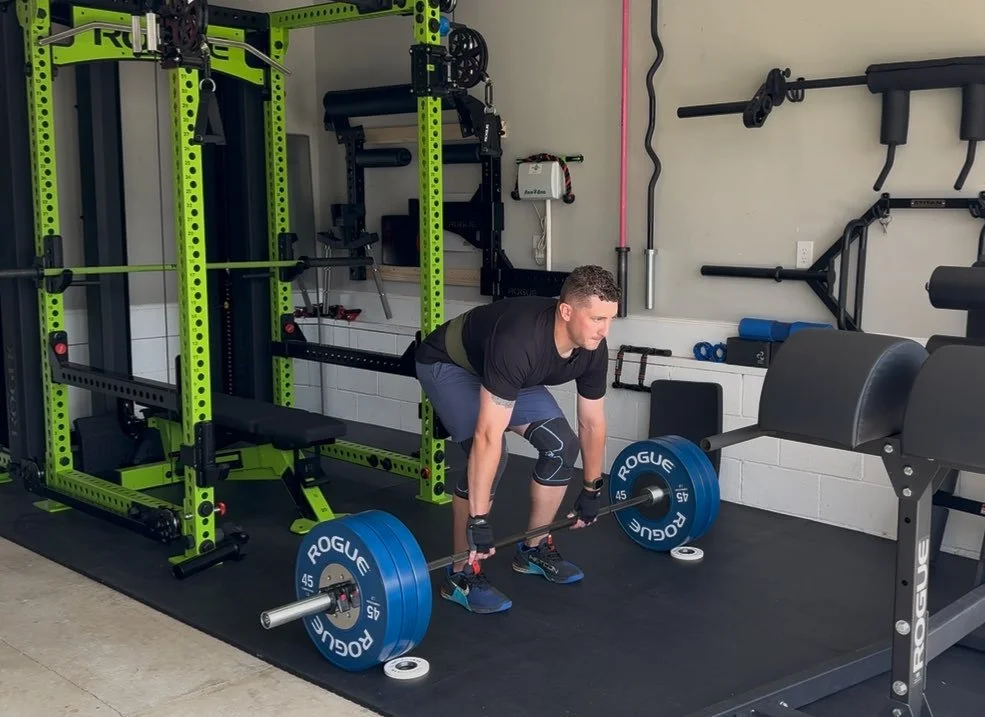
We train alone. There is no one hovering behind the bench waiting to grab a bar if a rep stalls. We train early or late. Getting pinned under a bar at 5:00 AM while the rest of the house is asleep is not just inconvenient, it is unacceptable. And in my case, with a 9 by 18 footprint, every piece of equipment has to justify its space whether it is in use or stored. For years, I ran the standard Rogue Monster spotter arms.
They are bombproof. Built like tanks. You could probably drop a truck on them and they would shrug it off. They are as reliable as death, taxes, and Kansas winning at Allen Fieldhouse. Rock Chalk.
But they are also massive. Heavy. Awkward. They dominate the rack when installed and they are not exactly graceful to move around. And that is where the issue started. Because they are so heavy and clunky, I would sometimes leave them set in one position instead of adjusting them for different lifts. If I took them off for hip thrusts or rack pulls, there were days when I hesitated to reinstall them for bench because I did not feel like wrestling 40 plus pounds of steel back into place before a session. It did not happen every time. But it happened. And that is the uncomfortable truth most people will not admit.
When safety equipment becomes inconvenient, human nature creeps in. You start rationalizing. You tell yourself you will be fine. You slightly alter your programming to avoid the hassle. Or you skip reinstalling something because it feels like extra work. That is where problems begin. The moment safety feels like a chore instead of a default, you are operating on borrowed luck. And borrowed luck always runs out eventually.
Enter Surplus Strength: The Stealth Advantage
I started looking for alternatives the moment my rack setup changed. Once I installed rack-mounted cables on the front uprights, the standard spotter arms became a liability. Traditional arms protrude aggressively. They block cable trolleys. They eat up vertical real estate. They limit range of motion in ways you do not notice until you try to superset barbell and cable work inside a tight footprint. Add in the fact that Rogue Monster racks have lower front bolts that restrict how low certain flip-down attachments can mount, and the margin for clean setup shrinks even more.
At that point, it stopped being about brand loyalty. It became about function. I needed something that matched how I actually train. Something low-profile. Precise. Purpose-built. Not overbuilt for aesthetics. Not oversized for Instagram presence. Just engineered to solve the problem without creating three new ones. That is when I found Surplus Strength.
What Makes the Stealth Arms Different
1. The Low Profile (The Game Changer)
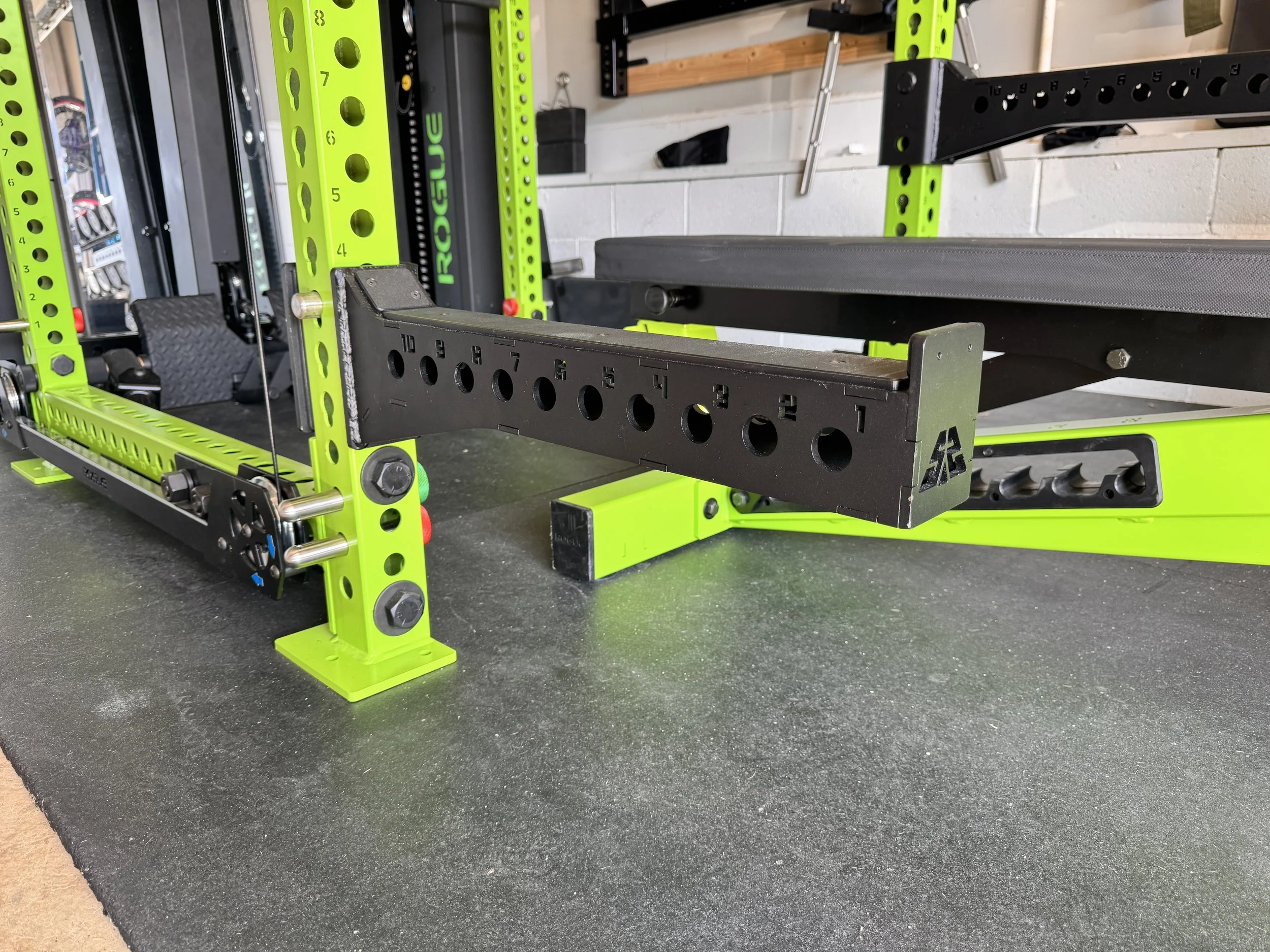
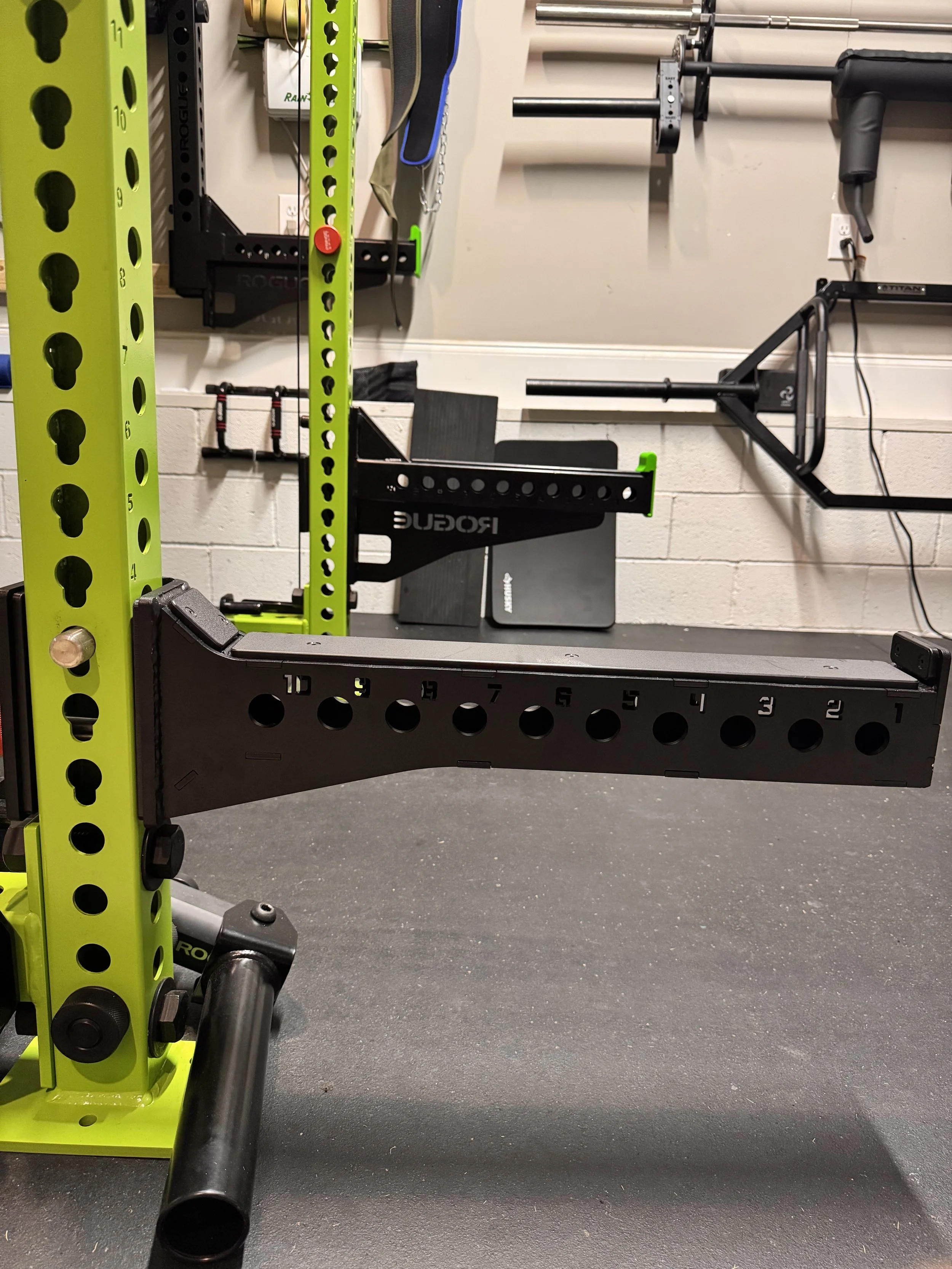
The biggest difference is not flashy. It is not complicated. It is not some revolutionary mechanical breakthrough. It is profile. The “stealth” name is not marketing fluff. These arms use a dramatically lower-profile mounting bracket compared to traditional spotter arms. Where most designs rely on bulky plates and multi-hole anchoring systems, the Stealth arms are streamlined and compact. And that changes everything.
On a rack with front-mounted cables, real estate matters. Traditional swing-in or multi-hole arms often require 7 or 8 holes worth of vertical space to mount properly. That is a significant portion of your upright. On a cable rack, those holes are already competing with trolley travel and attachment positioning. The Stealth arms can mount using 4 holes. That is not a small difference. That is reclaimed territory.
It means more usable rack space. More flexibility in positioning J-cups and safeties. Less interference with cables. Fewer compromises every time you want to change movements. The practical outcome is this: I can leave safety engaged for more lifts without tearing down half the rack. I do not have to constantly reconfigure to accommodate the arms. They integrate instead of dominate. And in a 9 by 18 foot garage where every inch earns its place, that matters.
2. UHMW Protection
This one is simple, at this price point, you want UHMW protection. Surplus Strength lines the contact points with high-quality UHMW. That protects your barbell’s knurling during a failed lift, but it also protects your uprights.After six months of sliding these on and off, my rack still looks clean. No metal-on-metal screeching. No chipped powder coat.
3. The “Set and Forget” Factor
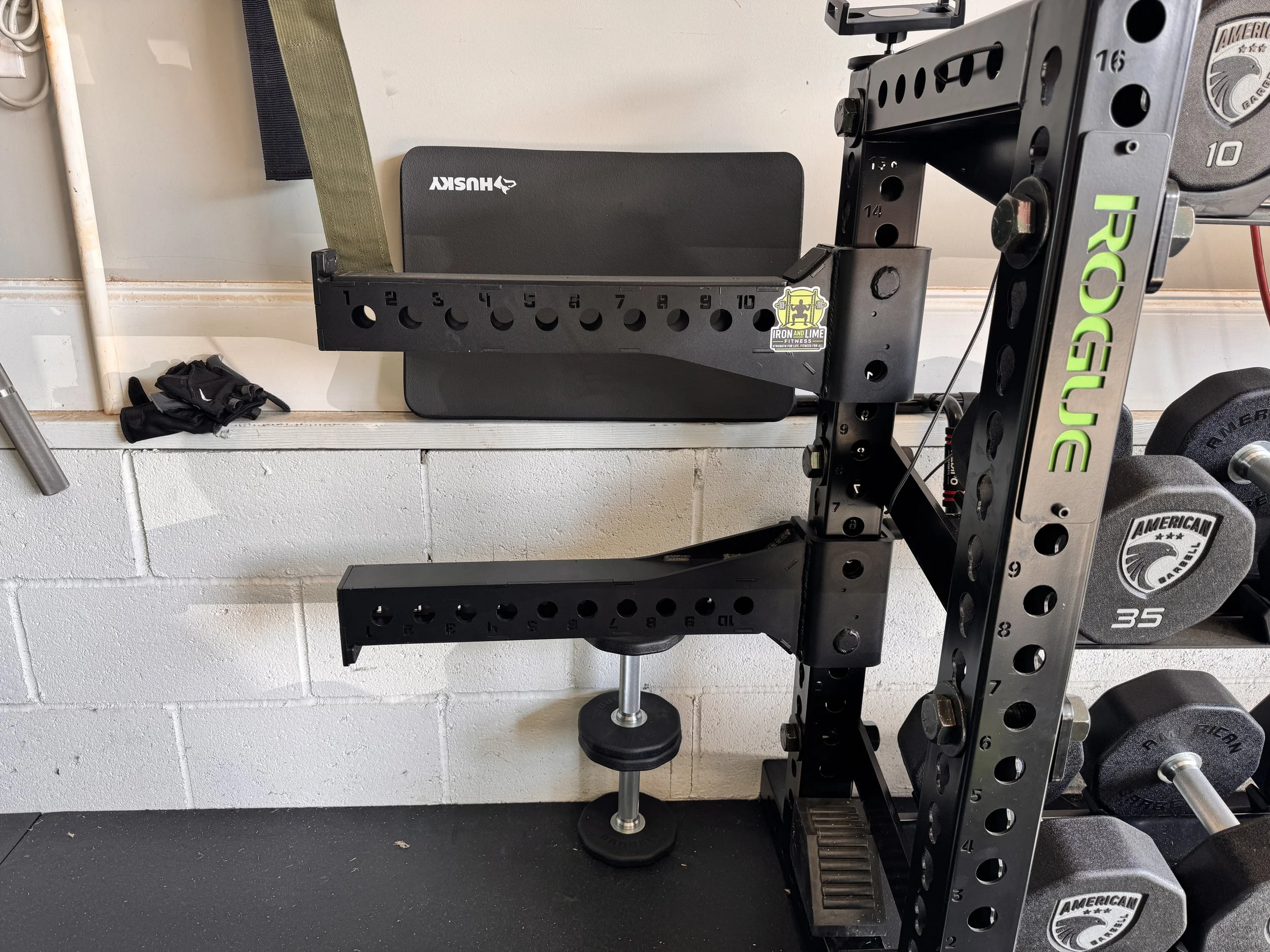
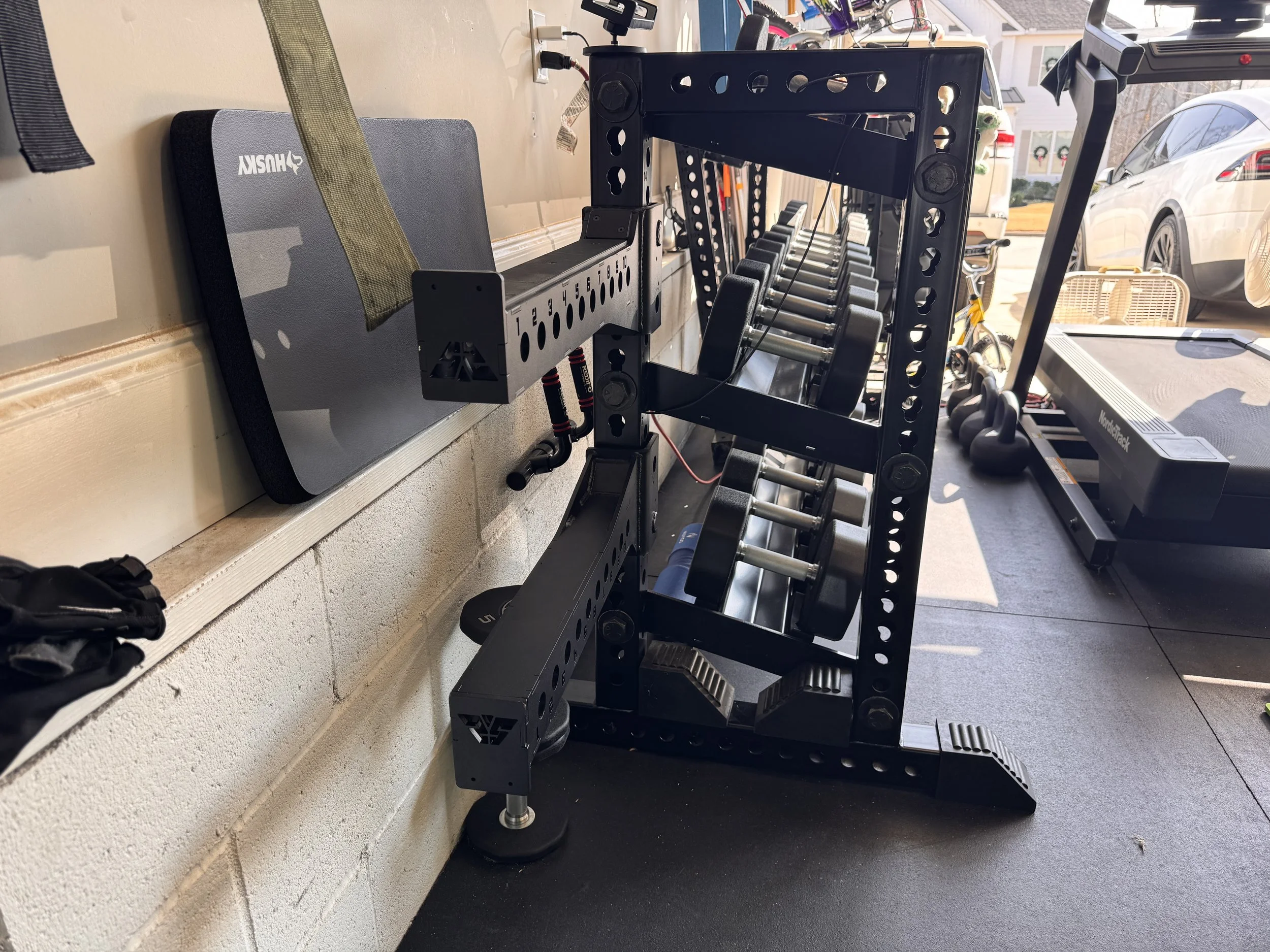
Because these are lighter and easier to handle, I actually move them. Squats. Bench. RDLs. I’m not fighting the equipment. Not that I didn’t with the Rogue spotter arms, but I would try to avoid it if I could. They’re also easy to store. Mine live cleanly on my Monster 3-tier dumbbell rack. Less friction equals more consistent use. That’s not motivation. It’s math.
One Non-Negotiable Detail: Use the Rear Pin
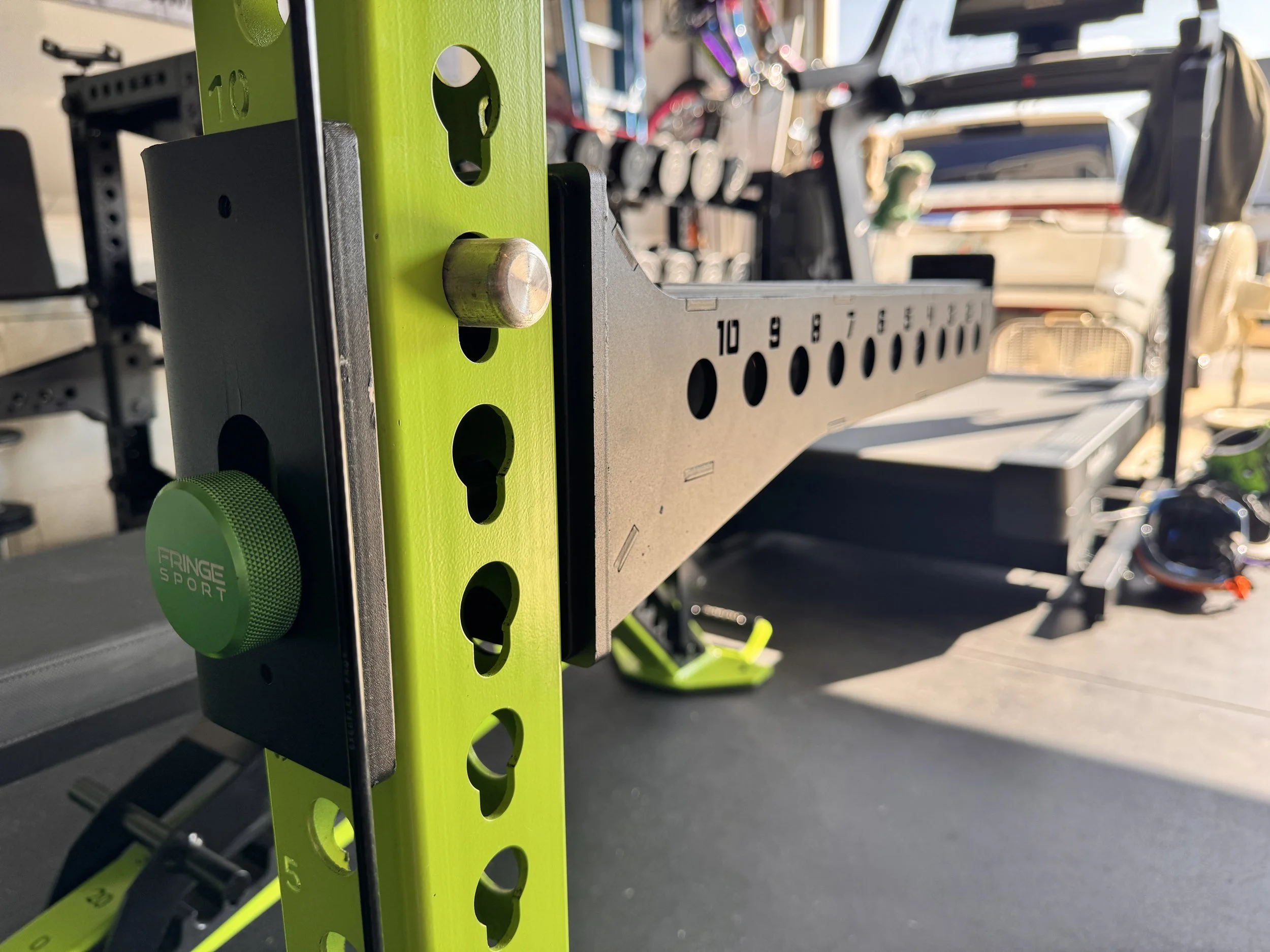
This part is not optional. The Stealth Spotter Arms must be pinned in the rear. Every time. Do not get casual about this.
The arms are low-profile by design. That is their advantage. But that streamlined bracket means they rely on proper rear pin engagement to eliminate rotational play. Without the rear pin installed, you will feel slight movement. Under normal circumstances it may seem minor, but under load physics does not negotiate. In a worst-case scenario, if a loaded plate makes contact at the wrong angle and the rear is not secured, the arm could shift or dislodge.
That is not a flaw in the design. That is leverage. Any slide in system system requires proper anchoring. Remove the anchor and you introduce variables. And variables are not welcome in a safety system. My current setup is simple. I am waiting on shorty pins from Bells of Steel so I can safely run these on the middle upright. Until those arrive, I do not lift in that configuration. Period. No experimenting. No “it should be fine.”
Five seconds to install the rear pin. That is the rule. This is not the place for shortcuts. This is not the place for optimism. This is safety equipment. It exists for the rep you miss, not the reps you make. Install the pin. Every time.
Surplus Strength Stealth Spotter Arms Specifications
Specs matter, especially for safety equipment.
Dimensions & Weight
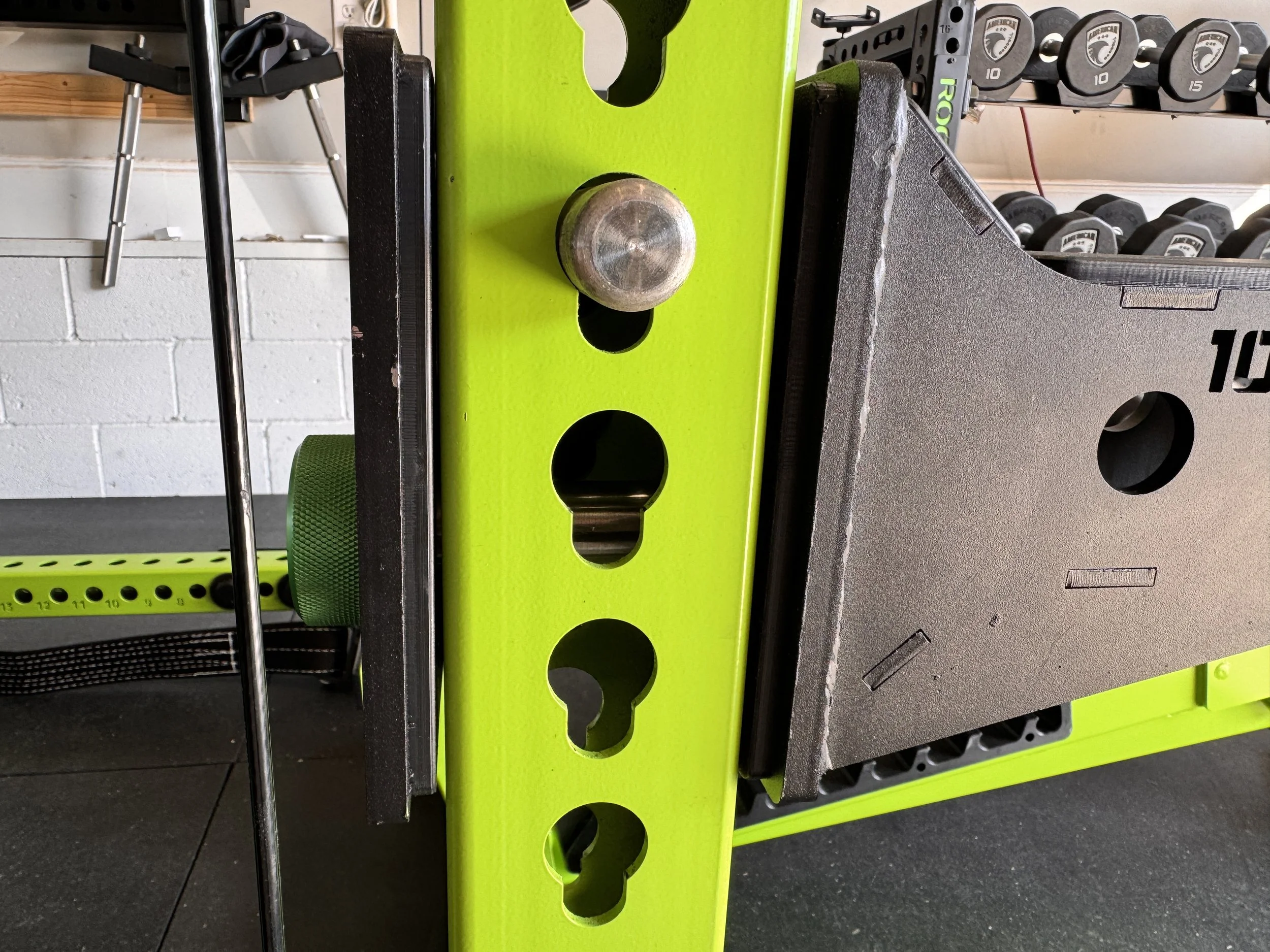
Total length: 27 3/16 inches
Usable catch area: 20 inches
Rack intrusion: 7 inches (3–4 holes)
Weight: 25 lbs per arm
Construction
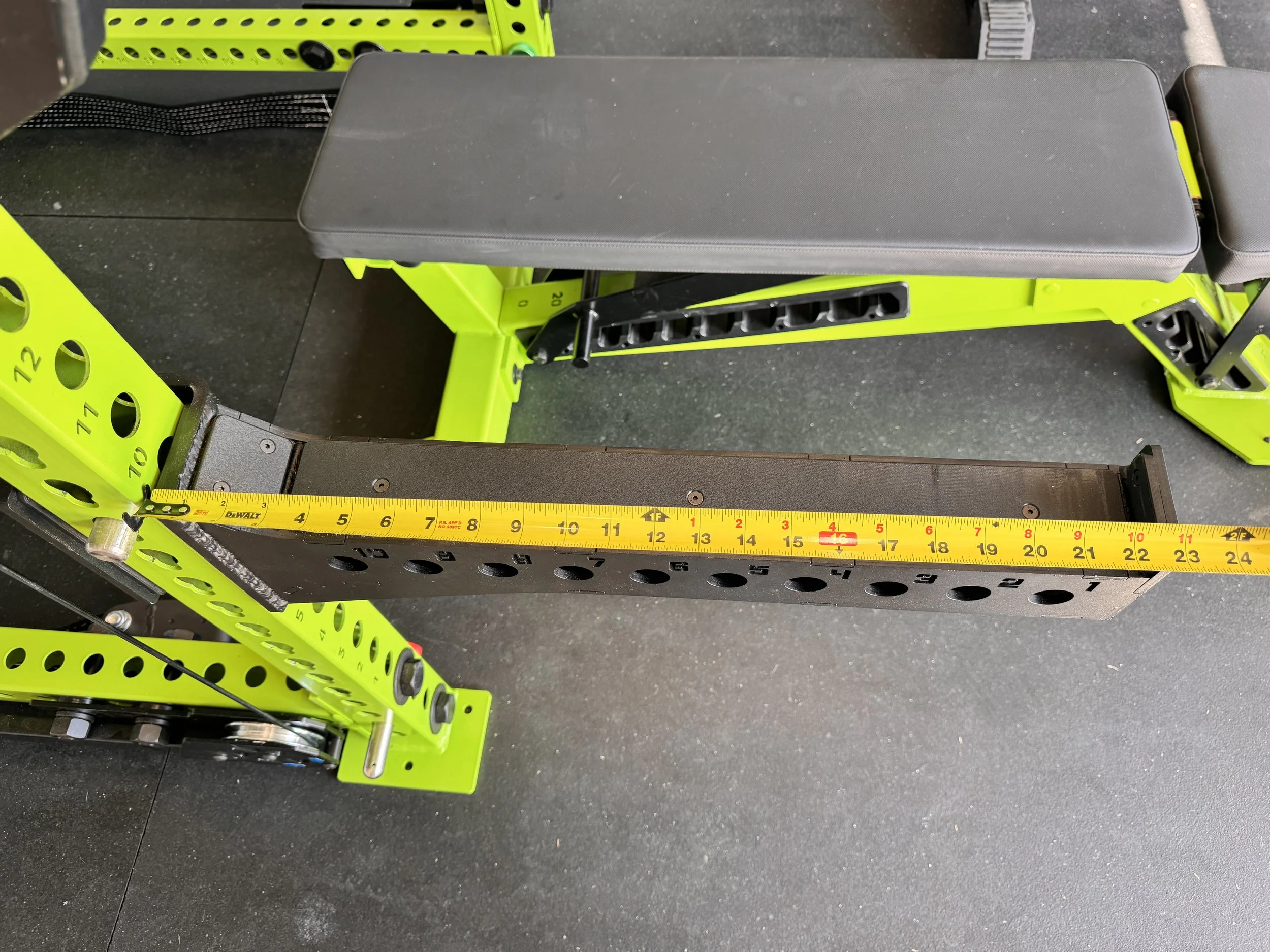
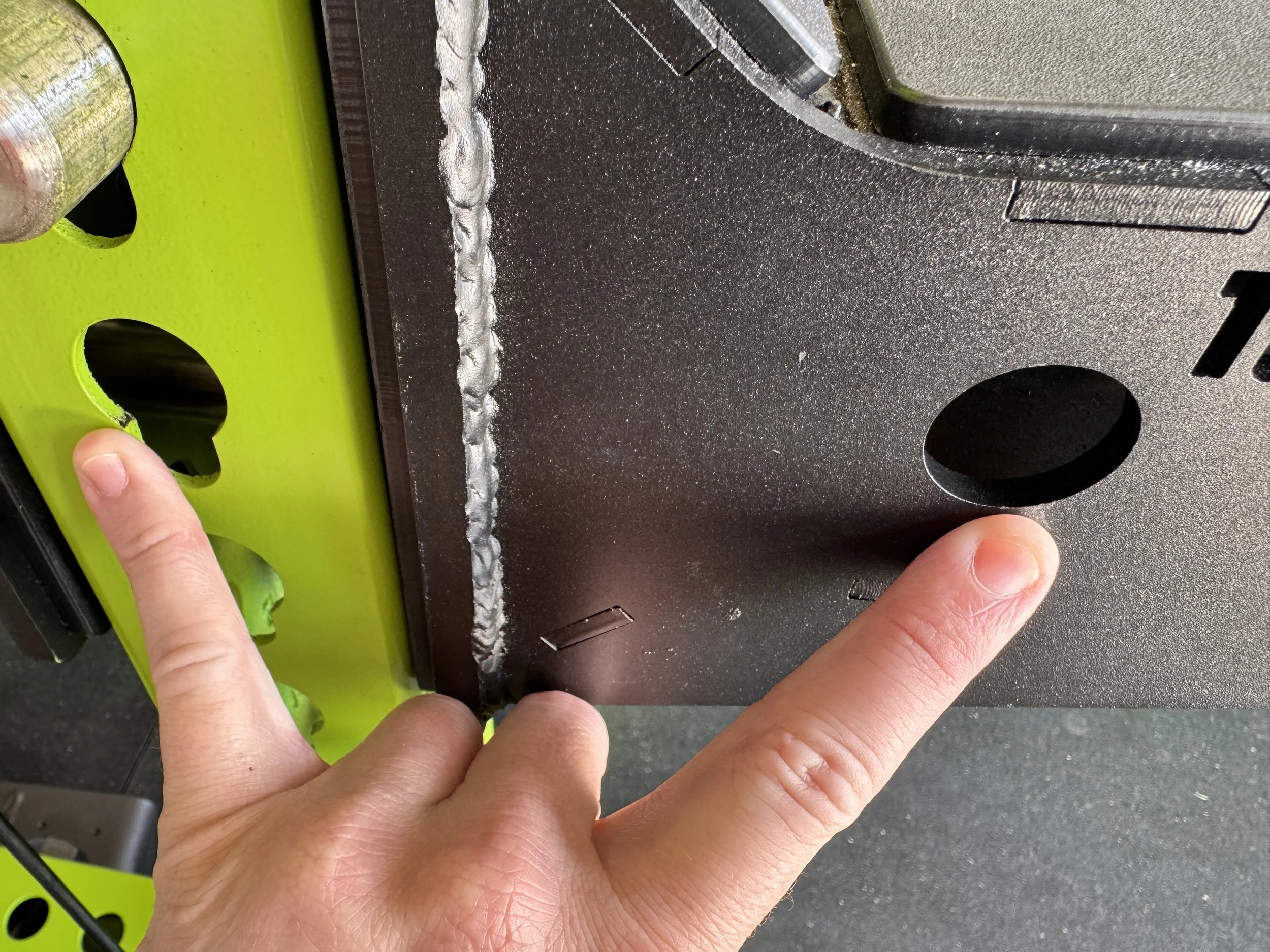
3/8-inch steel mounting channel
1/4-inch laser-cut vertical face
Flat steel design instead of 3×3 tubing
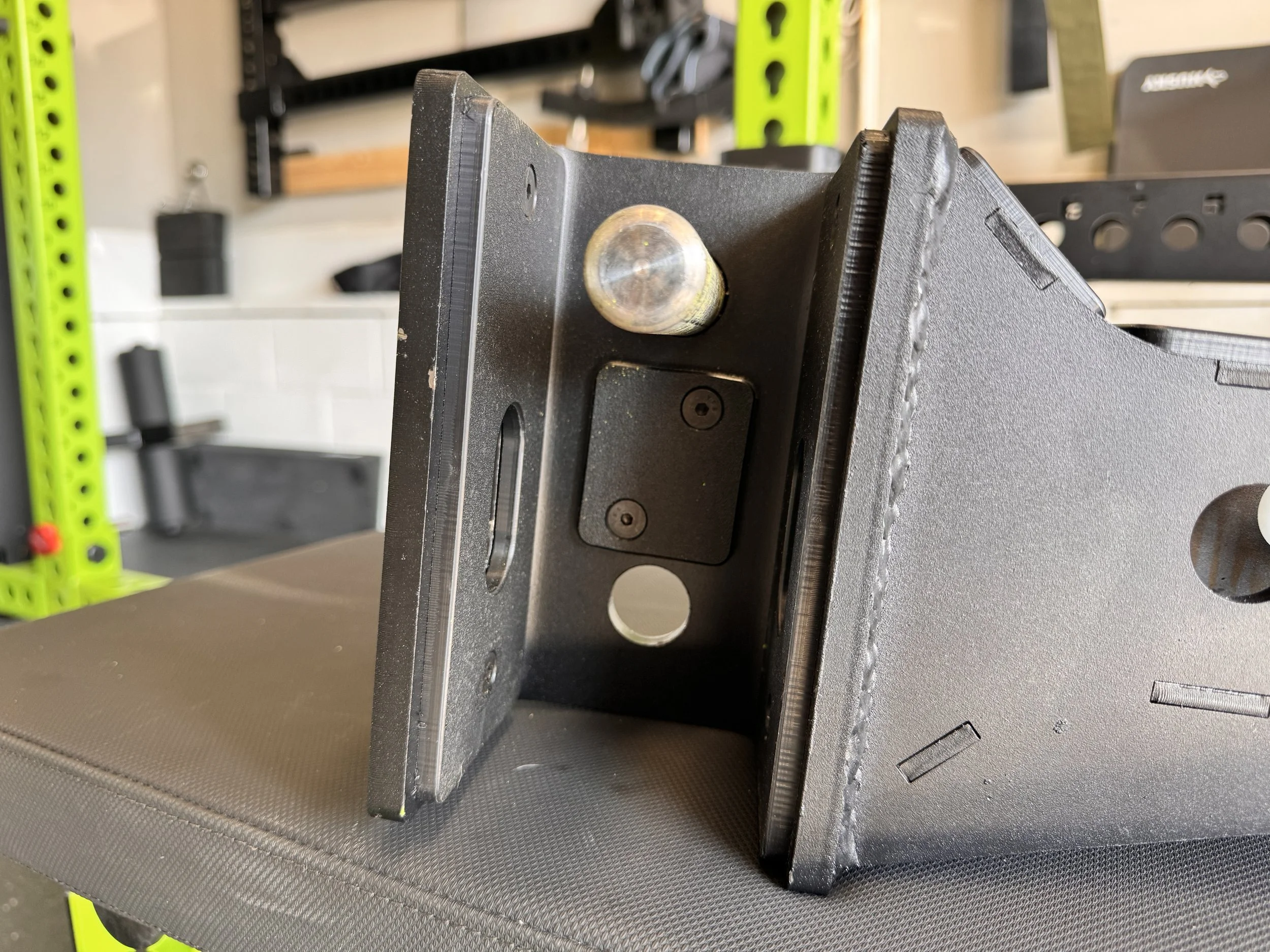
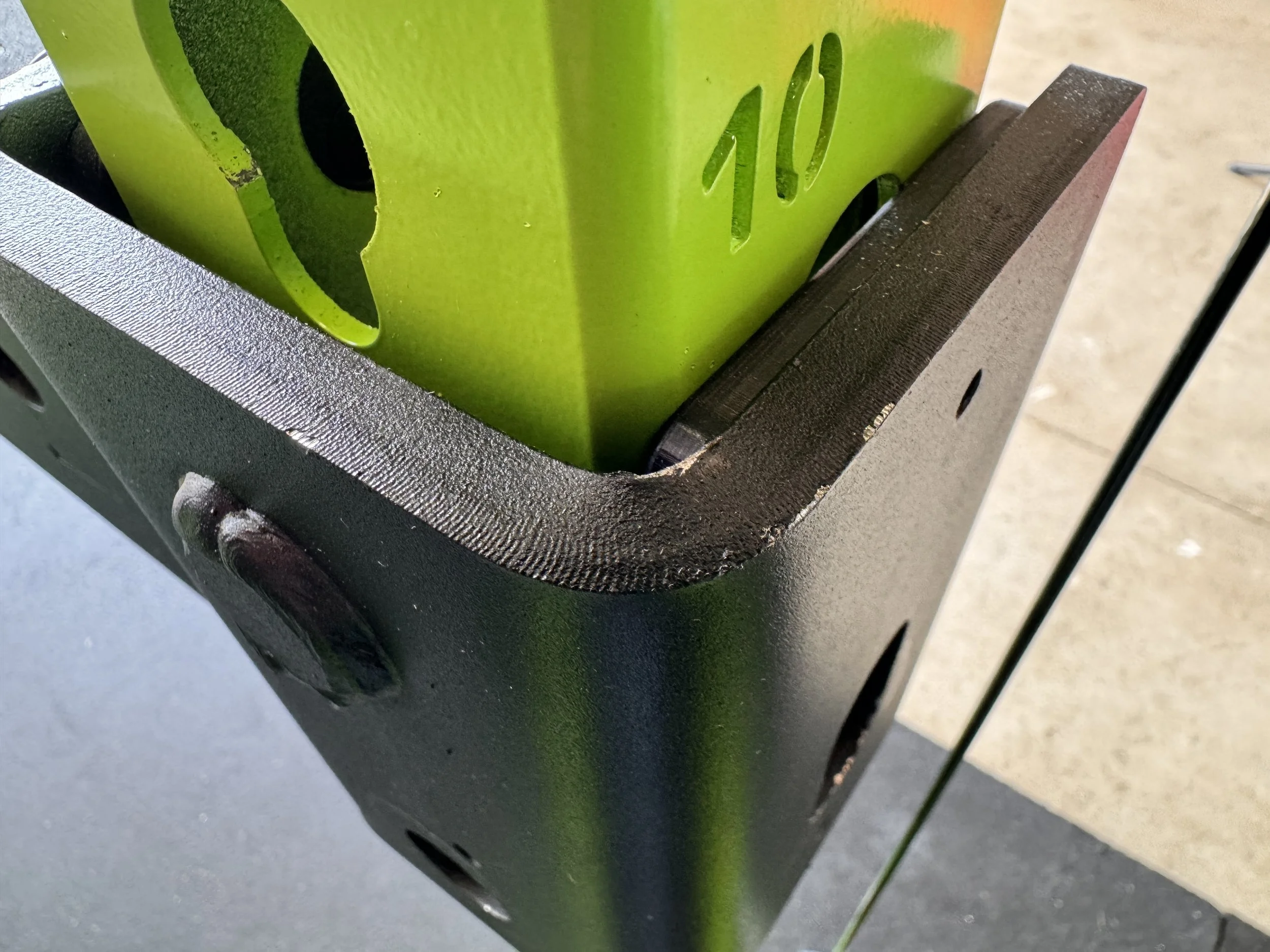
The difference in thickness is illistrated in the below picture, this thing is beefy
Pin System
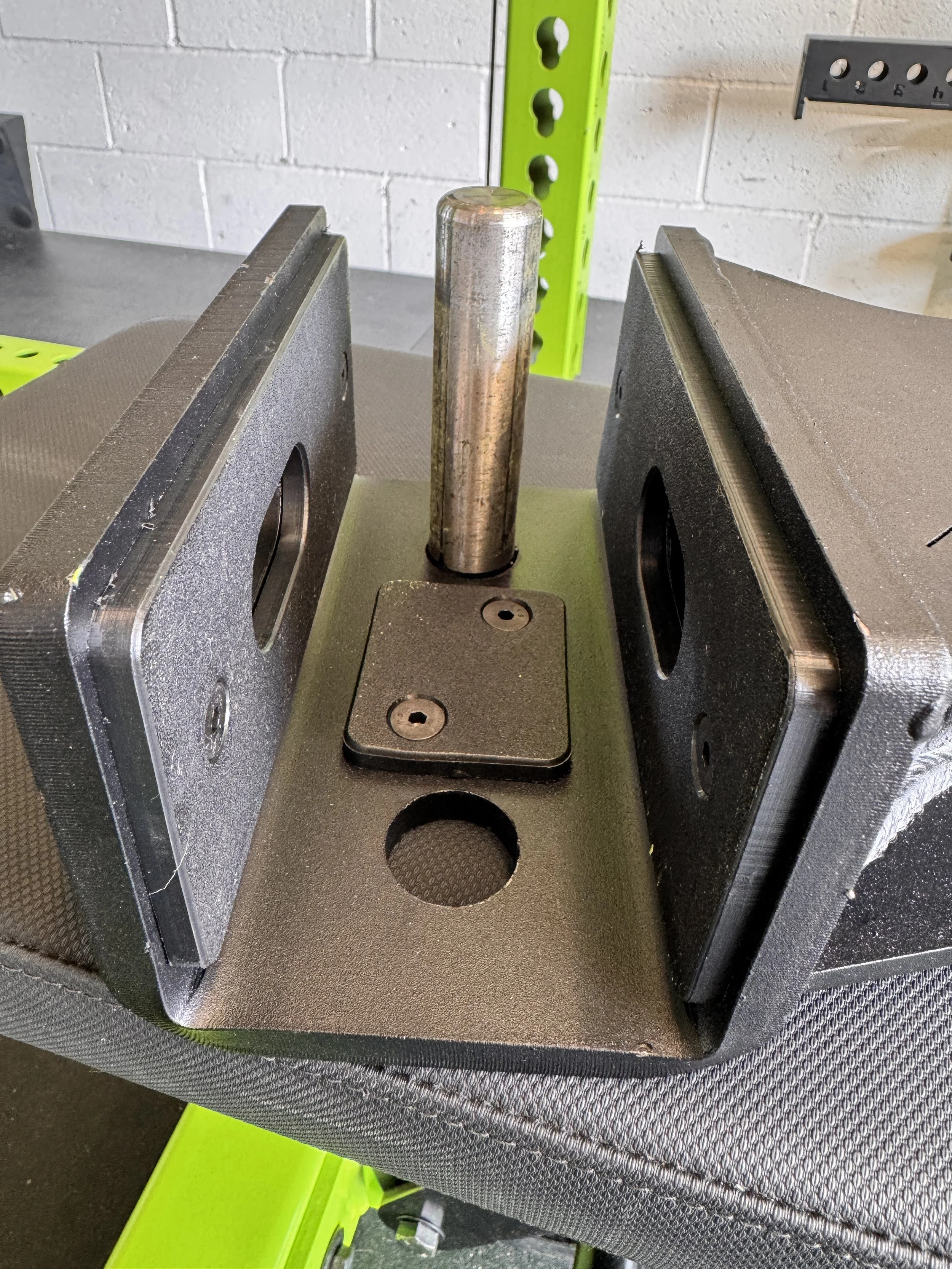
1-inch welded steel pin (a bit square for my taste; I prefer a rounded taper like Fringe Sport)
Rear locking pin required for full stability
UHMW Protection
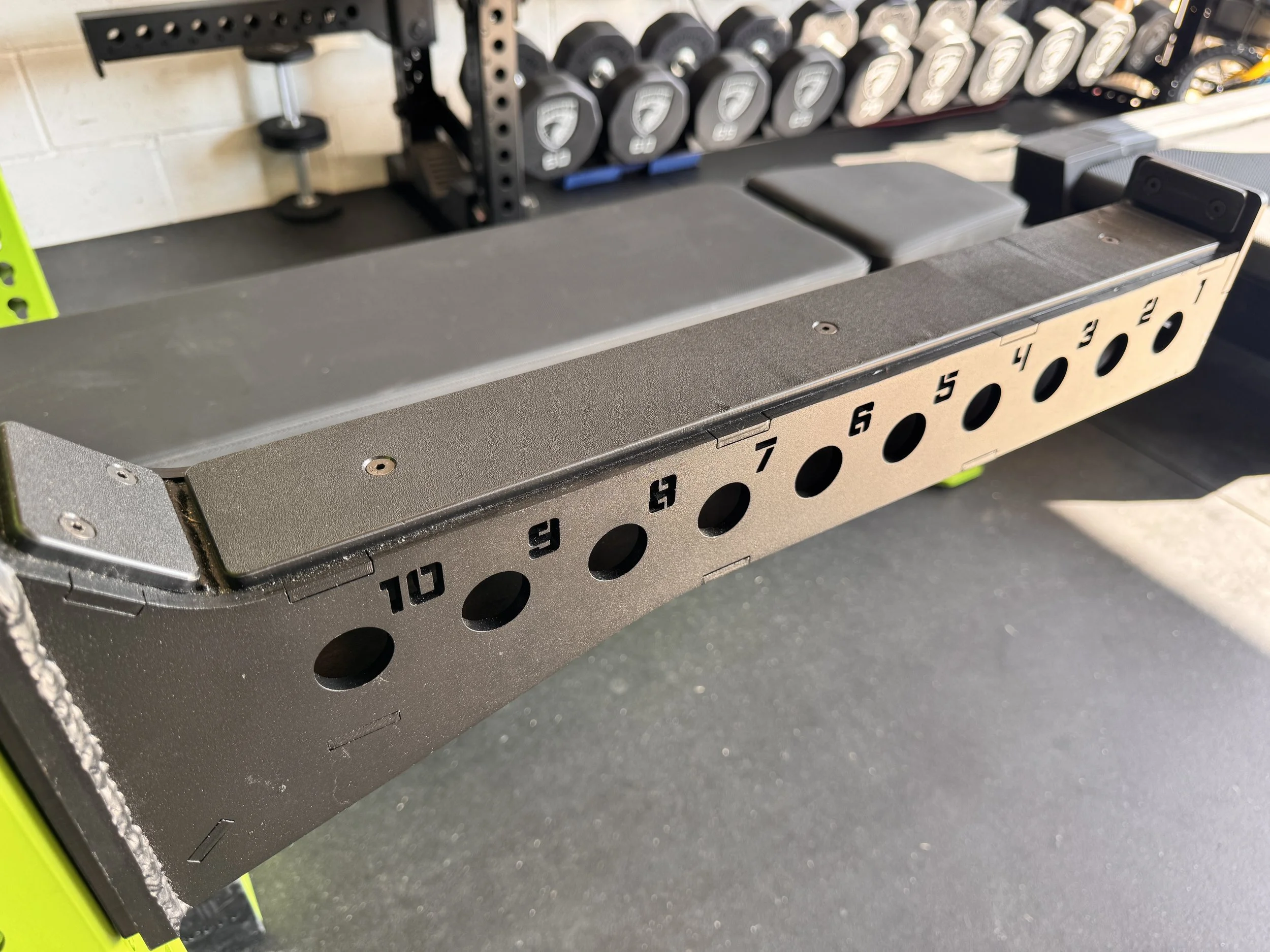
UHMW on all bar contact points
UHMW face-saver lip for barbell and lifter protection
Matte UHMW, which I prefer over Rogue’s shinier version
Rack Compatibility
Inline and offset hole patterns
Works with Rogue Monster, REP PR-5000, Sorinex, Bells of Steel, and other 1-inch, true 3×3 racks (will probably be a tad loose on imported racks like Rep or Titan)
This isn’t experimental gear. It’s purpose-built safety equipment that’s performed better than legacy spotter arms in my training.
Build Quality After 6 Months
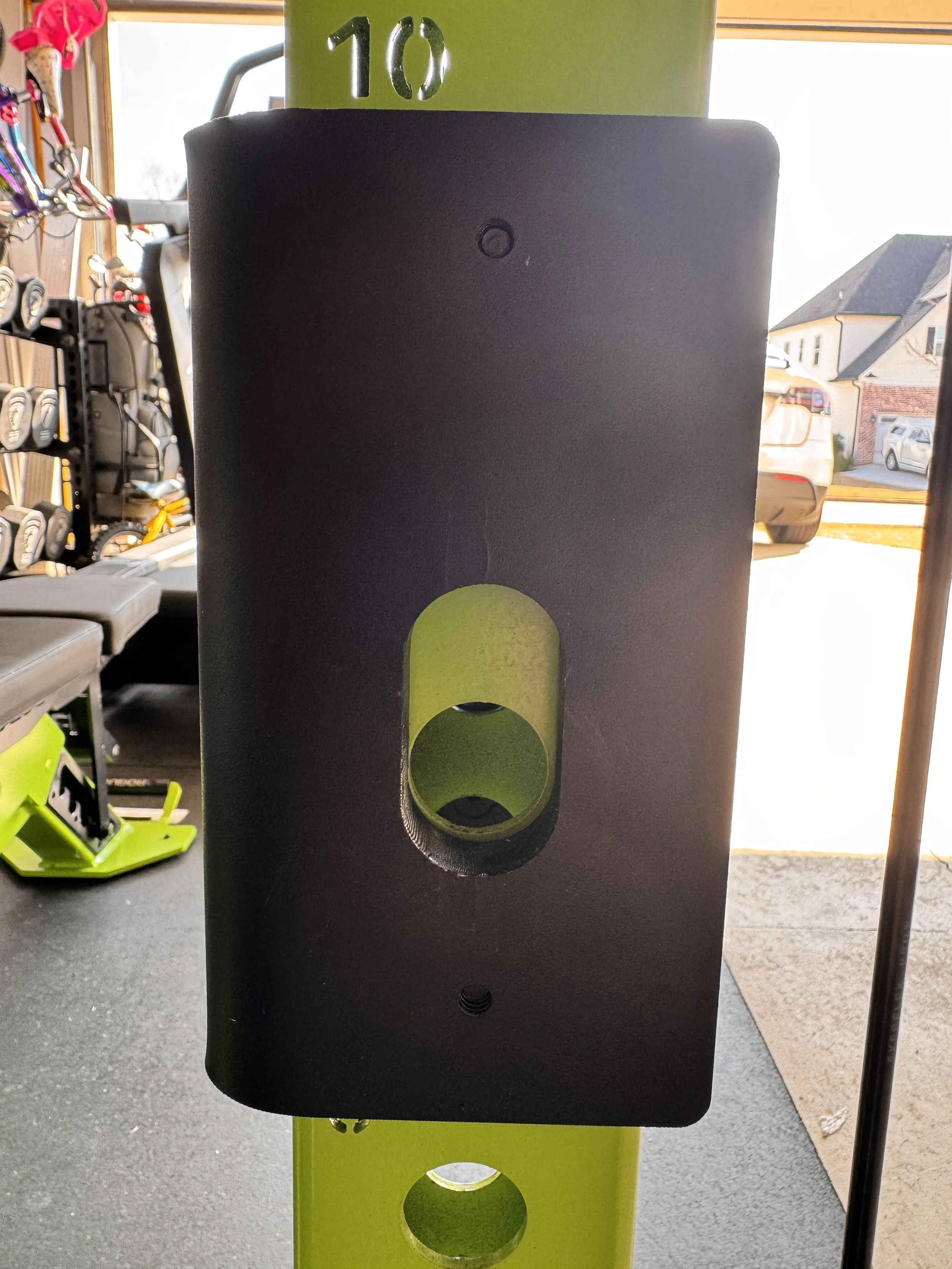
Six months in, nothing has loosened or shifted. Aside from minor powder coat wear, the steel looks new. The UHMW is scratched because it’s doing its job. The welds are clean, slightly less “machine-perfect” than big manufacturers, and that honestly adds confidence. It feels like someone inspected this before it shipped. If I’m trusting something with my life five days a week, it needs to be boringly reliable. There are a few power coat chips as seen in the below picture but that is expected in a gym that equipment is used daily.
Real-World Performance: Missed Squats and Failed Benches
A review doesn’t mean much if the product hasn’t been tested. Two months ago, I went for a heavy bench triple. It was early. Under-caffeinated. My ego wrote checks my body couldn’t cash. The bar stalled. Instead of panic, I lowered it, rolled it onto the spotters, and slid out. No bounce. No noise. No drama.
That quiet reliability is what you’re paying for. Full transparency, Jess in only there because I didn’t want to die on camera if this was my time. I also didn’t want to go out failing a 315 on bench, if bench press is the way I go, it’s 405 or bust.
Storage: A Small Detail That Matters More Than You’d Expect
In a 9×18 garage gym, floor space is not a luxury. It is currency. Every inch has to justify itself. If something sits in the way, even temporarily, it becomes friction. And friction in a small space multiplies quickly. One awkwardly stored attachment turns into a clutter corner. A clutter corner turns into hesitation. Hesitation turns into skipped movements or shortened sessions. Storage matters more than people admit.
When the Stealth arms are not mounted, they store cleanly on my Monster dumbbell rack. No weird angles. No overhang jutting into walkways. No leaning them against the wall with that quiet “I’ll deal with that later” energy that eventually becomes permanent. They look intentional. That matters in a shared garage.
This space is not just mine. Cars still park here. Kids move through here. It has to function. Equipment that stores cleanly respects the footprint. It respects the fact that this is a home first and a gym second. And there is something psychological about walking into a clean setup. When attachments have a home, the room feels controlled. Organized. Purposeful. Discipline in training starts with discipline in environment. Clutter invites laziness. Order invites execution. For a piece of safety equipment, clean storage might sound trivial. In a tight garage gym, it is not.
Accessories: Speed Pins and Customer Service
When I ordered the Stealth arms, I also picked up Surplus Strength speed pins. They worked. No mechanical issues. No defects. But I am particular about hardware feel. The taper on their pins was not as rounded as my Bells of Steel mag pins (my highest recommendation) or Fringe Sport mag pins, and I notice small things like that, especially at 5:00 in the morning when everything feels amplified. I want smooth insertion. Minimal wear. No resistance that feels unnecessary.
So I returned them. This is where company culture shows up.
Surplus Strength handled it exactly the way you would hope a smaller, serious company would. I had an email response the next day. No pushback. No defensive language. No “are you sure?” friction. Just a simple, clean return process. They are not a massive corporate machine like Rogue. You are not getting instant live chat with layers of automation. You are dealing with real people who understand their niche and stand behind their product.
That matters.
In the garage gym world, where many of us are mixing and matching ecosystems, good customer service is part of the value equation. If something needs adjustment, you want a company that responds with professionalism, not ego.
Price Comparison: Is It Worth It?
Let’s talk numbers. All in, my Stealth Spotter Arms came out to $615.68 shipped. That is not cheap.
If your primary objective is saving money, Rogue Monster Safety Spotter Arms 2.0 can be had for roughly $351 shipped. They are strong. Proven. Safe. I ran them for years. They will do the job. So what are you paying the premium for? Not strength.
You are paying for profile. For footprint. For workflow.
You are paying for arms that use fewer holes and preserve upright real estate. For a system that plays nicely with rack-mounted cables. For storage that does not create clutter. For versatility in attachment-heavy setups where every inch matters. If you have unlimited space and your rack sits in a dedicated room with no constraints, the Rogue arms make complete sense. They are bombproof and cost significantly less. But if your garage gym has to coexist with cars, storage, family traffic, and evolving attachments, the equation changes.
In tight spaces, efficiency is value. And in my case, the Stealth arms solved a workflow problem that the cheaper option could not. That is what I paid for.
Who These Are For (And Who They Aren’t)
Not every upgrade is for everyone. The Stealth Spotter Arms make sense if you train alone and take that reality seriously. If you bench heavy without a human spotter. If you squat before sunrise. If your safety plan cannot rely on luck or timing. They make sense if space is tight and every upright hole matters. If your rack shares space with cables, attachments, and the practical realities of a working garage. If workflow efficiency is not a luxury but a requirement. They make sense if you care about longevity. If your goal is to train consistently for years without cutting corners. If you want safety equipment that is easy enough to use that you never talk yourself out of installing it. And yes, they make sense if you are willing to spend a little more for usability instead of just raw steel.
They probably do not make sense if you train with a full crew and always have a spotter. Or if your rack sits in a dedicated room with unlimited space and you never move your safety arms once they are installed. In that case, save the money. The standard Rogue arms will do the job. Context matters. Final Verdict: Buy Nice or Buy Twice.
There’s an old garage gym saying: Buy once, cry once.
I bought twice.
I started with standard spotter arms (I trusted Rogue’s main offering), realized they didn’t fit my workflow, and eventually upgraded. I wish I’d started here. For serious garage gym lifters, especially those running rack-mounted cables or varied programming, the Surplus Strength Stealth Spotter Arms aren’t just an accessory. They’re infrastructure. They’re the Toyota Camry of my gym. I rarely think about them, but they work every time.
Iron & Lime overall Rating: 9.5/10
(Points deducted only for lead time. Full marks for execution and quality.)
Let's Talk
If you've got questions about fitness, being a dad, the Army, or if the Surplus Strength Stealth Spotter arms make sense for your situation, drop a comment below or message me on Instagram (@ironandlimefitness) or Facebook. I reply to everyone because this stuff matters-your money, your training, your goals.
Support the Garage Grind:
This is a family-run operation. I do the videos, the editing, the writing, the filming, the socials, the marketing, the blogging, the website, and obviously the training-all while balancing a full-time job and three kids who just want to hang out.
If this review helped you make a decision or gave you information you couldn't find anywhere else, hitting Like and Subscribe is the best way to keep this thing going. No ads, no sponsors, no BS-just real reviews from a real gym.
Let's train hard and stay consistent.
Strength for Life. Fitness for All.
- Drew
Iron & Lime Fitness
P.S. - If you end up buying these spotters and want to compare notes after a few months, hit me up. I love to hear how others are loving or not loving the spotter arms.
Strength for Life. Fitness for All.
Shop the Spotters:
Surplus Strength Stealth Spotter arms
Shop Here
Watch the full video review on our YouTube channel
Why I Switched from Rogue to Surplus Strength: The Best Safety Spotter Arms for Garage Gyms
More Articles here:
Here's Why I Wouldn't Buy The Rogue FM-6 Again: Rogue FM-6 Long-Term Review
Rogue Mutant Metals Ultimate Dip Attachment Review (1 Year Later): Is It Really Worth $365?
Rogue Kabuki Transformer Bar Review
Rogue Manta Ray Adjustable Bench Review
Rogue FM-6 Twin Functional Trainer Review
American Barbell Dumbbell Set and Rack Review
“Best Budget Gear for Building a Garage Gym”
Bells of Steel Safety Straps Review: A Perfect Fit for the Rogue FM-6
Train hard. Live bold. Stay lime.