
Rogue Multi-Use Rack Roller Review: 18 Months Later
By Drew
Iron and Lime | Gear Help
Last Updated: Oct 2026
Iron and Lime Fitness is independent and supported by readers. We may earn a small commission at no cost to you if you buy through an affiliate link. Shop Rogue here.
There is absolutely nothing wrong with the Rogue Multi-Use Rack Roller. In fact, from a quality and construction standpoint, it is exactly what I have come to expect from Rogue. It is overbuilt, extremely sturdy, made in the USA, and does exactly what Rogue says it is supposed to do. The roller moves smoothly, the mounting system is solid, and once it is installed on the rack, I have zero concerns about putting weight or pressure against it.
And after roughly 18 months of owning it, I still probably would not buy it again.
That might put me in the minority among home gym reviewers because this attachment gets a lot of love, and I understand why. On paper, the Rogue Multi-Use Rack Roller checks a ton of boxes. It can be used for Bulgarian split squats, hip thrusts, lat pulldown restraints, cable movements, and plenty of other exercises if you are creative enough. It is one of those products that looks increasingly useful the longer you stare at the product page.
My problem is that after actually living with it for a year and a half, I have found that versatility on paper and usefulness in a garage gym are not always the same thing.
That is really what this review is about.
The Multi-Use Rack Roller works. It works very well, actually. But most of the time, I have something smaller, lighter, and easier to use that accomplishes essentially the same thing. Over time, that matters. Home gym equipment has to earn its keep, and for me, this attachment simply has not earned its place often enough.
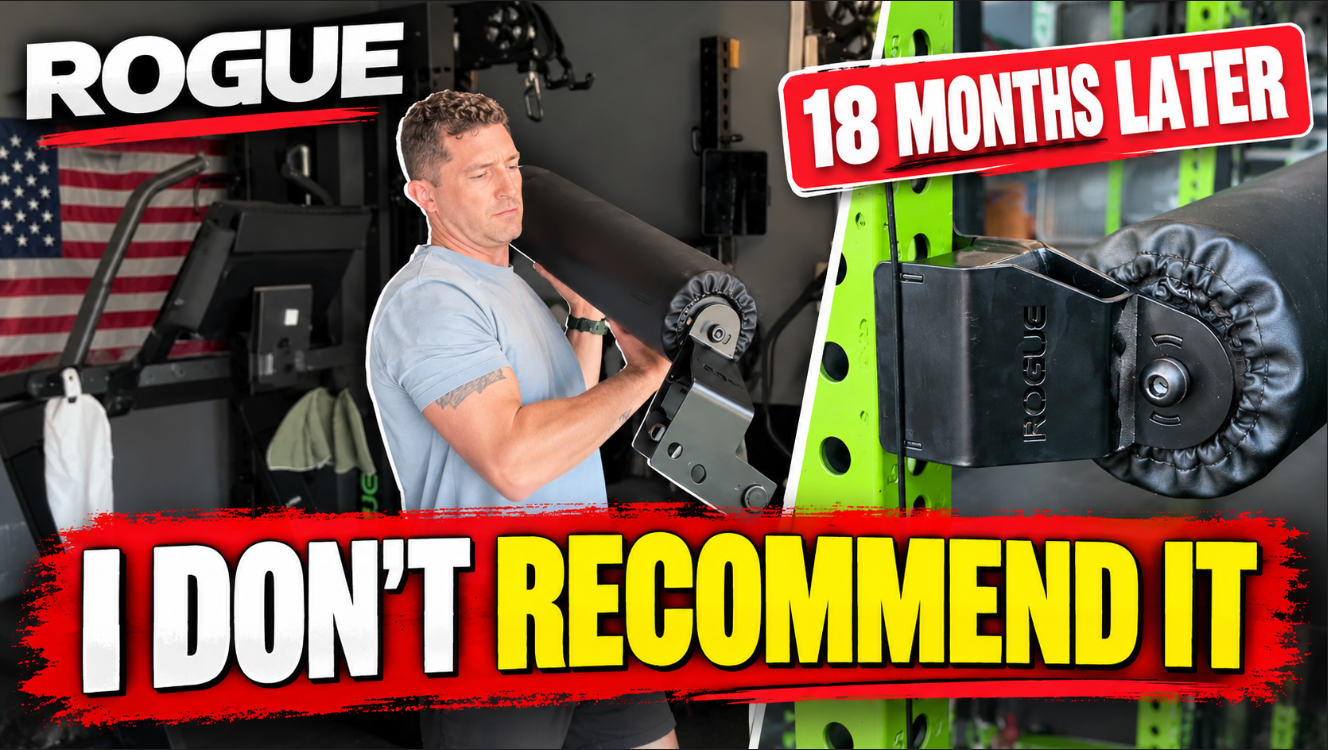
Watch the Youtube Video
What Is the Rogue Multi-Use Rack Roller?
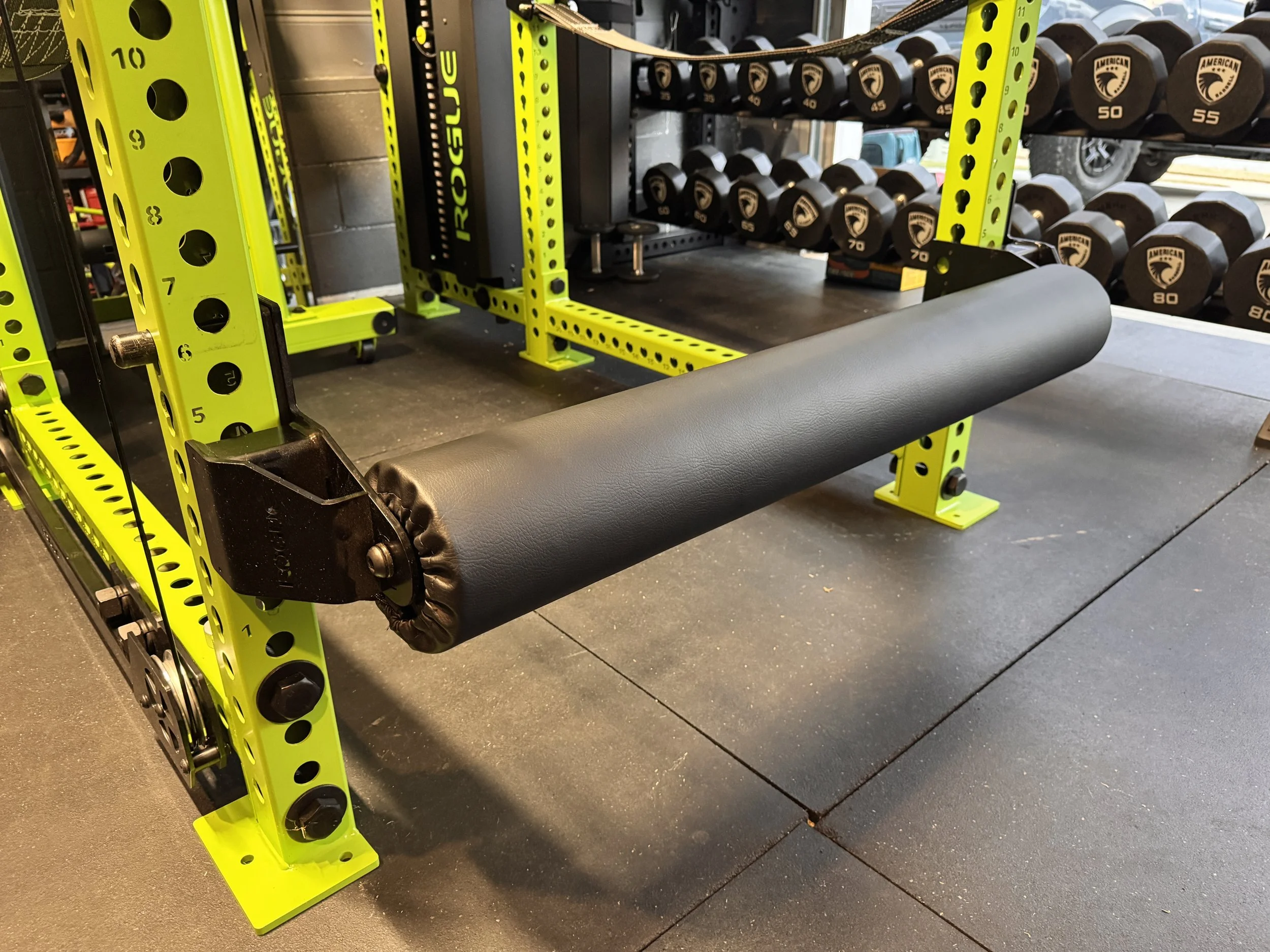
Rogue Monster Multi-Use Rack Roller
The Rogue Multi-Use Rack Roller is essentially a massive padded roller that mounts between two uprights on your power rack. I have the Monster version with one-inch hardware, while Rogue also makes a Monster Lite version for 5/8-inch racks. Mine weighs around 31 pounds, spans nearly the entire width of the rack, and uses a roughly 41-inch pad with a large six-inch roller.
The roller itself is one of the things Rogue got right. It rotates smoothly rather than acting like a fixed pad, which makes a noticeable difference for exercises where your body or foot needs to move against it. With Bulgarian split squats, your foot can roll naturally as you move through the rep. With hip thrusts, your back can move against the pad instead of catching on a stationary surface. It is a small design detail that makes the product feel much more purpose-built.
The mounting system is also well thought out. The brackets attach to opposing uprights with detent pins, and Rogue allows you to offset the brackets to make smaller height adjustments. Once you have everything installed, this thing is incredibly solid. The brackets are stout, there is UHMW around the major rack contact areas, and nothing about it feels cheap.
I did have an instance where mine left some marks on my rack despite the UHMW, which was frustrating, although I am not going to pretend I know whether that was something specific to my setup or how I installed it that day. Beyond that, I really do not have many complaints about the actual construction.
This thing is built like a tank.
Unfortunately, being built like a tank is also part of the problem.
The Problem Is Not What It Can Do
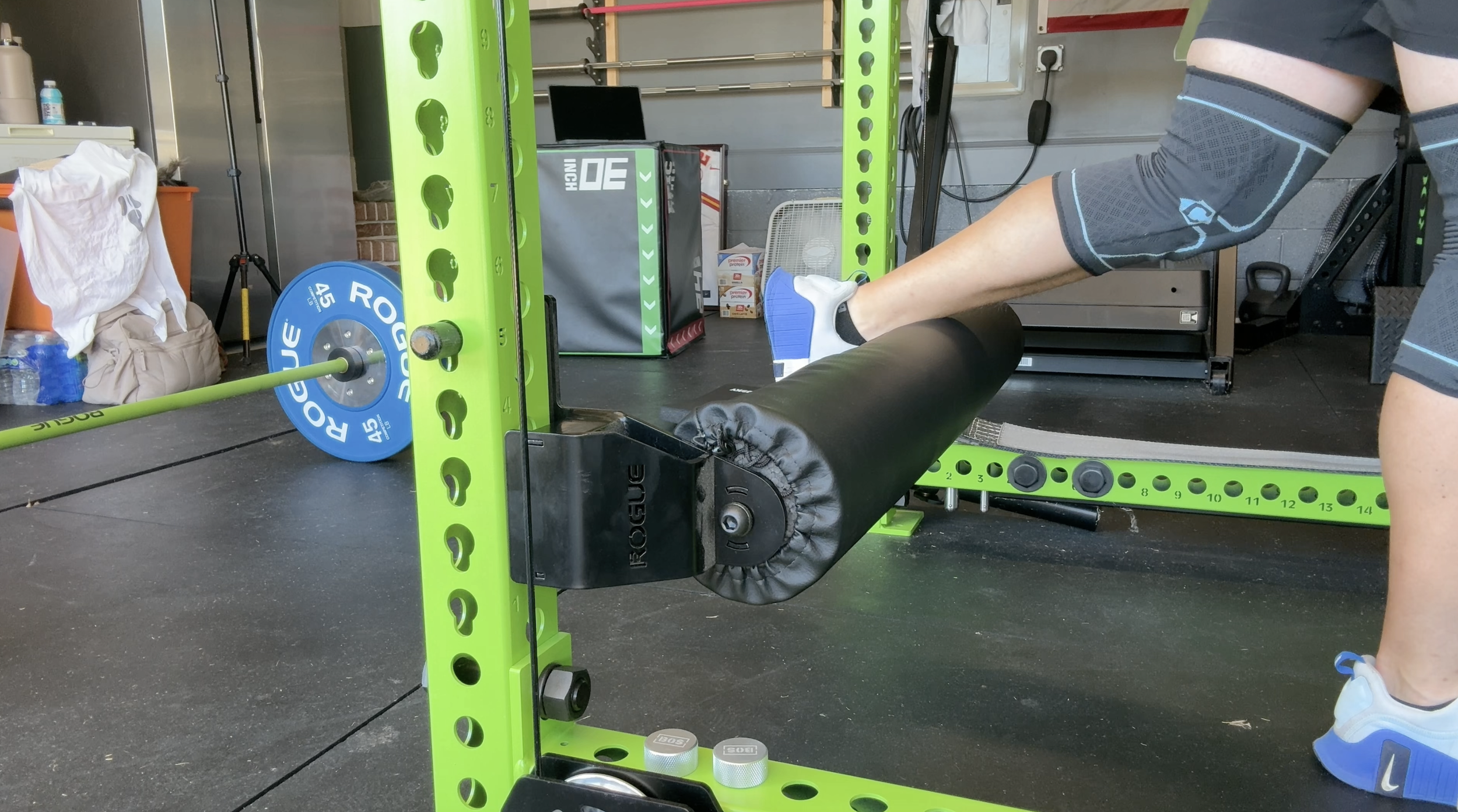
Bulgarian Split Squats on a Rogue Multi-Use Rack Roller
Rogue calls this a Multi-Use Rack Roller, and that name is deserved. You really can do a lot with it. I have used mine for hip thrusts, Bulgarian split squats, and as a restraint for pulldowns. Back when I owned the Rogue FM-6, I also used it as part of that setup, and I can see why FM-6 owners in particular might find it useful as a knee restraint for lat pulldowns.
There are also plenty of accessory movements where you can brace a leg, knee, ankle, or other part of your body against the roller. If your goal is to find exercises that work with this thing, you will find them.
But that eventually became the wrong question for me.
Instead of asking, “Can I use the Multi-Use Rack Roller for this?” I started asking, “Is the Multi-Use Rack Roller actually the easiest way to do this?”
Most of the time, my answer was no.
Bulgarian split squats are probably the easiest example. The Rack Roller works great for them. The rotating pad is comfortable, and because it spans the rack, you can position yourself almost anywhere you want. But I do not really need a nearly 50-inch-wide attachment spanning my entire rack to support one foot.
I already own Rogue single leg rollers.
I can grab one with one hand, install it on the upright, put it exactly where I want it, tighten it down, and start training. When I am finished, I pull it out and put it away. If I want a roller on both sides of the rack, I can install two of them independently.
The same thing keeps happening with other movements. If I need something to brace against during a cable exercise, a leg roller usually works. If I need support under a knee, ankle, or leg, a leg roller usually works. If I am doing pulldowns, I now have a Rogue CTM-1 with a dedicated setup that I would rather use.
The Rack Roller may technically be able to do all of those things, but I already own simpler tools that get me there faster.
That distinction has become increasingly important as my home gym has evolved.
Home Gym Equipment Lives and Dies on Friction
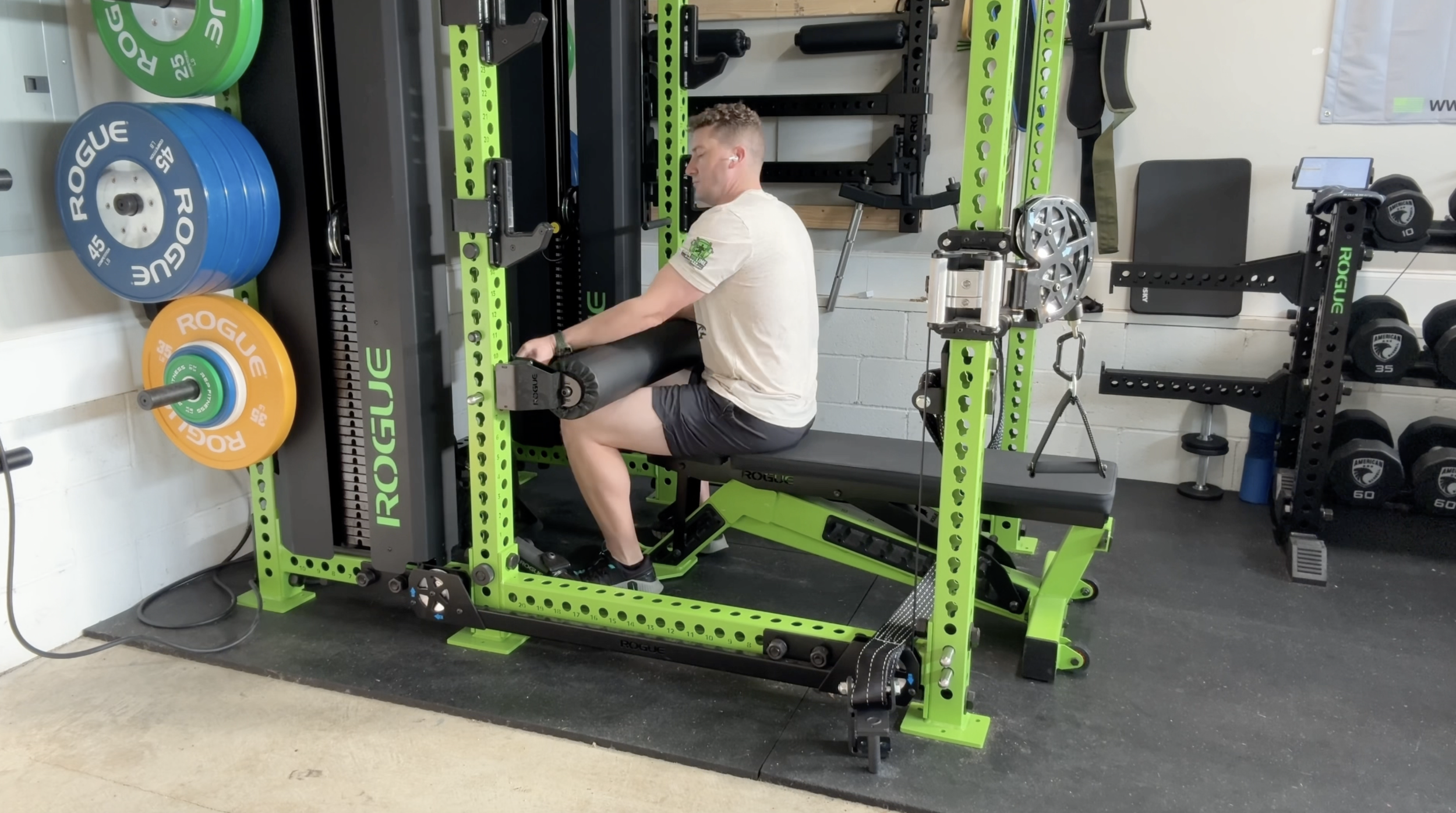
Rogue Multi-Use Rack Roller on Rogue FM-6
This attachment reinforced something I have become pretty passionate about with home gym design: home gym equipment lives and dies on friction.
I do not mean physical friction. I mean all the little steps between deciding to perform an exercise and actually performing it.
If an attachment takes five seconds to install, I will use it all the time. If I can grab something with one hand, stick it in the rack, and start working, there is almost no barrier between me and the exercise.
The Multi-Use Rack Roller is different.
Thirty-one pounds does not sound heavy. I have dumbbells sitting in the gym that weigh considerably more than that. But a 31-pound dumbbell is compact, balanced, and has a handle. A 31-pound roller that stretches roughly four feet across your body is a very different thing to move.
The attachment is simply awkward.
The roller itself moves when you grab it. You have a long steel assembly sticking out on both sides. Then you have to walk it over to the rack, position one bracket against an upright, line up the other side, find the correct holes, account for where the roller will actually sit relative to the mounting pins, and secure everything.
If you have cables running along those uprights, like I do with my functional trainer setup, you also have to work around those.
Is any of this particularly difficult?
No.
You get better at installing it. I can put it on much faster today than I could when I first bought it. But that does not eliminate the extra steps, and those little inconveniences compound over hundreds of workouts.
Eventually, I started walking past it.
That was not some conscious protest against the attachment. I did not wake up one morning and decide I hated the Rack Roller. I simply started reaching for my single leg rollers instead because they were easier.
And that is exactly how a $400 piece of home gym equipment ends up spending most of its life hanging on the wall.
I have even had nights where I looked at the next morning's workout, saw hip thrusts programmed, and took the Rack Roller off the wall in advance because I knew that at 4:30 in the morning I would not feel like dealing with it.
That is probably more informative than anything I could tell you from a spec sheet.
There Is One Exercise Where It Is Outstanding
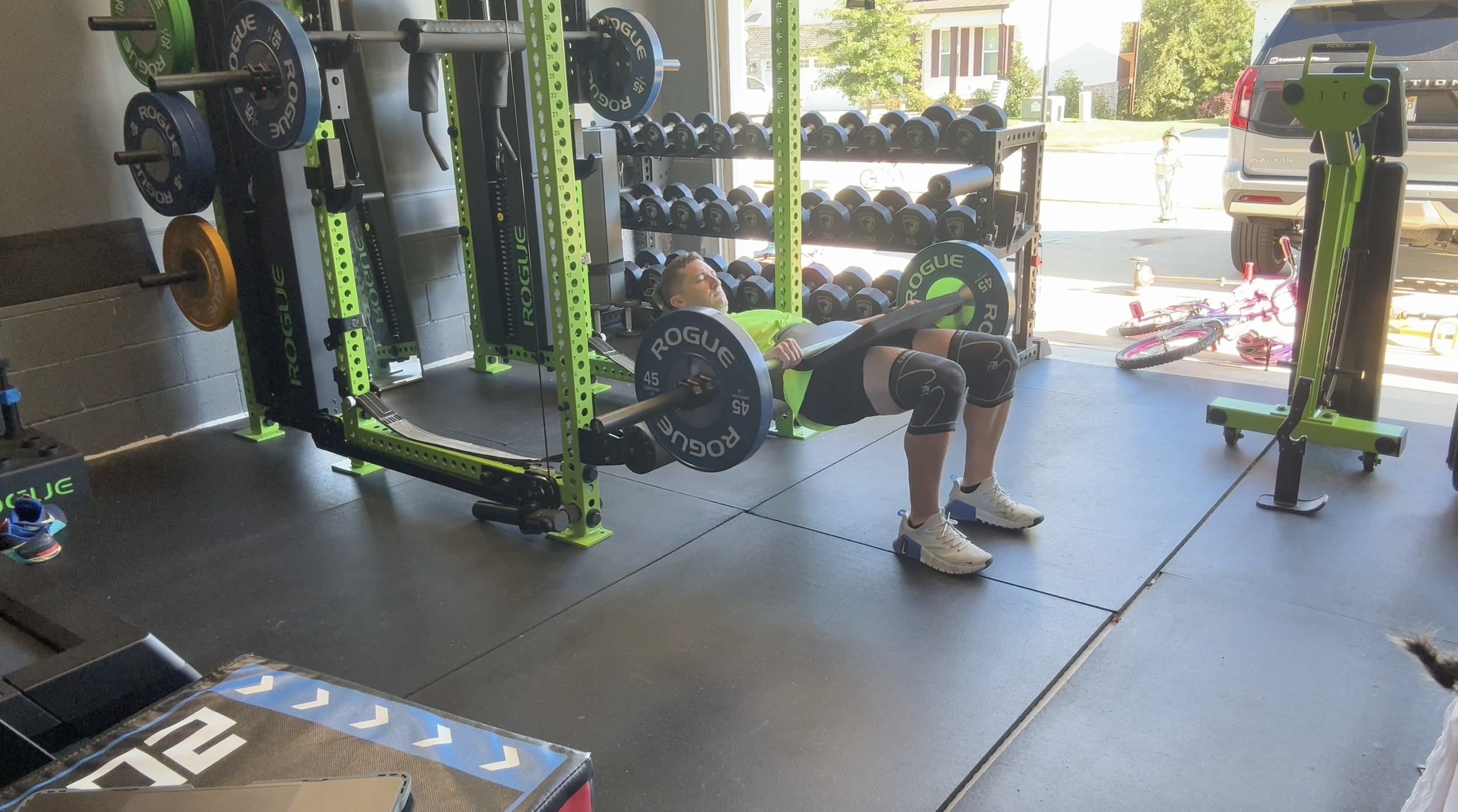
Rogue Multi-Use Rack Roller is outstanding for hip thrusts
With all of that said, there is one movement where I think the Rogue Multi-Use Rack Roller is legitimately excellent: hip thrusts.
If you are looking for a rack-mounted solution for hip thrusts, this is probably the strongest argument for buying one.
The six-inch roller is extremely comfortable against your back. It is sturdy enough that you feel completely supported, but the padding gives it enough compliance that it does not feel like you are bracing against a piece of rack steel. Because the pad runs almost the entire width of the rack, you also have plenty of room to position yourself without having to perfectly center your body against a narrow support.
The rotating roller makes an even bigger difference here. As you move through the hip thrust, the pad moves naturally against your back instead of dragging across it. Once everything is set up, it is an excellent experience.
I genuinely do not have another attachment in my gym that does that job as well.
If hip thrusts were one of the primary movements in my training, my opinion of this entire product could be different. But they are usually only in my programming about once a week, and that one exercise is not enough for me to overlook everything else.
The bigger issue is that my entire hip thrust setup still involves more work than I would like.
I install the Rack Roller. Then I have to deal with the functional trainer cables. Then I position the attachment I am using for resistance. There may be a barbell and plates involved. Then I have to slide myself underneath everything and get situated.
By the time I am actually ready to start my first working set, I have created what feels like a four- or five-minute engineering project just to perform hip thrusts.
To be completely fair to Rogue, the Multi-Use Rack Roller is probably the least problematic piece of that setup once it is installed. It performs its job extremely well.
But that fits the larger theme of my experience with it.
Every time I use this thing, I seem to walk away thinking, “The attachment was great. The setup sucked.”
That matters.
Versatility Is Not the Same as Convenience

Rogue Single Leg Rollers are my preference
I think home gym owners, myself included, are particularly susceptible to the idea of versatility.
We love products that can do ten things.
Why buy an attachment that performs one exercise when another attachment can theoretically perform fifteen?
I understand the logic. Space is limited in most garage gyms, and equipment is expensive. Getting multiple uses out of one piece of equipment sounds like the smart move.
But after building out my gym over the years, I have started to look at versatility differently.
I do not just want to know how many exercises something can technically perform. I want to know how many of those exercises I will actually choose to perform with it.
That is a very different question.
The Rack Roller can do Bulgarian split squats, but I prefer a single leg roller. It can work as a restraint for pulldowns, but I own a CTM-1 and would rather use the dedicated pulldown setup. It can help with accessory leg exercises, but I already have cables, a bench, a foam box, and multiple other attachments that can accomplish those movements with less setup.
At that point, all of the theoretical versatility starts to mean less.
If an attachment can perform fifteen movements but I consistently walk past it and grab something else, I cannot really call that versatility valuable to me.
This is also where I think a lot of home gym equipment reviews can be misleading, even unintentionally. It is easy to demonstrate ten exercises in a video. It is much harder to tell someone which of those ten exercises you are still using the product for 18 months later.
For me, that number got pretty small.
Then There Is the Price
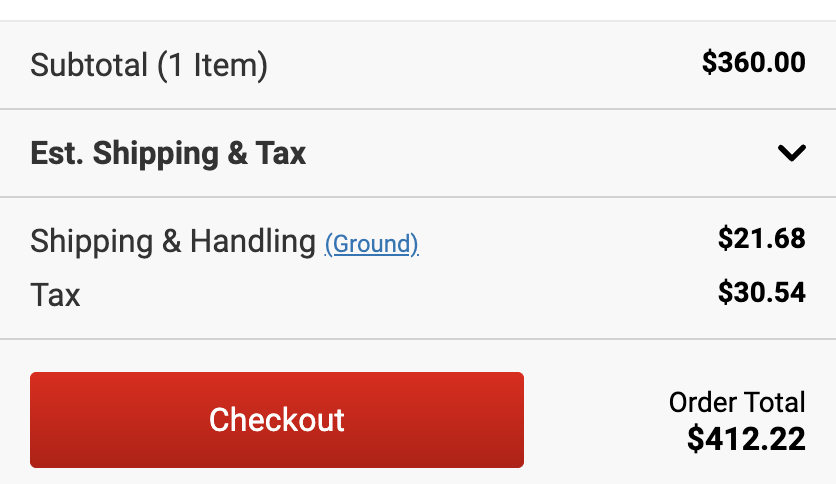
My Multi-Use Rack Roller came out to around $412 shipped. Whatever your home gym budget looks like, $400 is real money for an attachment.
And this is where the comparison with single leg rollers gets harder for me to ignore.
I can have two individual rollers that are lighter, easier to store, easier to manipulate, independently adjustable, and useful for a huge percentage of the movements where I might otherwise consider using the Rack Roller. For the way I actually train, that setup fits my gym better.
There are things the smaller rollers cannot replicate.
I want to be very clear about that because I do not think it is fair to pretend they are identical products.
The full-width six-inch roller is substantially better for hip thrusts. You get a larger support surface, the pad rotates naturally with your body, and you are not locked into one narrow spot on the rack. I have performed hip thrusts using a single leg roller, and it works, but it is not as good.
The Multi-Use Rack Roller wins that exercise easily.
But for me, it wins one exercise while the smaller rollers win the day-to-day battle of convenience.
That is ultimately the tradeoff.
Who I Think Should Actually Buy One
There is absolutely a home gym owner who will love the Rogue Multi-Use Rack Roller, and I think that distinction is important because I do not believe this is a bad product.
If hip thrusts are a major part of your programming, I would look much harder at it. This is easily the best use I have found for the attachment, and if you are performing hip thrusts two or three times a week, that alone could justify having it.
It also makes more sense if you are building a rack-centric gym where you want one power rack to perform as many functions as possible. If you do not have a dedicated lat pulldown, do not own single leg rollers, and do not have a bunch of other accessories already hanging around the garage, the Rack Roller's versatility becomes far more meaningful.
That is probably one of the biggest reasons my experience differs from someone else's.
My gym is pretty complete at this point. I have accumulated dedicated tools for a lot of these movements. That means the Multi-Use Rack Roller is competing against equipment specifically designed to solve individual problems.
A newer or more minimalist home gym may be a completely different story.
That is why I understand the positive reviews. I really do.
I am not saying everyone else who loves the Rack Roller is wrong. I am saying that after 18 months in my gym, with my equipment and the way I train, I have reached a different conclusion.
My Verdict After 18 Months
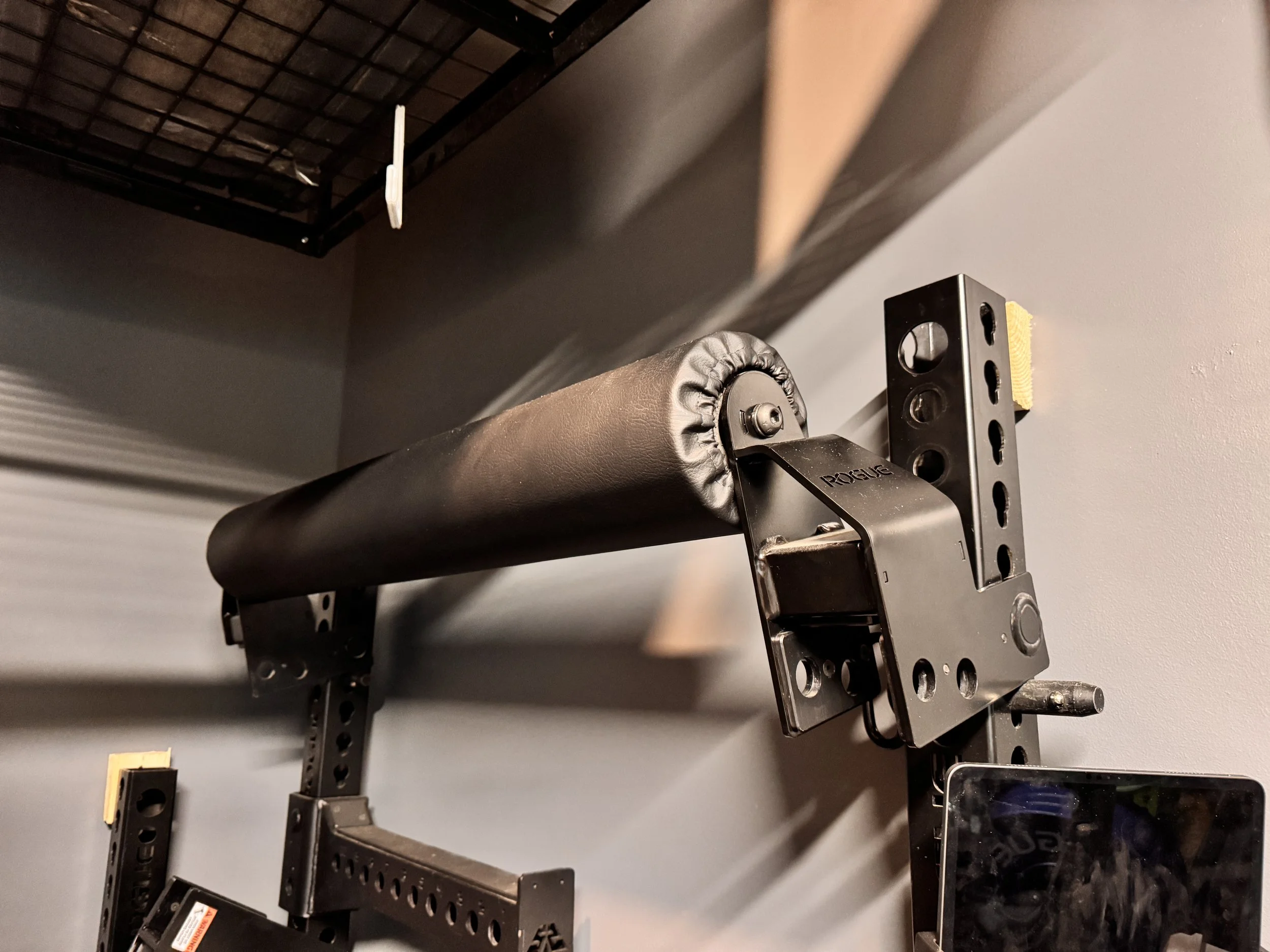
Storage is also a big ask
So, would I recommend the Rogue Multi-Use Rack Roller?
For most home gym owners, probably not.
And that is a strange conclusion because there is very little I can point to and call objectively bad.
The quality is excellent. The construction is exactly what I expect from Rogue. It is strong, stable, thoughtfully designed, and genuinely versatile. The rotating pad works well, and for rack-mounted hip thrusts, I think it is probably one of the best solutions in the home gym market.
My issue is everything surrounding those strengths.
It weighs 31 pounds. It is roughly four feet wide. It is awkward to move. It takes more effort to install and remove than the alternatives I use most often. It has to be stored somewhere when it is not mounted. And after spending nearly $400 on it, I still find myself reaching for two much simpler leg rollers most of the time.
That does not make the Multi-Use Rack Roller a bad product.
If anything, it is an incredibly overbuilt solution to several problems that I can personally solve more easily with smaller pieces of equipment.
And after 18 months, I think that is a far more useful conclusion than anything I could have told you during the first week of ownership.
I bought this attachment after seeing a lot of praise for it. I expected to use it constantly. I tried different movements with it, worked it into my training, and gave it plenty of opportunities to earn its place in the gym.
Most days, it still hangs on the wall.
I know that puts me in the minority compared with a lot of other people in the home gym space, and I am perfectly fine with that. The goal of Iron & Lime Fitness has never been to tell you that every Rogue product is amazing simply because I like Rogue equipment. It is also not to disagree with everyone else for the sake of being different.
The goal is to tell you what happens after the new-equipment excitement wears off and a piece of gear has to survive hundreds of real workouts in an actual garage gym.
Sometimes the answer is that an expensive piece of equipment becomes indispensable.
Sometimes you realize you already had two perfectly good leg rollers sitting there, standing on business the entire time.
For me, this was the second one.
The Rogue Multi-Use Rack Roller is capable of doing a lot. For the right home gym, it may be exactly the attachment someone needs. But equipment should not earn its place in your gym because of everything it could do.
It should earn its place because you actually want to use it.
After 18 months, the Rogue Multi-Use Rack Roller just never quite got there for me.
Strength for Life. Fitness for All.
Support the Garage Grind:
If this helped you make a decision, or gave you something you couldn't find anywhere else, hitting subscribe is the best way to keep this going. No fluff. No BS. Just real reviews from a real gym.
Got questions about any piece of equipment in here? Drop them in the comments. I read and reply to everything because this stuff matters. Your money, your training, your goals. You can also reach me directly on Instagram or Facebook at @IronAndLimeFitness.
-Drew, Iron & Lime Fitness
Barbells and Balance Things:
Watch the full video review on our YouTube channel
Rogue Multi-Use Rack Roller Review: 18 Months Later…I Wouldn’t Buy It Again
More Articles here:
MERACH UltraRow R60N Review: Is This Air + Magnetic Rower a Real Concept2 Alternative for Home Gyms?
Rogue Ohio Bar: Cerakote vs. Stainless Steel
Bumper Plate Showdown: Rogue Competition vs Training Bumpers | Which Rogue Plates Are Best?
Rogue Monster vs. Bells of Steel Manticore Safety Straps: An Honest Home Gym Comparison
Straydog Strength GOAT Attachment Review: What Nobody Tells You Before You Buy
Rogue Dual Indy Functional Trainer Review: The Honest Breakdown After Daily Use
Everything in This Gym Has a Reason to Be Here: A Complete Home Gym Tour
Rogue Sandwich J-Cup Too Tight? Here's How to Fix It (Calibration Kit Explained)
Home Gym Makeover: How We Transformed Our Home Gym - Paint, Layout, and a Long-Awaited Delivery
Kensui Sapporo Swiss Bar & Calibrated Gold Plates Review: Worth It for Home Gyms?
Rogue Fitness CTM-1 Review: Is it better than the Rep Adonis Cable Tower for Home Gyms?
Moving the FM-6: Why Garage Gyms Must Evolve (And How to Survive the Move)
American Barbell 10-Sided Urethane Dumbbells Review: Commercial Luxury or Financial Mistake?
Here's Why I Wouldn't Buy The Rogue FM-6 Again: Rogue FM-6 Long-Term Review
Rogue Mutant Metals Ultimate Dip Attachment Review (1 Year Later): Is It Really Worth $365?
Rogue Kabuki Transformer Bar Review
Rogue Manta Ray Adjustable Bench Review
Rogue FM-6 Twin Functional Trainer Review
American Barbell Dumbbell Set and Rack Review
“Best Budget Gear for Building a Garage Gym”
Bells of Steel Safety Straps Review: A Perfect Fit for the Rogue FM-6
Train hard. Live bold. Stay lime.