
Rogue Ohio Bar: Cerakote vs. Stainless Steel
By Drew
Iron and Lime | Gear Help
Last Updated: June 2026
Iron and Lime Fitness is independent and supported by readers. We may earn a small commission at no cost to you if you buy through an affiliate link.
Both finishes share the same legendary bar. Here’s how to figure out which one you should actually buy.
The Rogue Ohio Bar is probably the most copied barbell in the fitness industry. Thousands of reviews exist. You don’t need another one.
What most people actually want to know is simpler: Cerakote or stainless steel? One gives you color and customization. The other gives you stainless steel. Both cost real money. The right answer depends on how you train, where you train, and how much the feel of a bar matters to you.
Here’s what actually matters and which version I’d put my money on.
Let's get into it.
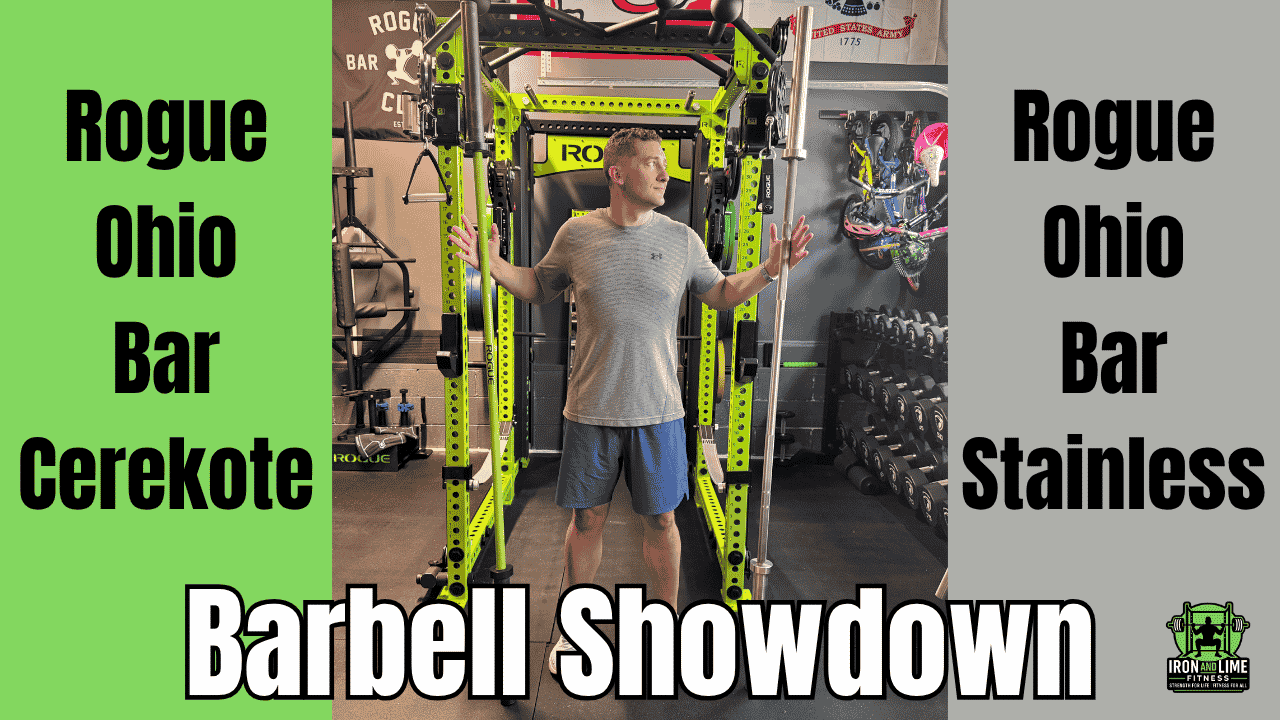
Watch the Youtube Video
Same Bar, Different Finish
Before anything else, understand what you’re actually choosing between. Underneath the finish, these are the same bar.
Both versions are 20kg, 28.5mm shaft diameter, dual knurl marks, bronze bushings, and medium knurling. Both are manufactured and assembled in Columbus, Ohio. Both are backed by Rogue’s lifetime warranty against bending.
This isn’t a bad bar versus good bar conversation. It’s a conversation about two excellent barbells and figuring out which one fits your situation.
The Cerakote Ohio Bar
The Cerakote version runs around $410 shipped. Cerakote came out of the firearms industry, where it was developed as a ceramic-based coating designed to resist corrosion. We use it on some of our military weapon systems. It works.
For most garage gym environments, Cerakote is more than sufficient. If you’re not training in a swamp or on the surface of the sun, it holds up extremely well. The biggest reason people buy it is straightforward: it looks good. Rogue offers a wide range of colors, and if aesthetics matter to you, Cerakote is one of the easiest ways to make your gym stand out.
Knurl feel is worth addressing directly. Cerakote is a coating, which means there is a layer between your hands and the steel. Compared to stainless steel, the knurl feels slightly more passive. Can you tell the difference? Yes. Will you care if you’re not doing a side-by-side comparison? Probably not. It still feels like an Ohio Bar. The medium knurl Rogue is known for is still there. It’s just not quite as direct.
Durability is where Cerakote earns serious respect. The Cerakote Ohio Bar carries an F8-R rating on Rogue’s durability scale. That translates to roughly 16 years of high-volume CrossFit usage at approximately 150,000 drops per year. For a home gym owner, that’s effectively a lifetime.
A quick note on the F-Scale since it’s worth understanding. Rogue invested over $2 million into researching barbell failure. They attached strain gauges to shafts and dropped bars hundreds of thousands of times under controlled conditions. What they found was that heavy weight isn’t the primary stressor. The biggest stress occurs when the plates hit the ground and the unsupported sleeves whip downward. A 135-pound bar dropped repeatedly can create more cumulative damage than a single 1,000-pound deadlift. The F-Scale, F1 through F8-R and beyond, reflects that research. The “R” designation means Rogue Work Hardening has been applied, a process that strengthens the steel beneath the surface.
Maintenance is simple. Light oil in the bushings, wipe it down occasionally, use a nylon brush when needed. Avoid aggressive steel brushes on the coating.
The Stainless Steel Ohio Bar
The stainless steel version starts around $432 shipped with chrome sleeves and about $540 shipped with stainless sleeves.
The difference is simple: no coating. What you’re holding is the actual steel. No barrier between your hands and the bar.
The first time I trained with a stainless Ohio Bar, the difference was immediately noticeable. The spin felt similar. The whip felt similar. But the knurl felt substantially more connected. Once you’ve spent real time with a stainless steel bar, going back is difficult. If you have both hanging on the wall, you’ll reach for the stainless one without thinking about it.
On corrosion resistance, stainless steel is essentially the gold standard for garage gym barbells. Humidity is not a problem. Southern summers are not a problem. A non-climate-controlled garage is not a problem. This is exactly the environment stainless steel was made for.
The stainless Ohio Bar carries an F100-R rating, and that number requires an explanation. Rogue’s engineers were unable to get the work-hardened stainless steel samples to fail during testing. They ran the tests repeatedly. The bars never failed. F100-R is the minimum rating Rogue was willing to assign because the testing exceeded what their lab could reliably measure. That’s an absurd level of durability, and it’s far beyond what any home gym owner needs.
But here’s the thing: people don’t buy stainless steel because Cerakote isn’t durable enough. They buy it because it feels better. The durability is just a bonus. Maintenance is minimal. Nylon brush, keep it clean, avoid steel brushes that can leave contamination on the surface.
Putting It Side by Side
The Cerakote Ohio Bar comes in around $410 shipped. You get multiple color options, excellent corrosion resistance, excellent durability with that F8-R rating, bronze bushings, and a slightly softer knurl feel due to the coating.
The stainless Ohio Bar starts around $432 shipped with chrome sleeves and around $540 with stainless sleeves. You get the best possible knurl feel, the best corrosion resistance available, that F100-R durability rating, bronze bushings, and a premium feel every single time you pick it up.
Which One to Buy
If you’re buying one barbell to do everything, the stainless steel Ohio Bar with chrome sleeves is the sweet spot. At roughly $432 shipped, you’re paying about $22 more than the Cerakote version. For that extra money, you get stainless steel where it matters most: the shaft. The feel is better. The corrosion resistance is better. It’s probably the version most people would choose if they could go back and do it again.
If you want the full stainless setup with stainless sleeves, the extra money buys maximum corrosion resistance and maximum durability. If you live near the coast, train in a very humid environment, or simply want the nicest Ohio Bar Rogue makes, it’s a fantastic option. I have the full stainless setup and it’s one of those purchases I never second-guessed. When I bought my Ohio Power Bar, I went stainless again for exactly the same reason.
That said, don’t let the F-ratings push you away from Cerakote. An F8-R rating is already beyond what most home gym owners will ever need. The Cerakote Ohio Bar is durable, reliable, attractive, and fully capable of being your forever bar. There isn’t a wrong choice here.
But if you’re a buy once, cry once type of person, stainless steel is my pick every time.
Links to both are in the video description. They’re affiliate links through Rogue. They don’t cost you anything extra, but they do help support the channel.
Where to Buy
Both bars are available through Rogue Fitness. My affiliate link is below. Same price either way, but it helps support the channel and this blog. I appreciate every click.
I'm Drew from Iron and Lime Fitness. Veteran-owned, unsponsored, real gear talk from someone who trains in a garage at 5am.
Keeping this channel running is a one-man operation. I film it, edit it, write it, blog it, build the website, run the socials, and handle the marketing, all while working a full-time job and raising three kids who mostly just want to hang out in the gym with me. It's a family operation in every sense.
If you're shopping Rogue, Bells of Steel, or Kensui anyway, using the links below supports the channel at no extra cost to you. It genuinely makes a difference in keeping the content coming.
Support the Garage Grind:
If this helped you make a decision, or gave you something you couldn't find anywhere else, hitting subscribe is the best way to keep this going. No fluff. No BS. Just real reviews from a real gym.
Got questions about any piece of equipment in here? Drop them in the comments. I read and reply to everything because this stuff matters. Your money, your training, your goals. You can also reach me directly on Instagram or Facebook at @IronAndLimeFitness.
Strength for life. Fitness for all.
-Drew, Iron & Lime Fitness
Barbells and Balance Things:
Watch the full video review on our YouTube channel
Rogue Ohio Bar: Cerakote vs Stainless Steel | Which Should You Buy?
More Articles here:
Bumper Plate Showdown: Rogue Competition vs Training Bumpers | Which Rogue Plates Are Best?
Rogue Monster vs. Bells of Steel Manticore Safety Straps: An Honest Home Gym Comparison
Straydog Strength GOAT Attachment Review: What Nobody Tells You Before You Buy
Rogue Dual Indy Functional Trainer Review: The Honest Breakdown After Daily Use
Everything in This Gym Has a Reason to Be Here: A Complete Home Gym Tour
Rogue Sandwich J-Cup Too Tight? Here's How to Fix It (Calibration Kit Explained)
Home Gym Makeover: How We Transformed Our Home Gym - Paint, Layout, and a Long-Awaited Delivery
Kensui Sapporo Swiss Bar & Calibrated Gold Plates Review: Worth It for Home Gyms?
Rogue Fitness CTM-1 Review: Is it better than the Rep Adonis Cable Tower for Home Gyms?
Moving the FM-6: Why Garage Gyms Must Evolve (And How to Survive the Move)
American Barbell 10-Sided Urethane Dumbbells Review: Commercial Luxury or Financial Mistake?
Here's Why I Wouldn't Buy The Rogue FM-6 Again: Rogue FM-6 Long-Term Review
Rogue Mutant Metals Ultimate Dip Attachment Review (1 Year Later): Is It Really Worth $365?
Rogue Kabuki Transformer Bar Review
Rogue Manta Ray Adjustable Bench Review
Rogue FM-6 Twin Functional Trainer Review
American Barbell Dumbbell Set and Rack Review
“Best Budget Gear for Building a Garage Gym”
Bells of Steel Safety Straps Review: A Perfect Fit for the Rogue FM-6
Train hard. Live bold. Stay lime.