
By Drew
Iron and Lime | Gear Reviews
Last Updated: Oct 2026
Iron and Lime Fitness is independent and supported by readers. We may earn a small commission at no cost to you if you buy through an affiliate link. Shop Rogue here.
Summary
The Rogue TR-2D Tricep Dual Cable Attachment is exactly the kind of product Rogue excels at manufacturing: beautifully machined, innovative, exceptionally well-built, and expensive. Unfortunately, it's also a perfect example of why premium construction doesn't always translate into a better training experience.
I paid $209 shipped for the TR-2D. For that money, you get an American-made cable attachment featuring 32mm knurled aluminum handles, an integrated aluminum pulley, aircraft-grade cable, and approximately 20 inches of independent cable travel. The design allows for traditional tricep pushdowns, alternating extensions, isometric holds, face pulls, curls, and several other movements that take advantage of the independently moving handles.
I've been using the TR-2D on my 90-inch Rogue CTM-1 and Dual Indy cable setup. At 6'1", I've found that the attachment's approximately 21-inch overall length creates some frustrating limitations during traditional tricep pushdowns. Combine that with the lack of cushioning at the bottom of the handles, and I frequently find myself reaching for my $13 tricep rope or Rogue's rotating V-grip instead. While the TR-2D works well for face pulls and overhead tricep extensions, it hasn't become the versatile, everyday attachment I expected.
My conclusion is pretty straightforward: The TR-2D is an excellent piece of equipment from a manufacturing standpoint, but it's not an attachment I would purchase again. Its unique pulley system has legitimate applications, but for the way I train, the practical limitations outweigh the benefits.
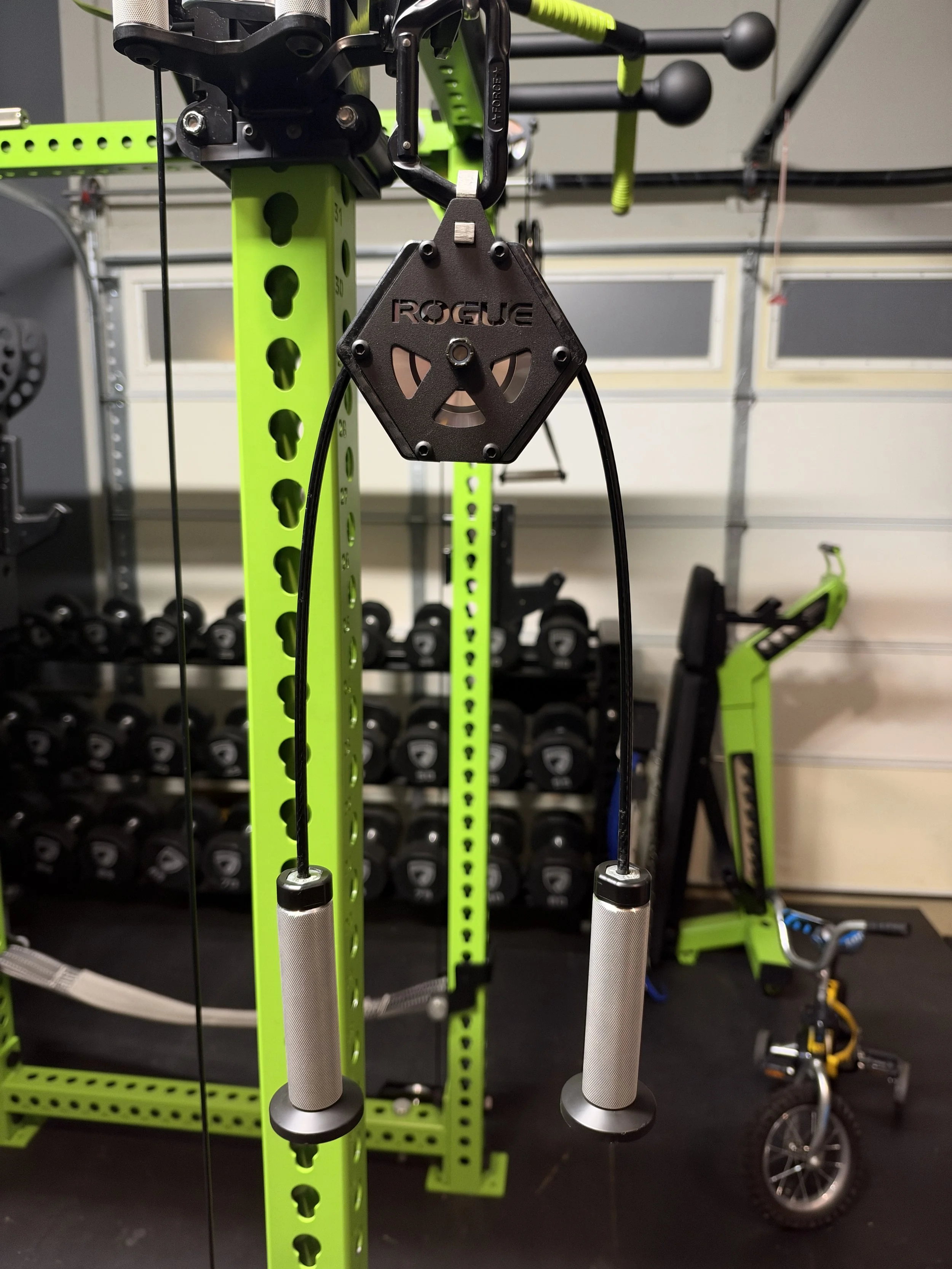
Rogue TR-2D Tricep Cable Attachment
Things I Love
Exceptional Rogue manufacturing quality
Excellent 32mm knurled aluminum handles
Smooth and well-engineered pulley system
Independent handle movement creates unique training possibilities
Approximately 20 inches of cable travel
Great for alternating exercises and isometric holds
Works well for face pulls and overhead tricep extensions
Solid construction with no noticeable slop or looseness
Offers functionality that traditional tricep ropes cannot easily replicate
Innovative design that genuinely brings something different to cable training
Things I Don't Love
$209 shipped is a significant investment for a cable attachment
Hard stops at the bottom of the handles lack cushioning
Less comfortable against my hands than a traditional tricep rope or Rogue's rotating V-grip
Approximately 21-inch overall length limits usable working space
At 6'1", traditional pushdowns are awkward on my 90-inch CTM-1 and Indy setup
Requires me to adjust my stance and body positioning to accommodate the attachment
Taller lifters using shorter cable towers may experience similar limitations
Doesn't provide a better experience than my traditional rope for conventional pushdowns
Most advertised exercises can already be performed with less expensive attachments
Hasn't earned a regular place in my training despite its versatility
The impressive engineering doesn't translate into enough practical value for my setup
Would I Recommend It?
For most people looking to upgrade their traditional tricep pushdowns, no.
If you're specifically interested in alternating cable movements, isometric training, and experimenting with different exercise variations, I think the TR-2D has some legitimate appeal. Its independent pulley system works extremely well, and the manufacturing quality is exactly what I've come to expect from Rogue.
However, your height and cable machine configuration should play a significant role in your purchasing decision. At 6'1", using 90-inch Rogue cable equipment, the attachment simply hangs too low for my preferred pushdown mechanics. Someone who's 5'7" or using a taller cable machine may have a completely different experience.
But if you're primarily looking for a comfortable, versatile tricep attachment, I think there are better options for considerably less money. My traditional $30 rope remains my preferred choice for conventional pushdowns, and Rogue's rotating V-grip provides another excellent alternative.
I appreciate what Rogue accomplished with the TR-2D, and I certainly wouldn't call it a bad product. But at $209 shipped, I expect more than impressive engineering. I expect an attachment that improves my training and earns its place in my gym.
For me, this one hasn't.
Iron & Lime Verdict: Not Recommended for my setup. Excellent construction, but limited practical value for taller lifters using 90-inch cable equipment.
TR-2D: Excellent Quality, But Is It Worth $209?
When Rogue Fitness releases a new cable attachment, I'm usually pretty interested. Over the years, I've added quite a few Rogue attachments to my home gym, and many have become regular parts of my training. I appreciate good engineering, quality materials, and equipment that offers meaningful improvements over traditional gym accessories. So when Rogue introduced the TR-2D Tricep Dual Cable Attachment, it immediately caught my attention.
On paper, the TR-2D checks almost every box I look for in a premium cable attachment. It features beautifully machined aluminum components, knurled handles, an integrated pulley system, and a design that allows for independent arm movement during various cable exercises. Rather than simply creating another traditional tricep rope, Rogue developed something that offers additional training possibilities through dynamic cable movement.
It's an interesting concept, and one that I genuinely wanted to love.
Unfortunately, after spending considerable time using the TR-2D in my home gym, I've reached a conclusion that might surprise some people. The Rogue TR-2D is an exceptionally well-made attachment that I wouldn't purchase again.
That isn't because the pulley system doesn't work or because Rogue compromised on manufacturing quality. Quite the opposite. My concerns come down to two relatively simple design considerations: the lack of cushioning at the bottom of the handles and the attachment's overall length, particularly when performing traditional tricep pushdowns.
At 6'1", using the attachment on my 90-inch Rogue CTM-1 and Indy cable setup, I've found that the TR-2D creates some frustrating limitations that I simply don't experience with less expensive alternatives.
And considering that I paid $209 shipped to get this attachment into my gym, those limitations are difficult to overlook.
Here's my experience with the Rogue TR-2D, what I appreciate about its design, where I think Rogue could improve it, and who might still benefit from adding one to their home gym.
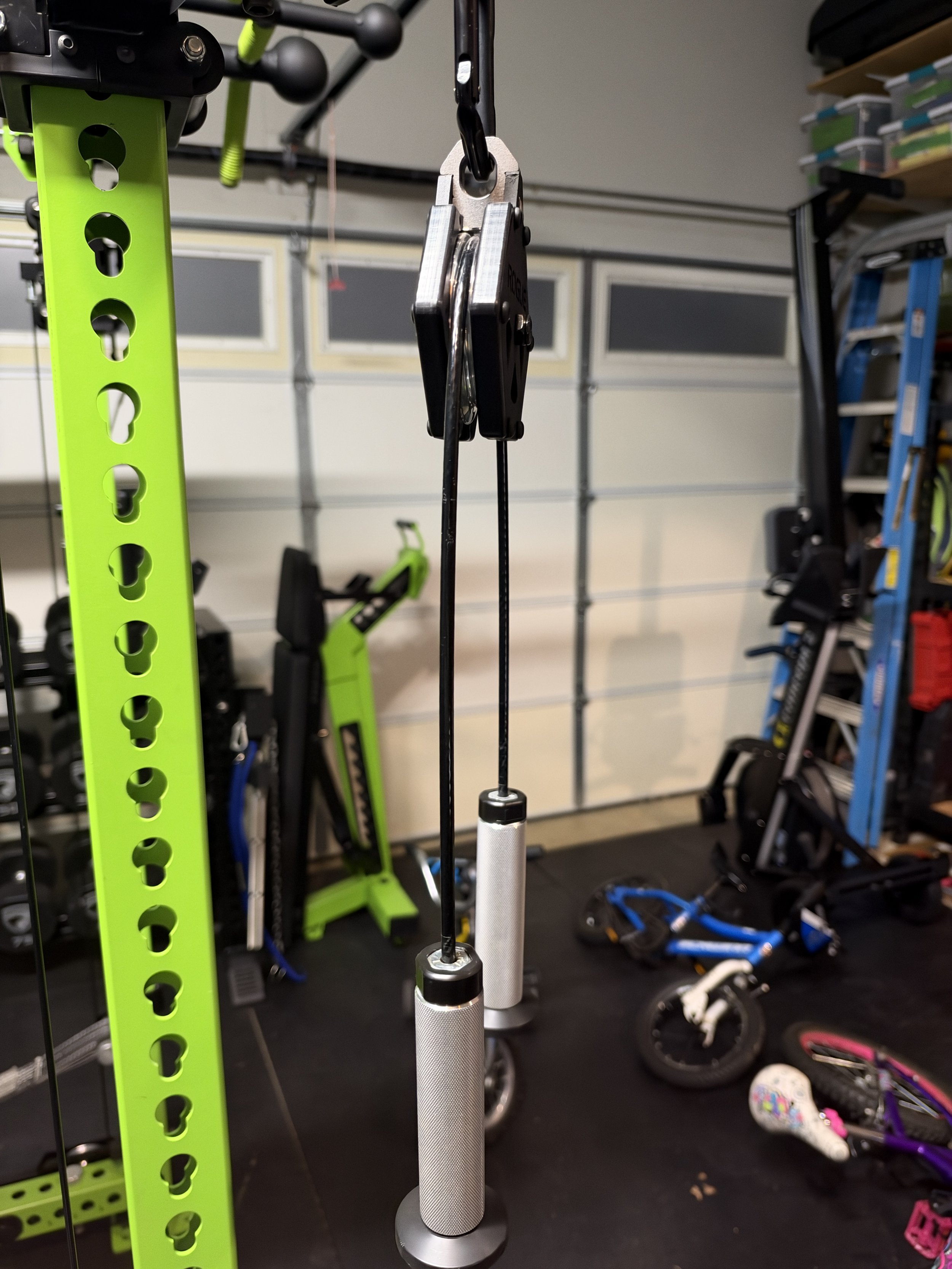
Rogue TR-2D Tricep Cable Attachment Pulley
What Is the Rogue TR-2D Tricep Dual Cable Attachment?
The Rogue TR-2D Tricep Dual Cable Attachment is designed as a premium alternative to traditional tricep ropes, providing additional movement possibilities through an integrated pulley system.
Instead of connecting two fixed rope ends to a central attachment point, Rogue uses an aircraft-grade cable that runs through an aluminum pulley. Each end of the cable features a knurled aluminum handle, allowing the handles to move independently as the cable travels through the pulley.
This design provides approximately 20 inches of cable travel between the handles, creating opportunities for dynamic and isometric exercises that aren't easily replicated with a conventional tricep rope.
For example, during a traditional tricep pushdown, both handles can move together. However, you can also perform alternating extensions, hold one arm in an extended position while moving the other, or deliberately change the positioning of your hands throughout an exercise.
That additional freedom of movement is the defining feature of the TR-2D.
Rogue markets the attachment for tricep pushdowns, overhead extensions, face pulls, hammer curls, straight-arm pulldowns, weighted crunches, and other cable exercises. It's a versatile concept that attempts to expand the functionality of a traditional cable attachment without requiring a second cable machine or separate pulley system.
The TR-2D weighs approximately 3.25 pounds and features 32-millimeter knurled aluminum handles, a 3.5-inch aluminum pulley, a stainless steel attachment point, and protective UHMW edge guards.
The attachment measures approximately 21 inches tall when both handles are positioned at the same height, a dimension that becomes especially important later in this review.
From a mechanical perspective, the design is impressive. The pulley moves smoothly, the handles provide a secure grip, and the independent cable movement functions exactly as intended.
But while the engineering is interesting, the real question is whether those features make the TR-2D a better attachment for everyday training.
And that's where my opinion becomes more complicated.
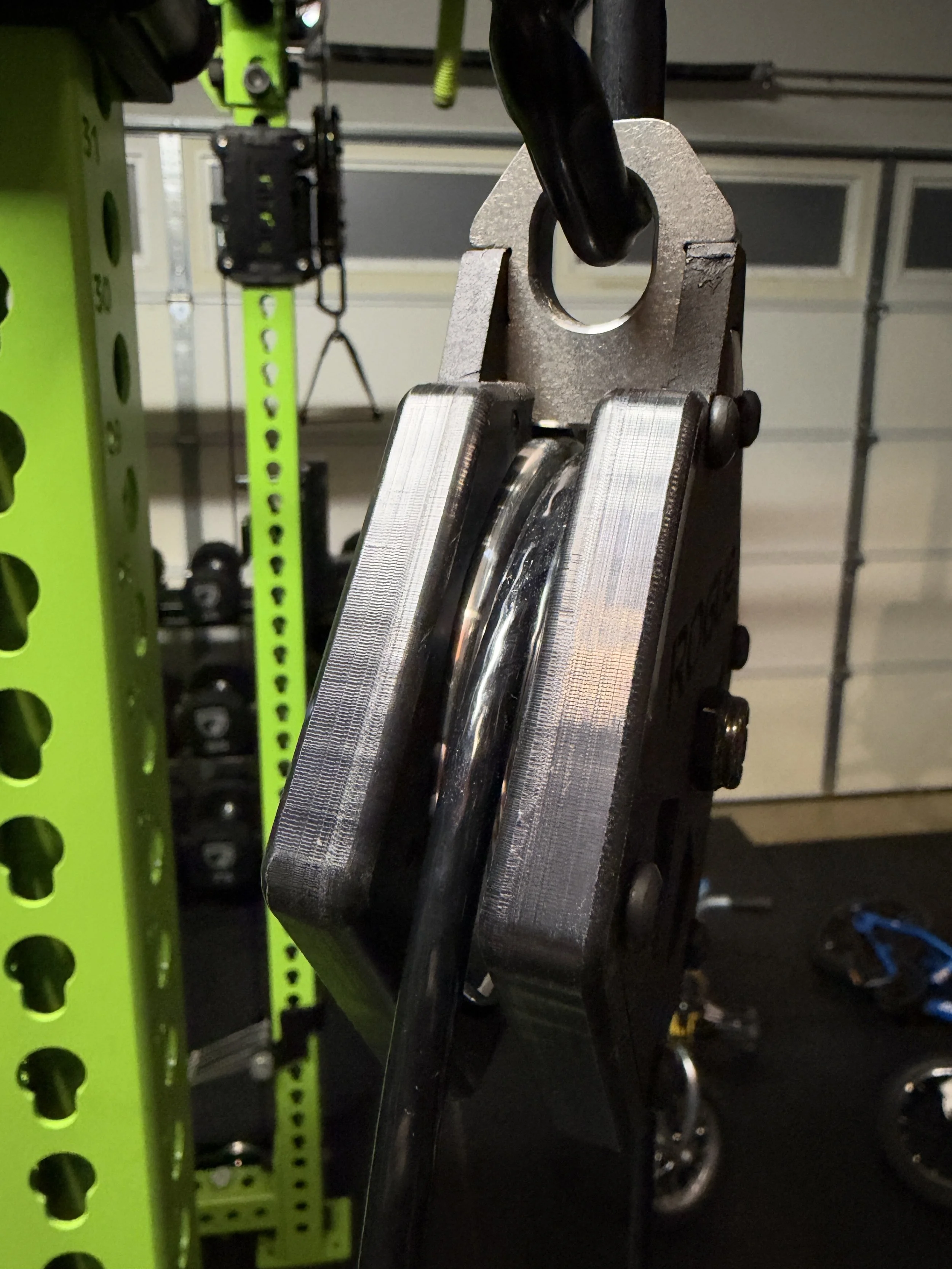
Rogue TR-2D Tricep Cable Attachment Tight Tolerances
Build Quality: Exactly What I Expect From Rogue Fitness
If there's one area where I have almost nothing negative to say about the Rogue TR-2D, it's manufacturing quality.
Rogue continues to produce some exceptionally well-built gym equipment, and the TR-2D is another example of that commitment.
The aluminum handles feel substantial without being unnecessarily heavy. The knurling provides an excellent grip, and the handle diameter is comfortable for a variety of movements. Everything fits together tightly, and the attachment has the sort of solid construction that immediately inspires confidence.
The integrated pulley system is equally impressive.
The movement is smooth and controlled, with no noticeable looseness or excessive play in the assembly. The cable travels cleanly through the pulley, and nothing about the attachment feels cheap or poorly designed from a manufacturing standpoint.
This is equipment that I would expect to survive years of consistent use in a home gym.
Having reviewed numerous Rogue products on Iron and Lime Fitness, I've developed relatively high expectations for their equipment. Attachments like the CG-1C Multi-Grip Camber Cable Attachment and Rogue's rotating V-grip have reinforced those expectations by combining quality manufacturing with practical functionality.
The TR-2D absolutely belongs in that same conversation when we're discussing construction quality.
But there's an important distinction between something being well manufactured and something being well suited to your training.
A premium finish, expensive materials, and exceptional machining don't automatically make an attachment comfortable or practical.
And while Rogue deserves credit for how well the TR-2D is constructed, I think there are some legitimate ergonomic concerns that become noticeable once you start putting it to work.
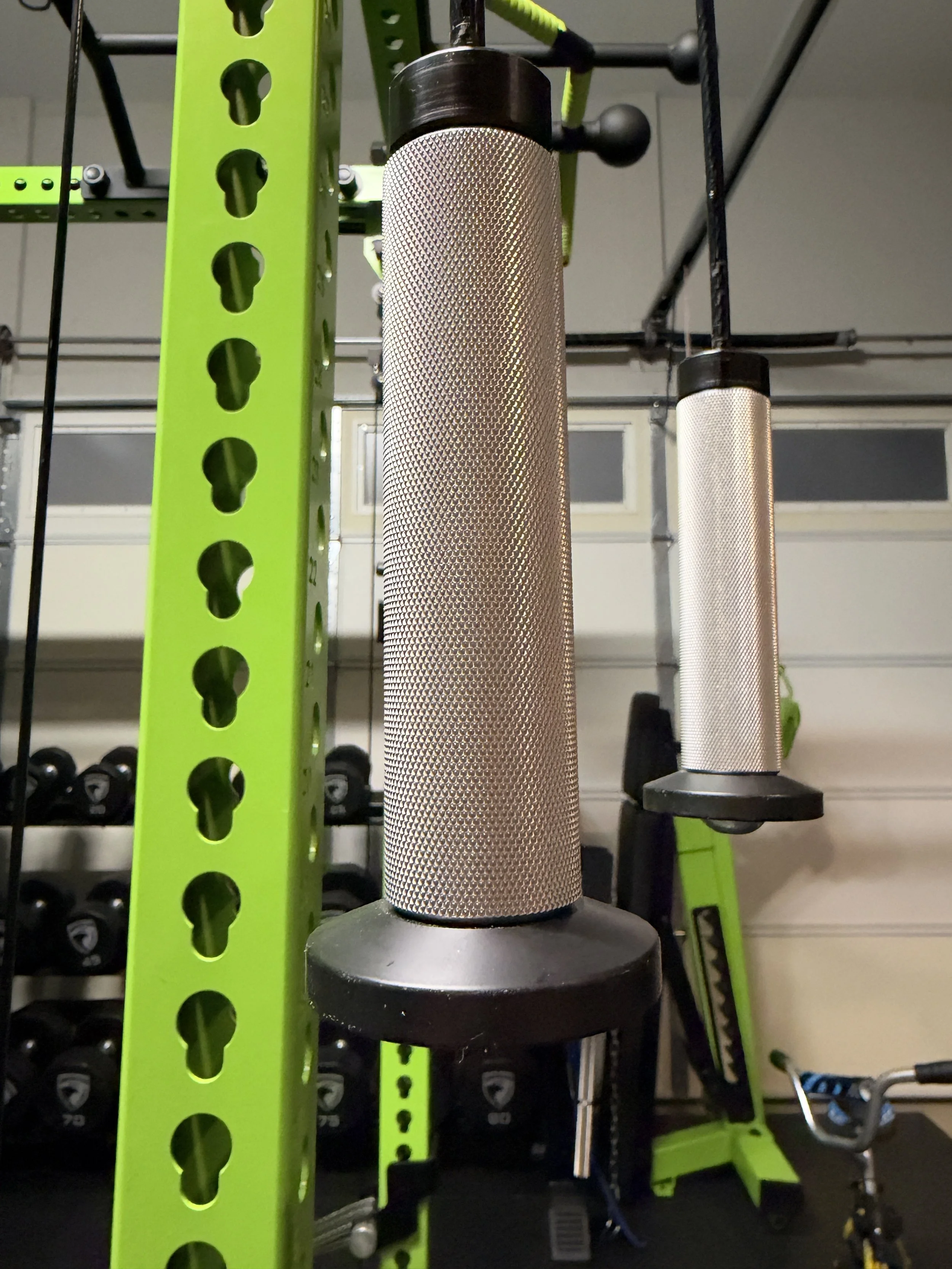
The Rogue TR-2D handle is probably fine for some, for me it gets hard on heavy sets
The First Problem: No Cushioning at the Bottom of the Handles
One of my favorite features of the TR-2D is also the source of my first criticism.
The handles themselves are excellent.
I genuinely like the 32-millimeter diameter, the knurling, and the overall feel of the aluminum construction. I've generally preferred solid handles over traditional ropes whenever possible, particularly when those handles provide a secure and comfortable gripping surface.
However, the TR-2D features a relatively hard stop at the bottom of each handle.
And unlike a conventional tricep rope, where you're pressing against a rubber end, there's no meaningful cushioning to soften that contact point.
This becomes noticeable during traditional tricep pushdowns.
As I extend my arms and separate my hands toward the bottom of the movement, I naturally apply some pressure against the stops at the ends of the handles. With a traditional rope, the rubber ends provide a comfortable surface to push against.
With the TR-2D, that contact feels noticeably harder.
Is it painful? No. I wouldn't characterize it that way.
However, it's also not particularly comfortable, especially when compared directly against attachments that incorporate softer contact surfaces.
And as the resistance increases, that hard contact point becomes more noticeable.
What makes this especially surprising is that Rogue has already demonstrated an understanding of how important handle comfort can be.
Take the Rogue Rotating V-Grip Cable Attachment, for example.
That's another attachment I've been using in my gym, and one of the things I appreciate about it is how comfortable the handles feel throughout the movement. The contact surfaces provide a better experience without sacrificing the advantages of a solid grip.
I would have loved to see Rogue incorporate something similar into the TR-2D.
A simple rubberized or cushioned stop at the bottom of each handle could make repeated sets of tricep pushdowns considerably more comfortable.
It wouldn't require fundamentally changing the attachment's design or sacrificing its defining pulley system.
It's a relatively small detail, but premium gym equipment should get the small details right.
And when an attachment costs $209 shipped, I think it's reasonable to expect a level of comfort that matches its impressive construction.
Would this issue alone prevent me from recommending the TR-2D?
Probably not.
But when combined with my biggest criticism, the situation becomes much harder to overlook.

TR-2D would benefit from using the same handles as the Rouge Rotating V-Grip
The Biggest Issue: The TR-2D Is Too Long for My Cable Setup
The most significant problem I've experienced with the Rogue TR-2D is its overall length.
And before getting into the details, I want to establish two important points about my setup.
First, I'm 6'1".
Second, I'm using the attachment with my 90-inch Rogue CTM-1 and a 90-inch Indy cable setup.
Both of those factors play a substantial role in my experience with the TR-2D.
According to Rogue's specifications, the attachment measures approximately 21 inches tall when both handles are at the same height. When you account for the hardware connecting it to the cable machine, you're dealing with a relatively long attachment hanging below the upper pulley.
That's where the trouble begins.
When performing traditional tricep pushdowns, I prefer a starting position that allows me to comfortably flex my elbows under tension, maintain a relatively consistent body position, and extend through a full range of motion.
With shorter attachments, this is relatively straightforward.
I can connect a traditional tricep rope or Rogue's rotating V-grip to the CTM-1 and begin training without making significant adjustments to my stance or positioning.
With the TR-2D, however, the handles start considerably lower.
That reduces the available vertical working space before I've even started the exercise.
At 6'1", I find myself adjusting my body around the attachment rather than simply getting into my preferred pushdown position.
I can step farther away from the machine, bend my knees, lean forward, or otherwise modify my positioning to accommodate the additional length.
And technically, those adjustments allow me to perform the movement.
But that's not really the point.
I don't want to spend $209 on a premium tricep attachment and then have to work around its design to perform one of the most basic tricep exercises.
The entire purpose of buying specialized equipment should be to improve the training experience, not make it more complicated.
And what's particularly frustrating is that I don't experience this same issue with my other tricep attachments.
A traditional rope works.
The rotating V-grip works.
Both provide a more comfortable starting position on the same cable machine.
With the TR-2D, I lose valuable working height because of the attachment's overall dimensions.
And for an attachment primarily associated with tricep training, that's a significant limitation.
Why Your Height and Cable Machine Matter
Now, I want to be especially fair to Rogue here because I don't believe everyone will experience the same problems I'm describing.
My experience is influenced by both my height and the equipment I'm using.
Someone who's 5'6", 5'7", or 5'8" may have a completely different experience performing pushdowns with the TR-2D on a 90-inch cable machine.
A shorter lifter could have substantially more room to work with, allowing them to maintain a comfortable starting position without making the adjustments I find necessary.
Likewise, someone using a taller functional trainer or a cable machine with a higher attachment point may not experience this issue at all.
In those situations, the additional length might have relatively little impact on the exercise.
That's why I don't want to characterize the TR-2D as universally too long.
It's too long for me, at 6'1", using my particular cable equipment and preferred training positions.
And that's an important distinction.
I also think it's something that gets overlooked in equipment reviews.
Two people can purchase the exact same attachment, use it for the exact same exercise, and reach entirely different conclusions based on their height, equipment dimensions, and individual movement preferences.
Neither experience is necessarily wrong.
It's simply a reminder that gym equipment doesn't exist in isolation.
Compatibility isn't just about whether the attachment physically connects to your cable machine. It's also about whether the combination provides enough usable working space to perform the movements you want.
If you're considering the TR-2D for a Rogue CTM-1, Indy system, FM-6 trolley setup, or another cable machine with a relatively low attachment point, I would pay particular attention to the available height.
That doesn't mean you shouldn't buy it.
But it does mean you should understand how the attachment's dimensions might affect your training before spending the money.
For me, this has been the single biggest reason the TR-2D hasn't become a regular part of my workouts.
Where the TR-2D Actually Shines: Dynamic and Isometric Training
Despite my criticisms, there is one area where the Rogue TR-2D genuinely separates itself from traditional cable attachments.
And that's its independent pulley system.
This was one of the biggest reasons I wanted the attachment in the first place.
Rather than forcing both handles to remain in a relatively fixed relationship, the integrated pulley allows one handle to move independently of the other.
That creates some interesting possibilities for dynamic and isometric training.
For example, you can hold one arm in an extended position while performing repetitions with the opposite arm. After completing the movement, you can switch sides or alternate continuously throughout the set.
You can also deliberately offset the handles during curls or extensions, creating movement patterns that aren't easily replicated with a traditional tricep rope.
The system forces you to control the position of both hands, which can make certain exercises feel different from their conventional counterparts.
For someone who regularly incorporates alternating movements, isometric holds, or specialized cable exercises into their training, that added functionality could be genuinely valuable.
And mechanically, the TR-2D performs extremely well in these situations.
The pulley moves smoothly, the handles provide excellent grip security, and the additional movement freedom works as intended.
This is where I think Rogue deserves credit for trying something different.
There are countless traditional tricep ropes available, and most function almost identically.
The TR-2D introduces a different approach to cable training rather than simply offering a more expensive version of a familiar design.
I appreciate that.
However, I also think it's important to distinguish between an attachment offering additional training possibilities and those possibilities being valuable enough to justify the purchase.
For someone specifically interested in dynamic and isometric cable movements, the TR-2D makes a considerably stronger argument for itself.
But for someone primarily interested in traditional tricep pushdowns, the benefits become much less convincing.
Exercise Versatility: More Options Don't Always Mean Better Training
One thing I consistently consider when reviewing home gym equipment is versatility.
Space and money are finite resources, even for those of us who have developed a questionable habit of collecting gym equipment.
When I'm spending premium money on an attachment, I generally want it to serve more than one purpose.
And to Rogue's credit, the TR-2D is capable of performing several different movements.
Beyond traditional tricep pushdowns, it can be used for overhead tricep extensions, face pulls, hammer curls, straight-arm pulldowns, and other cable exercises.
The independent cable movement also provides opportunities to modify some of those exercises in ways that traditional attachments cannot easily replicate.
For example, alternating hammer curls allow each arm to move through a different position, while face pulls give you more freedom to independently adjust your hands throughout the exercise.
From a mechanical perspective, the attachment performs these movements well.
But here's where I think an important distinction needs to be made.
Different doesn't automatically mean better.
The fact that I can perform an exercise with the TR-2D doesn't necessarily mean I prefer performing that exercise with it.
And after spending time experimenting with different movements, I've found that I generally reach for other attachments.
For traditional pushdowns, I prefer my rope.
For curls, I already own attachments that I enjoy using.
For face pulls, the TR-2D works well, but I also have simpler alternatives that accomplish the same general purpose.
The exercises where I've found the TR-2D most useful are face pulls and overhead tricep extensions.
And while those are legitimate uses, they haven't been enough to make this a frequently used attachment in my training.
In fact, despite buying something specifically marketed as a tricep attachment, I rarely use it for conventional tricep pushdowns.
That probably tells you everything you need to know about how well it fits my setup.
The TR-2D certainly adds another option to my gym.
But it hasn't meaningfully replaced any of the attachments I already owned.
And when considering the price, that distinction becomes increasingly important.
Rogue TR-2D vs. a Traditional Tricep Rope
One of the easiest ways to explain my opinion of the TR-2D is to compare it directly against a conventional tricep rope.
If you placed both attachments in front of me and asked which was the more impressive piece of equipment, the TR-2D would win without question.
The aluminum construction is beautiful.
The integrated pulley system is mechanically interesting.
The handles are significantly more refined.
And the independent cable movement provides training possibilities that a traditional rope simply cannot replicate.
From an engineering perspective, the TR-2D is clearly the more sophisticated attachment.
But if you asked which one I would rather use for conventional tricep pushdowns on my Rogue CTM-1, I would take the rope.
And the price difference makes that conclusion even more significant.
The traditional tricep rope I've been using cost me approximately $30 on Amazon, and I've had it for around two and a half years.
It isn't particularly impressive to look at.
It doesn't have precision-machined aluminum handles or a specialized pulley system.
And there's nothing especially innovative about its design.
But it works.
The rubber stops provide a comfortable contact point for my hands.
The shorter overall length allows me to establish a better starting position.
And I can perform pushdowns without constantly adjusting my stance to accommodate the attachment.
For conventional tricep training, those practical benefits matter more to me than the additional engineering found in the TR-2D.
Now, I want to be clear that the two attachments aren't functionally identical.
The TR-2D can perform dynamic and isometric movements that a traditional rope cannot replicate in precisely the same way.
That additional capability has legitimate value for someone who wants to incorporate those movements into their training.
But if your primary goal is performing effective, comfortable tricep pushdowns, I don't believe the TR-2D necessarily provides a better experience.
And in my particular setup, I actually prefer the less expensive option.
Sometimes simple equipment is the better solution.
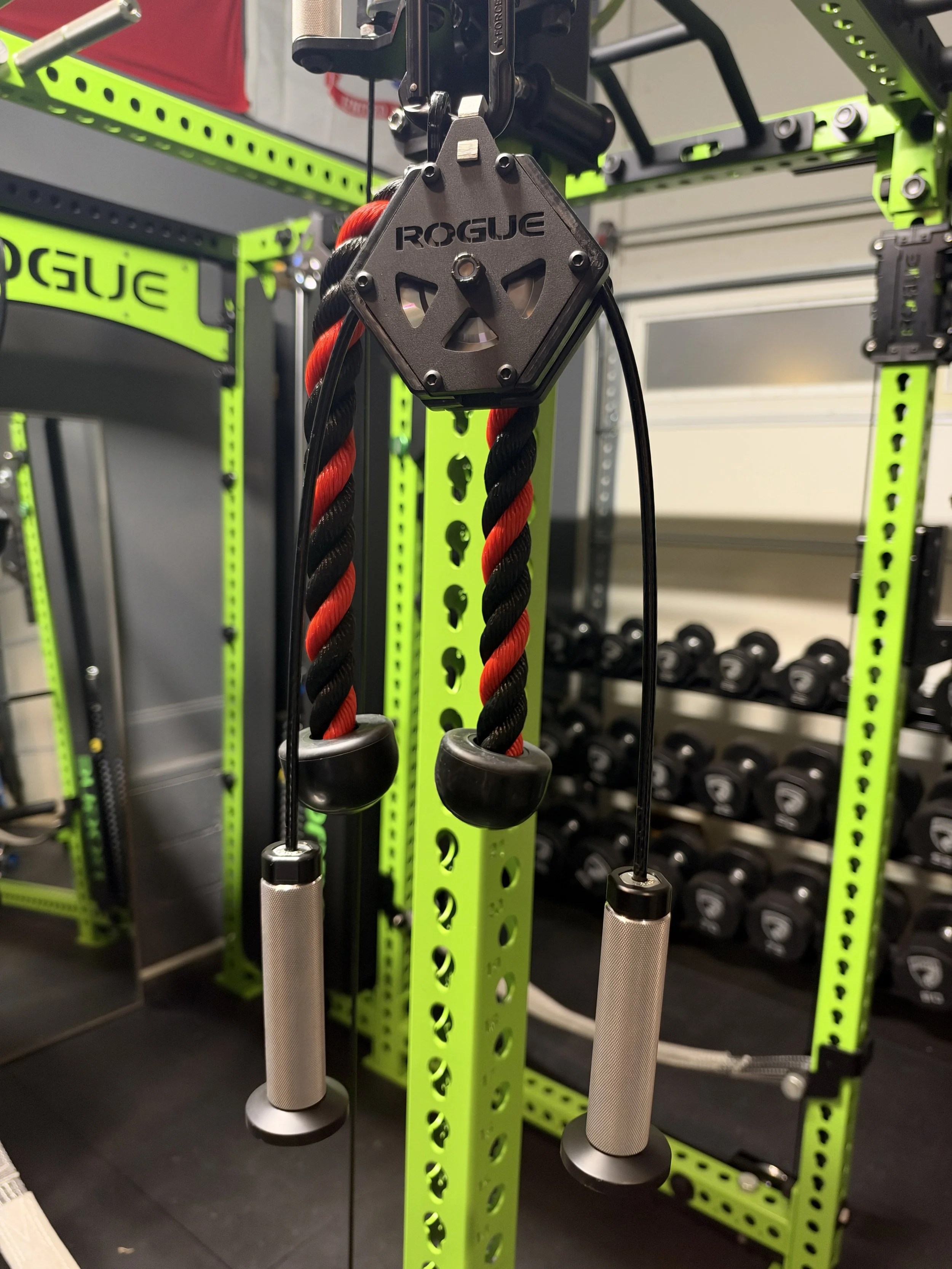
TR-2D versus a $13 Tricep Rope
Is the Rogue TR-2D Worth $209 Shipped?
This is ultimately the question that matters most.
Is the Rogue TR-2D worth the money?
For me, the answer is no.
I paid $209 shipped to get this attachment into my home gym, and while I recognize the quality of the materials and manufacturing, I haven't found enough practical value to justify that investment.
The important distinction here is that I'm not questioning whether the attachment is expensive to manufacture.
The TR-2D clearly requires more engineering and higher-quality components than a traditional rope.
The machined aluminum handles, integrated pulley, aircraft-grade cable, and stainless steel hardware all contribute to a more sophisticated product.
And Rogue has done an excellent job bringing those components together.
But when evaluating equipment for my home gym, I don't judge value solely by how impressive something looks or how much engineering went into its construction.
I judge it by how well it performs, how often I use it, and whether it meaningfully improves my training.
And by those standards, the TR-2D hasn't delivered.
The hard stops at the bottom of the handles make conventional pushdowns less comfortable than I would prefer.
The overall length creates positioning challenges on my 90-inch cable equipment.
And while the independent pulley system is interesting, I haven't found myself using those additional movement options frequently enough to justify the price.
I already own simpler attachments that perform my preferred exercises more comfortably.
That doesn't mean the TR-2D lacks value for everyone.
If you're specifically interested in dynamic cable movements, alternating exercises, or incorporating additional isometric work into your training, the TR-2D offers something unique.
For those purposes, the premium price may be easier to justify.
But if you're looking for an everyday tricep attachment that will immediately improve traditional pushdowns, I think there are better ways to spend your money.
Who Should Buy the Rogue TR-2D?
Despite my experience, I can understand why some people would genuinely enjoy owning the Rogue TR-2D.
If you're someone who likes experimenting with cable exercises, incorporates alternating and isometric movements into your workouts, or specifically wants the freedom provided by an independent pulley system, the TR-2D offers functionality that isn't commonly available in traditional attachments.
I also think people with taller cable machines may have a substantially better experience than I have.
If your equipment provides enough vertical working space to accommodate the attachment's length, one of my biggest complaints could become irrelevant.
Likewise, shorter lifters may find the TR-2D considerably easier to use for conventional pushdowns.
Your height, the height of your cable attachment point, and your preferred exercise positioning all influence how well this product will work for you.
However, if you're around my height of 6'1" and using a 90-inch cable setup, I would approach the purchase more cautiously.
The TR-2D's dimensions may reduce your available working space enough to make traditional pushdowns unnecessarily awkward.
And if your primary goal is simply finding a comfortable, reliable attachment for tricep training, I would strongly consider other options before spending more than $200.
A traditional tricep rope remains an excellent choice.
Rogue's rotating V-grip is another attachment that I've really enjoyed using.
Neither provides exactly the same independent pulley functionality as the TR-2D, but both offer a more straightforward experience for the conventional tricep movements I perform regularly.
Ultimately, I think the TR-2D makes the most sense for someone who specifically wants its unique dynamic movement capabilities rather than someone simply looking for an upgraded tricep rope.
Final Verdict: A Great Product I Wouldn't Buy Again
After spending considerable time with the Rogue TR-2D Tricep Dual Cable Attachment, my opinion remains relatively straightforward.
It's an exceptionally well-manufactured product with an innovative design, but it hasn't earned a permanent place in my regular training rotation.
The machining is excellent.
The pulley system works smoothly.
The knurled aluminum handles feel fantastic in your hands.
And I genuinely appreciate Rogue continuing to develop equipment that brings something different to the home gym market.
But the lack of cushioning at the bottom of the handles is disappointing for an attachment at this price point.
More importantly, the overall length creates a significant limitation when performing traditional tricep pushdowns on my 90-inch Rogue CTM-1 and Indy cable setup.
At 6'1", I consistently find myself adjusting my body position to accommodate an attachment that should make the exercise easier and more comfortable.
That's not the experience I'm looking for from premium equipment.
Now, if you're shorter or have a taller cable machine, your experience could be completely different.
And if you specifically want the TR-2D for alternating cable movements or isometric training, I think there's a much stronger argument for purchasing it.
But for my home gym, the combination of limited working height, less comfortable handle stops, and a $209 delivered cost makes the TR-2D difficult to recommend.
It's a great product that I wouldn't buy again.
And I think that's an important distinction.
Not every piece of equipment needs to be poorly made to be a disappointing purchase.
Sometimes an attachment can be beautifully constructed, mechanically impressive, and genuinely innovative while still being the wrong choice for your training.
The Rogue TR-2D is a perfect example.
At the end of the day, when I walk into my gym to train triceps, I'm still reaching for my traditional rope or rotating V-grip.
And considering what I spent on the TR-2D, that's a difficult conclusion to ignore.
If you're considering this attachment, my recommendation is to think carefully about your height, your cable machine's available working space, and the exercises you actually perform most often.
Because at this price, the TR-2D shouldn't just look impressive hanging on your wall.
It should make your training better.
And for me, it simply hasn't.
Join the Conversation
Do you own the Rogue TR-2D Tricep Dual Cable Attachment? I'd love to hear how it's working in your gym, particularly if you're using it on a taller cable machine or you're a shorter lifter.
Have you experienced similar issues with traditional tricep pushdowns, or has the independent pulley system become something you regularly incorporate into your training?
Share your experience in the comments.
For more honest home gym equipment reviews, Rogue Fitness comparisons, and practical advice on building a better training space, follow Iron and Lime Fitness on YouTube and Instagram.
As always, thanks for reading. I genuinely appreciate your support.
Support the Garage Grind:
If this helped you make a decision, or gave you something you couldn't find anywhere else, hitting subscribe is the best way to keep this going. No fluff. No BS. Just real reviews from a real gym.
Got questions about any piece of equipment in here? Drop them in the comments. I read and reply to everything because this stuff matters. Your money, your training, your goals. You can also reach me directly on Instagram or Facebook at @IronAndLimeFitness.
-Drew, Iron & Lime Fitness
Barbells and Balance Things:
Watch the full video review on our YouTube channel
Rogue TR-2D Review: Great Attachment, But I Wouldn’t Buy It Again
More Articles here:
Rogue CG-1C Review: Is This $205 Cable Attachment Worth It?
Rogue Multi-Use Rack Roller Review: 18 Months Later…I Wouldn’t Buy It Again
MERACH UltraRow R60N Review: Is This Air + Magnetic Rower a Real Concept2 Alternative for Home Gyms?
Rogue Ohio Bar: Cerakote vs. Stainless Steel
Bumper Plate Showdown: Rogue Competition vs Training Bumpers | Which Rogue Plates Are Best?
Rogue Monster vs. Bells of Steel Manticore Safety Straps: An Honest Home Gym Comparison
Straydog Strength GOAT Attachment Review: What Nobody Tells You Before You Buy
Rogue Dual Indy Functional Trainer Review: The Honest Breakdown After Daily Use
Everything in This Gym Has a Reason to Be Here: A Complete Home Gym Tour
Rogue Sandwich J-Cup Too Tight? Here's How to Fix It (Calibration Kit Explained)
Home Gym Makeover: How We Transformed Our Home Gym - Paint, Layout, and a Long-Awaited Delivery
Kensui Sapporo Swiss Bar & Calibrated Gold Plates Review: Worth It for Home Gyms?
Rogue Fitness CTM-1 Review: Is it better than the Rep Adonis Cable Tower for Home Gyms?
Moving the FM-6: Why Garage Gyms Must Evolve (And How to Survive the Move)
American Barbell 10-Sided Urethane Dumbbells Review: Commercial Luxury or Financial Mistake?
Here's Why I Wouldn't Buy The Rogue FM-6 Again: Rogue FM-6 Long-Term Review
Rogue Mutant Metals Ultimate Dip Attachment Review (1 Year Later): Is It Really Worth $365?
Rogue Kabuki Transformer Bar Review
Rogue Manta Ray Adjustable Bench Review
Rogue FM-6 Twin Functional Trainer Review
American Barbell Dumbbell Set and Rack Review
“Best Budget Gear for Building a Garage Gym”
Bells of Steel Safety Straps Review: A Perfect Fit for the Rogue FM-6
Train hard. Live bold. Stay lime.