
By Drew
Iron and Lime | Gear Reviews
Last Updated: Nov 2026
Iron and Lime Fitness is independent and supported by readers. We may earn a small commission at no cost to you if you buy through an affiliate link. Shop Rogue here.
Summary
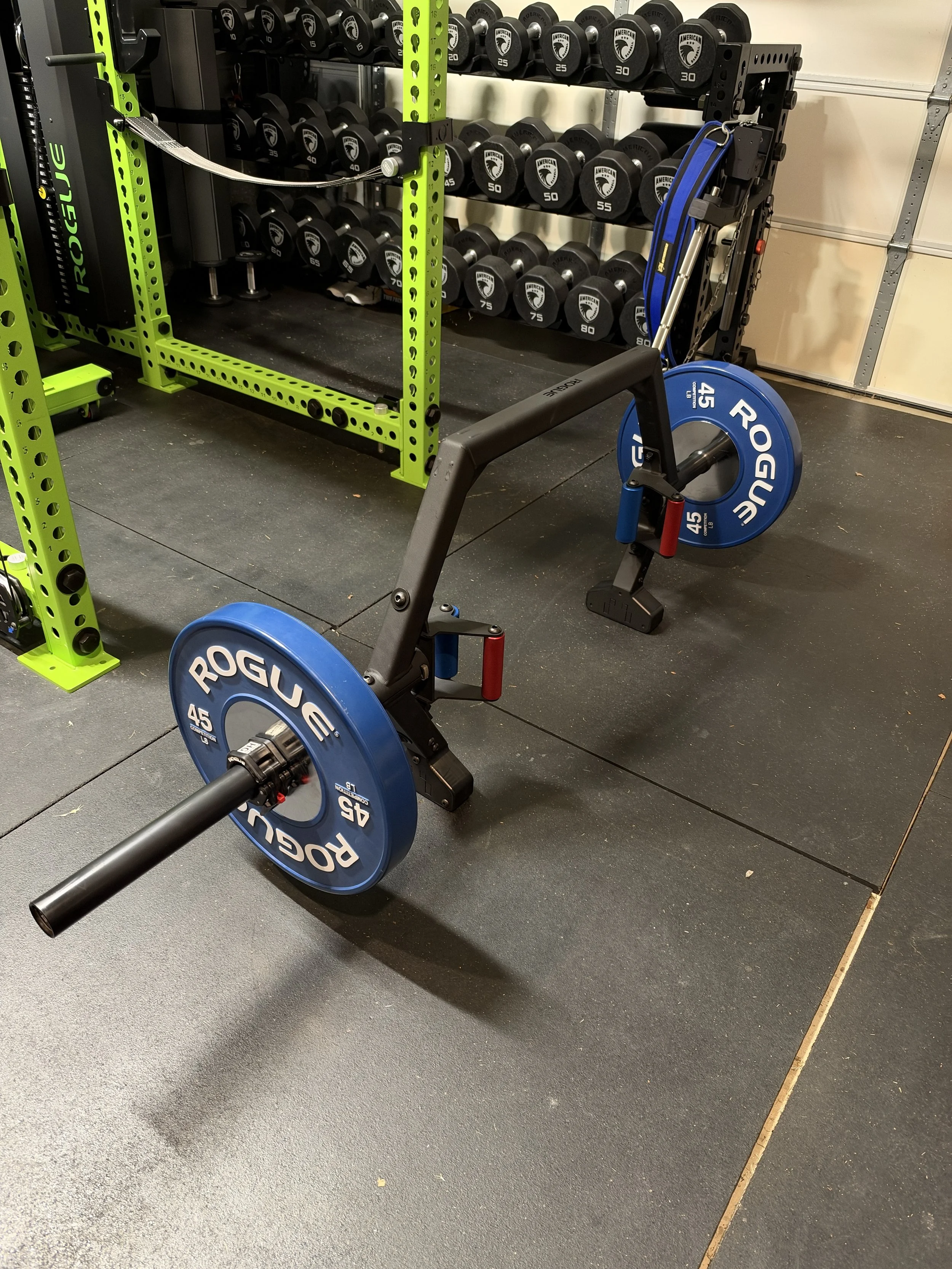
Rogue TB-3 Open Trap Bar
The Rogue TB-3 Open Trap Bar might be one of the most interesting specialty barbells Rogue has released in years. With an open-frame design, modular construction, interchangeable H-5 handles, an integrated deadlift jack, and optional rackable sleeves, Rogue has finally introduced a trap bar that addresses many of the limitations of its traditional TB-1 and TB-2 designs.
I purchased the Heavy-Duty open-frame configuration with rackable sleeves and dual H-5 handles, paying approximately $625 including tax and shipping.
After a five-week wait for delivery, assembly, and three workouts over my first week of ownership, I've been extremely impressed.
The construction is outstanding, the bar feels remarkably stable, and I appreciate the flexibility that comes with Rogue's modular design. The interchangeable H-5 handles are a particularly welcome addition, especially since I've already invested in Rogue's expanding handle ecosystem through other attachments in my gym.
The open-frame design also provides considerably more exercise possibilities than a conventional closed hex bar. In fact, after only a week, I've already decided to sell my Sorinex Diamond Hex Bar.
That's not a criticism of Sorinex. I've owned that bar for years, and it's been fantastic. But the TB-3 accomplishes everything I need from a traditional trap bar while offering additional functionality that makes keeping both difficult to justify.
That said, the TB-3 isn't perfect.
I've already noticed a few drawbacks, including the added weight of the Heavy-Duty frame, grip fatigue when using the larger 45mm handles for heavy deadlifts, and a stability consideration when unloading plates with the integrated jack.
I'm also not particularly enthusiastic about the textured black powder coat, and I have some unanswered questions about how Rogue's modular connections will hold up after years of heavy training.
But my biggest criticism is actually a decision I made when ordering.
If I were buying the TB-3 again, I'd probably choose the Standard frame instead of Heavy-Duty.
The difference in price is only $30. The difference in weight is approximately 10 pounds. After moving this 68-pound bar around my garage for a week, I've realized I probably would have appreciated the lighter construction more than the additional steel.
This is a first-week ownership review, not a long-term durability assessment. I've completed three workouts with the bar, and there are still several movements and performance characteristics I want to evaluate.
But after my initial experience, I'm impressed enough to make the TB-3 my primary trap bar.
Things I Love
Outstanding American-made construction
Stable, well-balanced feel during deadlifts
Open-frame design offers greater versatility than traditional hex bars
Interchangeable Rogue H-5 handles
Four available handle diameters
Dual-height handle configuration
Standard Olympic sleeves compatible with regular barbell collars
Integrated deadlift jack
Rackable sleeve option
Solid modular joint design with excellent initial fitment
Compatibility with Rogue's growing H-5 attachment ecosystem
Relatively affordable configuration upgrades
Enough versatility to replace my Sorinex Diamond Hex Bar
Things I Don't Love
Heavy-Duty construction adds approximately 10 pounds
The 68-pound unloaded weight makes plate calculations less convenient
The 45mm handles significantly challenge my grip during heavier deadlifts
Fixed 25-inch handle spacing
No alternative H-5 knurling patterns
Textured powder coat isn't my preferred finish
Uneven plate unloading can cause the bar to tip
Modular connections require hardware inspection and long-term monitoring
No published maximum load-capacity rating that I could locate
Green H-5 handles aren't available in the TB-3 configurator
$625 delivered is a significant investment for a specialty bar
Would I Recommend It?
Absolutely, particularly if you're looking for a premium open trap bar and value versatility, customization, and American manufacturing.
Based on my initial experience, Rogue has done an excellent job creating a piece of equipment that feels substantial while offering practical improvements over traditional trap bars.
The combination of an open frame, interchangeable handles, rackable sleeves, and integrated deadlift jack makes the TB-3 particularly attractive for serious home gym owners.
However, I would recommend giving the Standard frame serious consideration before automatically choosing Heavy-Duty.
I purchased the heavier model because I wanted equipment that would last for decades. After actually using it, I think the Standard configuration probably would have met my needs just fine.
And while I appreciate Rogue's quality, there are less expensive open trap bars available that deserve consideration.
Iron & Lime Verdict: Recommended after initial testing. Excellent construction, impressive versatility, and strong early performance. I'd choose the Standard frame for most home gym applications. A longer-term durability verdict will follow after additional testing.
Rogue TB-3: A Modern Upgrade to the Traditional Trap Bar
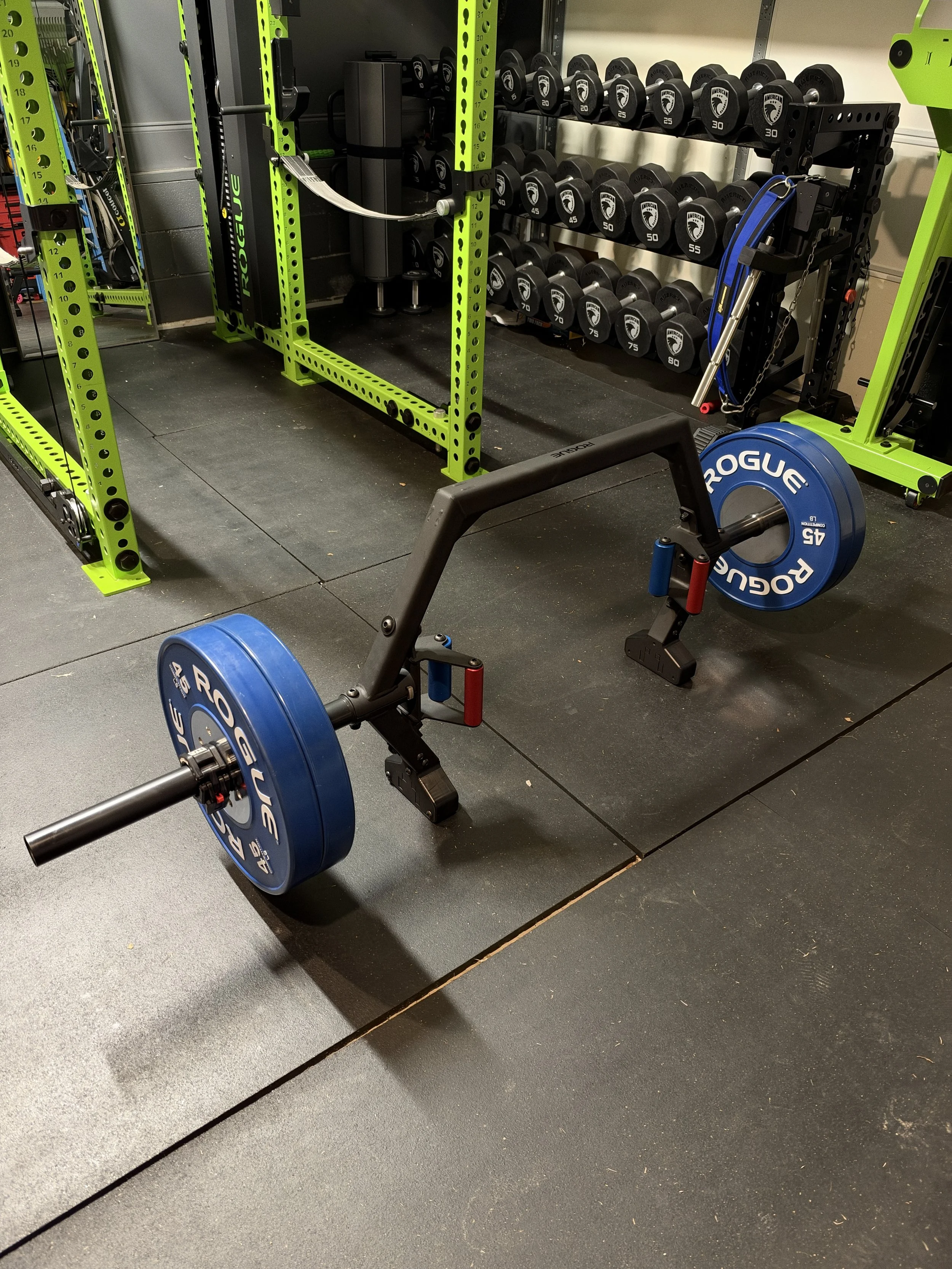
Rogue TB-3 Open Trap Bar
I've spent a lot of time around trap bars over the years, both in my personal training and throughout my Army career.
Traditional hex bars have been around for decades, and for good reason.
They provide a neutral-grip pulling position, allow lifters to stand closer to the center of the load, and offer an alternative to conventional straight-bar deadlifts.
I've used Sorinex and Rogue trap bars extensively, and I've never had any major complaints about the traditional closed-frame design for deadlifting.
But there's an obvious limitation.
You're essentially standing inside a steel cage.
That works perfectly well for deadlifts, but it becomes restrictive when you want to perform exercises like lunges, step-ups, loaded carries, or other movements requiring additional freedom of movement.
Open trap bars address that limitation by eliminating one of the crossmembers.
And while Rogue has been producing excellent conventional trap bars for years, other manufacturers have already introduced open-frame designs with features such as integrated deadlift jacks and interchangeable handles.
The TB-3 brings Rogue into that category.
But rather than simply taking the TB-2 and removing a section of the frame, Rogue developed a modular platform with substantial customization.
You can choose different frames, sleeve lengths, handle arrangements, and grip diameters.
That appealed to me because I'm always looking for ways to improve the versatility of my garage gym without continually adding equipment that occupies more space.
And because I've generally had excellent experiences with Rogue equipment, the TB-3 immediately caught my attention.
Rogue TB-3 Specifications at a Glance
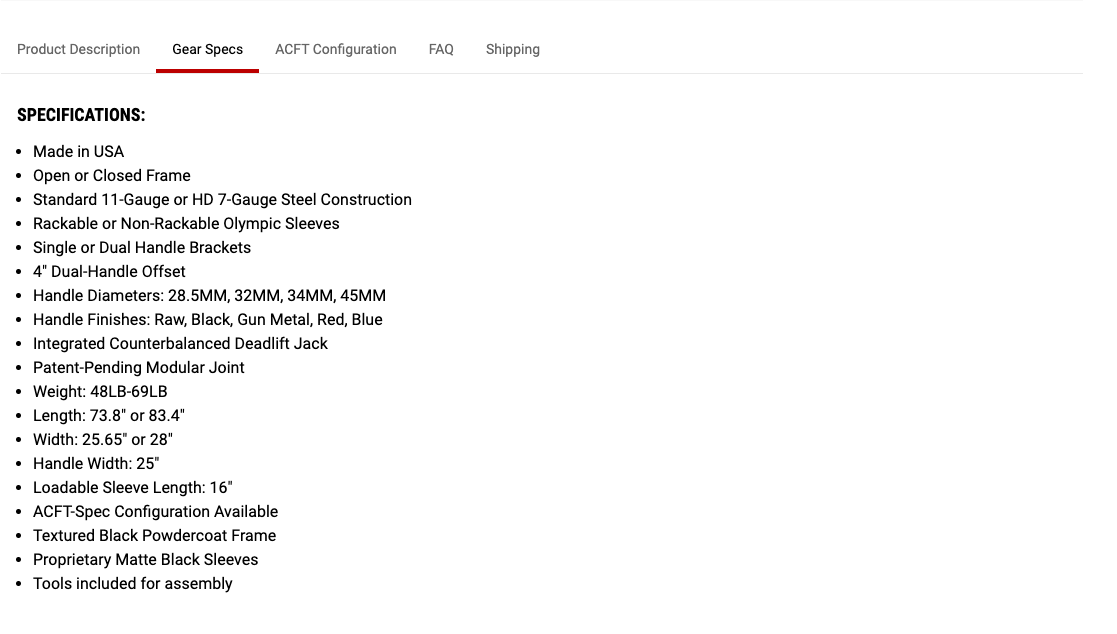
Rogue TB-3 Open Trap Bar Specs
Rogue offers several different configurations of the TB-3, so specifications will vary depending on how you order it.
My configuration includes the open Heavy-Duty frame, rackable sleeves, and dual H-5 handles in 34mm and 45mm.
I also chose the rackable sleeves because I wanted to use the bar inside my power rack for movements like strap-supported rack pulls and Romanian deadlifts.
One Specification I'd Like Rogue to Publish
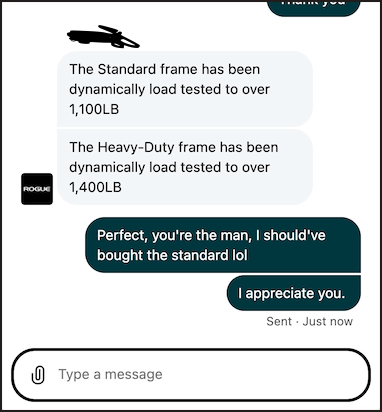
One thing I couldn't find in Rogue's published information was a numerical maximum weight-capacity rating for either the Standard or Heavy-Duty frame.
That surprised me. So I reached out to Rogue, fortunately, customer service is a strong suit for them. The weight capacity of the standard TB-3 is 1,100 lbs, and the weight capacity of the heavy duty TB-3 is 1,400 lbs.
Rogue provides extensive information about the materials, dimensions, and available configurations, but I'd like to know what the actual load ratings are.
The Heavy-Duty frame uses substantially thicker steel, but without published capacity figures, it's difficult to determine precisely what additional performance you're getting.
I'm certainly not going to be deadlifting 1,000 pounds with this thing.
Most of my heavier training falls into a much more reasonable range.
But I still think capacity information would help buyers determine whether the Heavy-Duty upgrade is worthwhile.
If you're marketing two different frame grades, I'd like to understand what practical differences justify the heavier construction.
Delivery and Packaging: A Five-Week Wait and Three Boxes
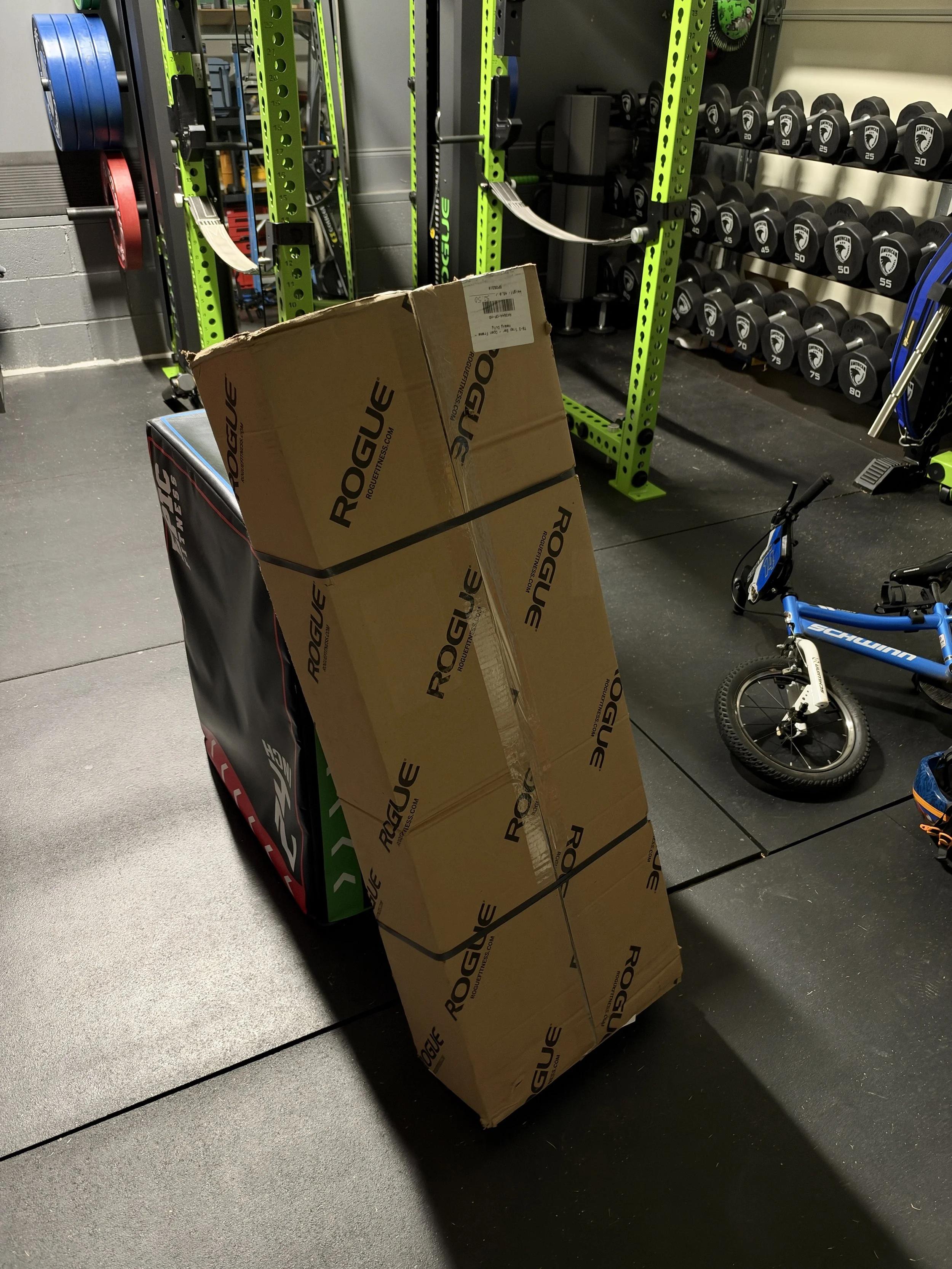
Rogue TB-3 Open Trap Bar Box
I waited approximately five weeks for the TB-3 to arrive.
And when it finally shipped, it came in three separate boxes.
Unfortunately, those boxes didn't arrive together.
The first box, containing the main frame components, showed up a day before the other two.
Normally, waiting another day isn't a big deal.
But after waiting five weeks for a new piece of gym equipment, I was basically a kid on Christmas morning.
So there I was with part of a brand-new trap bar sitting in my garage that I couldn't actually assemble.
I didn't even bother unpacking that first box because I knew I'd get even more impatient once I started seeing the components.
Naturally, I handled the situation like a mature adult.
I checked the tracking information and my front door camera approximately 37 times.
Fortunately, the remaining boxes arrived the following day.
How Was the Packaging?
With equipment this heavy, packaging matters.
I've purchased enough Rogue equipment over the years to know that shipping large steel components can be an adventure.
I've had deliveries where rack uprights or other heavy components arrived with portions of the packaging damaged or the steel protruding through the cardboard.
To Rogue's credit, they've consistently taken care of issues when I've experienced them.
But it's still something I pay attention to whenever new equipment arrives.
Fortunately, there were no problems with the TB-3.
Everything arrived in excellent condition, with no damaged components or unexpected surprises.
Considering the substantial weight of the individual pieces, I was happy with the packaging.
Outside of the delayed arrival of the remaining boxes, I have no complaints about the delivery experience.
Assembly: Better Than I Expected
One of my initial concerns with the TB-3 was its modular construction.
I've always appreciated fully welded trap bars.
They're simple, substantial, and don't introduce additional hardware that could potentially loosen over time.
The TB-3 takes a different approach.
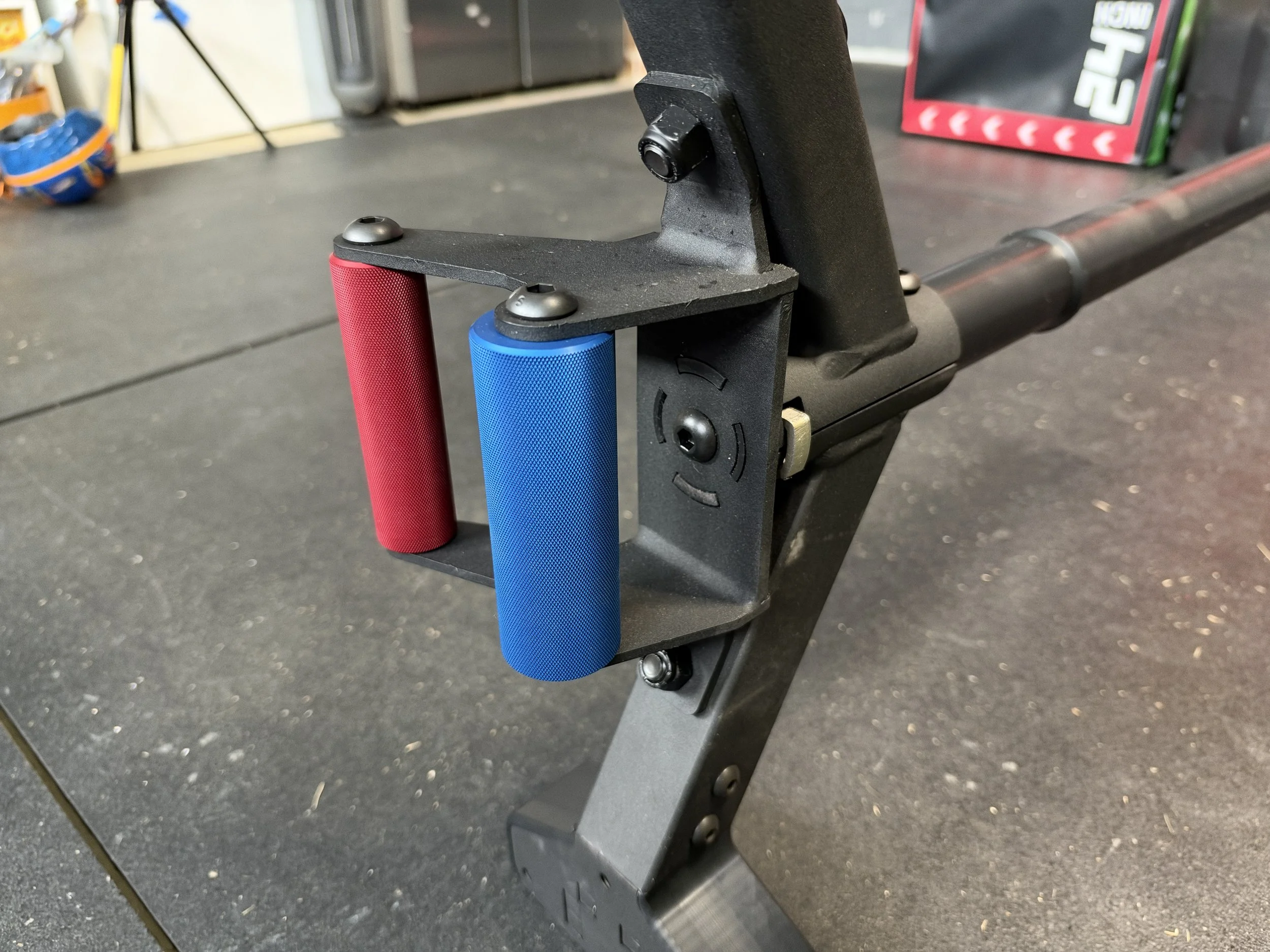
Rather than using one welded frame, Rogue relies on modular sections connected through a patent-pending joint system.
The connection joins the frame, handle bracket, and sleeve assembly using interlocking components and a threaded connection.
What I particularly appreciate is the way the components fit together.
The joint uses integrated tabs and mating surfaces that help locate the components and resist unwanted movement rather than relying solely on a bolt clamping separate pieces together.
Once everything is tightened, the finished bar feels incredibly solid.
Honestly, it doesn't feel noticeably different from a welded trap bar during normal handling.
And I was pleasantly surprised by that.
The assembly itself was straightforward, and the components fit together nicely.
Will the Modular Connections Loosen Over Time?
Rogue TB-3 Open Trap Bar Connections
This is probably my biggest unanswered question about the TB-3.
With a traditional welded trap bar, there aren't major bolted connections between the frame and sleeves that need periodic attention.
The TB-3 has several modular joints.
And while everything feels extremely secure after my first week, I want to see how those connections behave after months and years of heavier training.
I've already used the bar with several plates per side, and nothing has given me reason to question the construction.
But three workouts aren't enough to establish long-term reliability.
Rogue also includes a maintenance reminder in the manual regarding ensuring that the hardware is properly tightened before use.
That's worth taking seriously and following.
I hope the design proves stable enough that frequent retightening isn't necessary, but only time will tell.
I'll continue monitoring the connections and plan to revisit this in a one-year ownership review.
If the joints start developing movement or require regular adjustment, that's something potential buyers deserve to know.
For now, I think Rogue did a great job with the engineering.
Why I Ordered the Heavy-Duty Frame
When I buy gym equipment, I generally buy it with the intention of keeping it forever.
I'm not running a channel where equipment gets cycled out every few weeks simply because something newer becomes available.
I've had major pieces of equipment in my gym for years, and I don't plan on replacing them unless there's a meaningful reason.
I prefer investing in quality equipment and keeping it.
That's one reason the Heavy-Duty TB-3 initially appealed to me.
I really believe in the open trap bar concept, and I wanted something that could potentially serve my family for decades.
Hopefully, another 10 years from now, my daughter and sons will be out here lifting seriously too.
And maybe eventually their kids will be using some of the same equipment.
I grew up in Kansas, and I still remember seeing videos of Darren Sproles training when he was at Kansas State.
Watching someone that explosive moving serious weight leaves an impression.
So when I'm thinking about the long-term value of gym equipment, part of me imagines one of my kids or grandkids becoming an absolute monster in the weight room.
Maybe one of them will eventually be deadlifting 800 pounds.
Who knows?
And if that happens, I'd like to have equipment capable of supporting their training.
Now, I recognize there's not much scientific reasoning behind choosing 7-gauge over 11-gauge steel simply because I want something to last a long time.
Especially without published load-capacity differences.
But that's the mindset I had when I ordered it.
And after a week of using the bar, I'm beginning to think I may have overdone it.
Build Quality and Balance: Excellent, With One Qualification
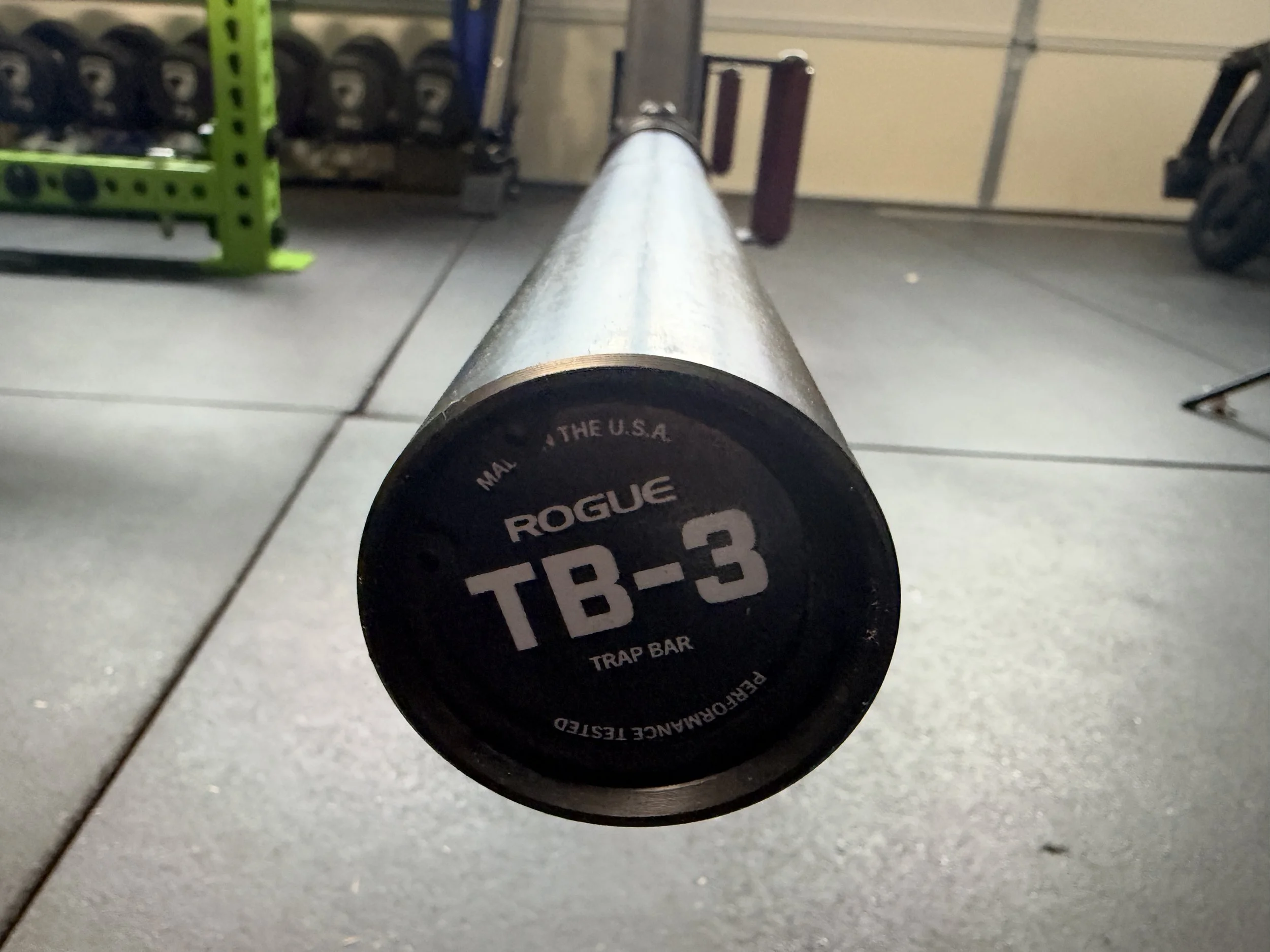
Rogue TB-3 Open Trap Bar Endcap
One thing Rogue consistently does well is manufacture substantial equipment.
And the TB-3 is no exception.
The frame feels incredibly sturdy, the support gussets add to the substantial construction, and the completed bar gives you the impression that it's built for serious use.
But the aspect that impressed me most was the balance.
Open trap bars can be awkward depending on how the weight is distributed.
Removing one of the crossmembers changes the frame geometry, and some designs can feel noticeably different from conventional closed bars.
The TB-3 incorporates counterbalanced feet to address that.
And from my experience, Rogue did an excellent job.
I wouldn't call the bar perfectly balanced in every situation, but when picking it up for a deadlift, it feels remarkably similar to my Sorinex Diamond Hex Bar.
The bar feels stable and predictable, and I haven't noticed unwanted flex during the workouts I've completed.
That's exactly what I wanted.
However, I have noticed that I'm not quite as comfortable using it for walking lunges yet.
That may simply be a familiarity issue on my part, but the open-frame design feels different during that type of movement.
I want more time experimenting with different exercises before claiming the TB-3 performs all of them equally well.
That's an important distinction.
Just because a bar allows more movements doesn't automatically mean it's the best tool for every one of those movements.
Standard Olympic Sleeves and Rogue's Proprietary Finish
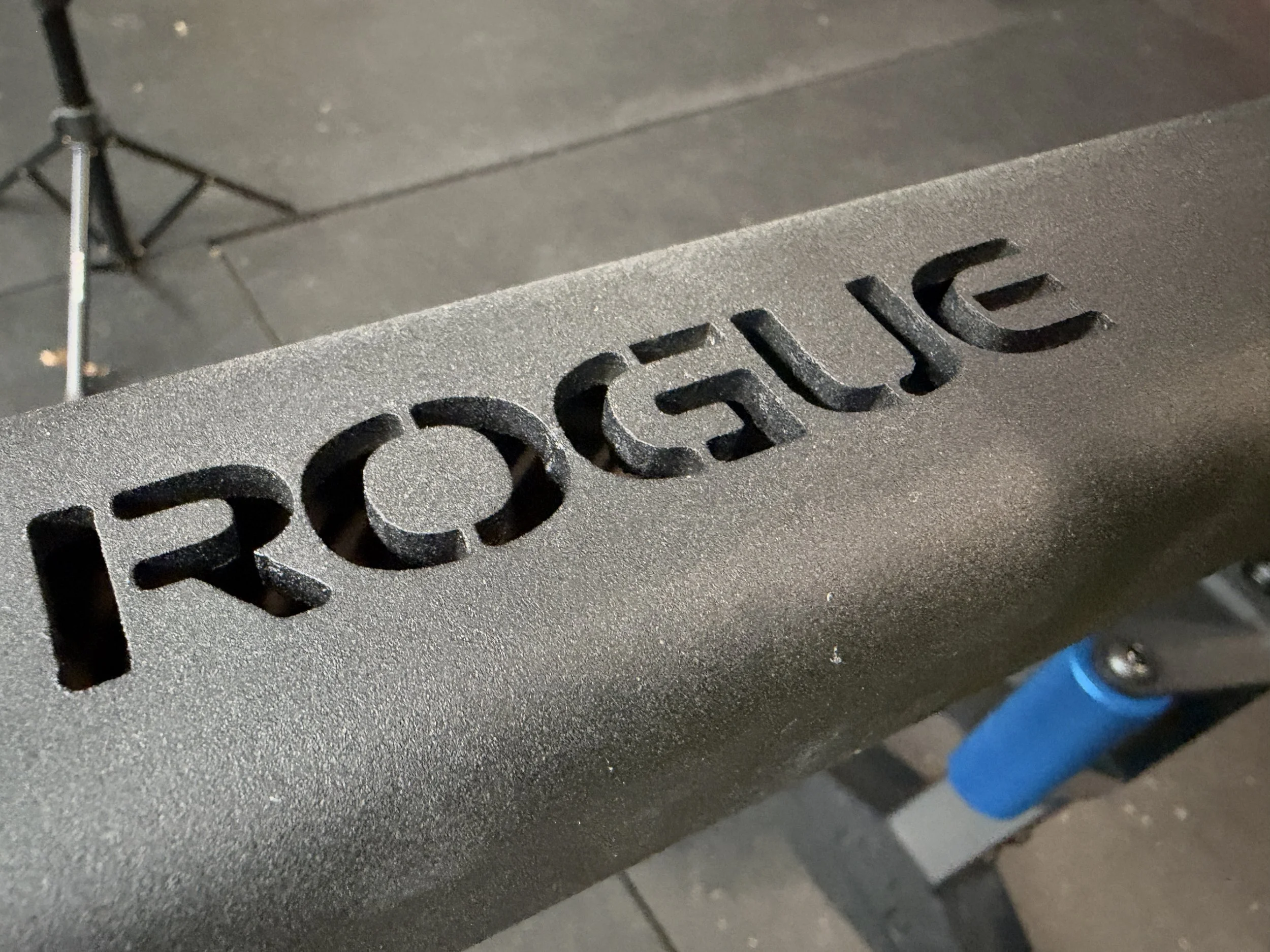
Rogue TB-3 Open Trap Bar thickness
One of the features I immediately appreciated was Rogue's decision to use standard Olympic-spec sleeves.
That means I can use the same collars I already use on my regular barbells.
And if you've accumulated enough specialty bars, you probably understand why that's important.
Some specialty bars require axle collars or other accessories because their sleeve dimensions differ from conventional Olympic barbells.
I already have enough attachments and accessories in this garage.
I don't need another collection of collars.
I own two sets of Rogue HG 2.0 collars, and they've been excellent.
I use them across multiple bars, and I appreciate that the TB-3 works with them too.
Powder Coat: Not My Favorite Choice
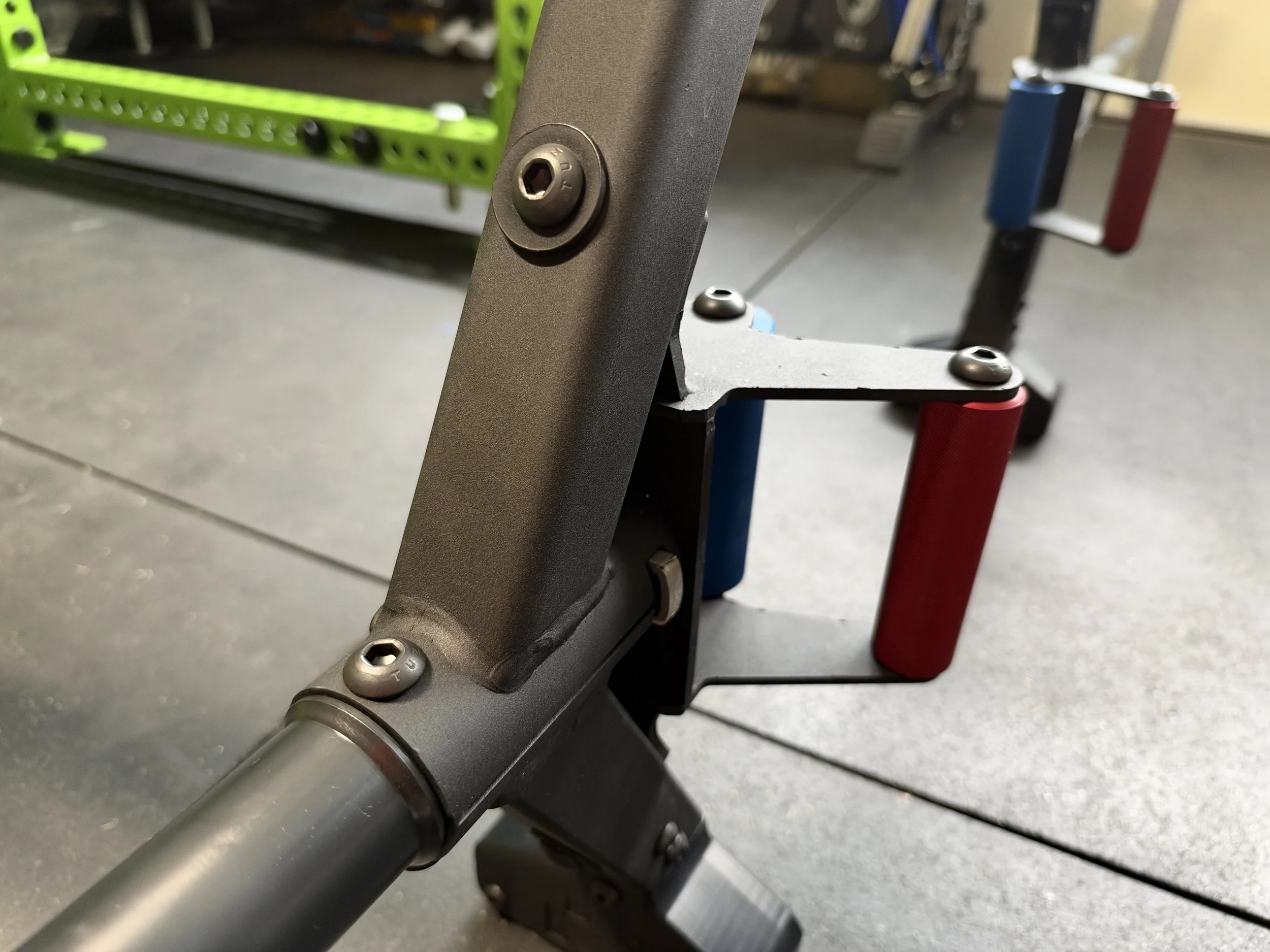
Rogue TB-3 Open Trap Bar Finish
The TB-3 uses a textured black powder coat on the frame.
And while I don't think there's anything inherently wrong with that finish, it isn't my personal preference.
I generally prefer the smoother powder-coated finishes Rogue uses on some of its racks.
And honestly, if Rogue offered a lime-green frame, that probably would've been my first choice.
The textured black looks fine, but I don't love it.
I'm also familiar with how different finishes age because I've owned several specialty bars for years.
My Sorinex Diamond Hex Bar has a smoother finish, and while it's developed some cosmetic wear over time, it's held up exceptionally well.
I appreciate equipment that continues looking good after years of regular use.
Proprietary Matte Black Sleeves
Rogue uses its proprietary matte black surface treatment on the TB-3 sleeves.
The treatment is designed to improve wear resistance compared with conventional applied coatings.
I like the appearance, and my early experience hasn't revealed any issues.
But plate loading and unloading will eventually put any sleeve finish to the test.
I've owned enough barbells to recognize that a finish looking great on day one doesn't guarantee how it will look after several hundred workouts.
I'll continue monitoring the TB-3 sleeves and frame finish as I use the bar.
That's one of the things I'll specifically revisit in my long-term review.
The Integrated Deadlift Jack: Excellent Convenience, With an Important Catch
One of the features I appreciate most is the integrated deadlift jack.
Rogue uses counterbalanced feet with textured protective contact surfaces that allow the bar to be tilted onto the feet.
When tilted, the sleeves rise off the floor, creating enough clearance to load or unload plates.
That's incredibly convenient.
I train early in the morning, and I want equipment that allows me to move through workouts efficiently.
Having the jack integrated into the bar means one less accessory to retrieve or reposition.
But there's something important I discovered while unloading plates.
Be Careful When Removing Plates Unevenly
During one of my workouts, I had two plates loaded on each side.
When I removed the plates from one side first, the bar tipped toward the side that still had weight loaded.
That caught my attention.
It's worth understanding because the integrated jack doesn't eliminate the need to manage the balance of the plates.
My recommendation is to alternate sides when unloading plates and maintain control of the bar as the load changes.
I haven't tested every possible loading combination, so I'm not going to claim there's a universal number of plates that will or won't cause tipping.
But I did experience it when unloading two plates from one side while leaving the other side loaded.
That's a practical ownership detail I think potential buyers should know.
The same principle applies when loading plates.
Take your time, pay attention to the changing weight distribution, and don't assume the bar will remain stable in every unbalanced loading condition.
How Easy Is It to Tilt the Bar?
Another factor worth evaluating is how much effort it takes to operate the integrated jack under heavier loads.
The feet provide substantial clearance, but their geometry also affects how far the bar needs to rotate.
Depending on the amount of weight loaded and the flooring surface, that can influence how easy the jack feels to operate.
I haven't conducted a head-to-head comparison with other open trap bar designs, so I'm not going to rank Rogue's system against competitors.
But overall, I appreciate having the jack integrated into the bar.
The convenience is significant, and the tipping issue is manageable as long as you're mindful of how you load and unload plates.
Rackable Sleeves: A Major Selling Point for My Garage Gym
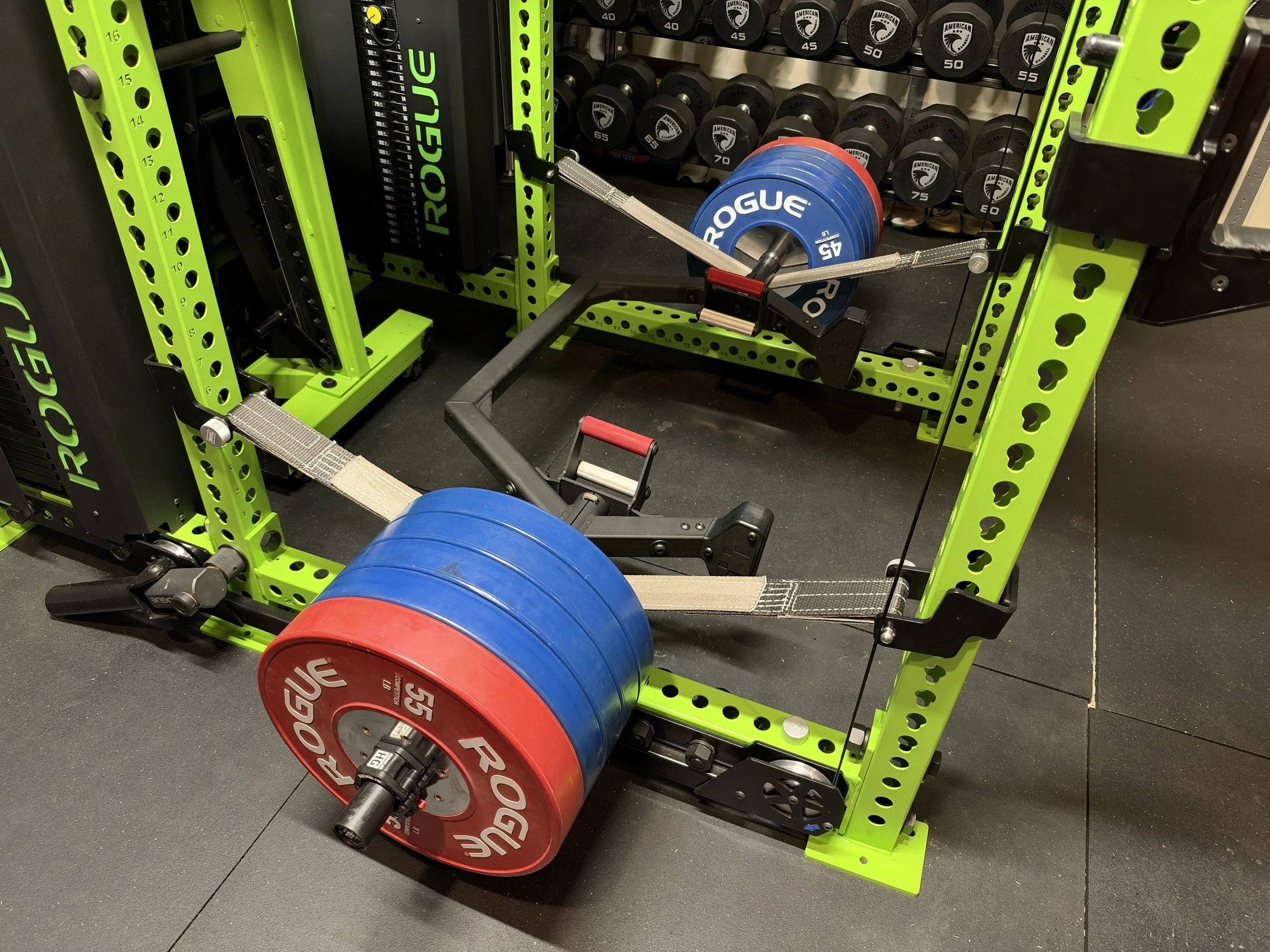
Rogue TB-3 Open Trap Bar
The rackable configuration was one of the biggest reasons I purchased the TB-3.
I generally train between 4:30 and 6:30 in the morning.
And my kids sleep directly above the garage.
That creates an interesting challenge when you're trying to do heavy deadlifts without turning the entire house into an alarm clock.
One thing I've found helpful is using safety straps for movements like rack pulls and Romanian deadlifts.
I can position the straps so the bar finishes only a few inches above the floor, allowing me to train heavy without repeatedly dropping bumper plates onto the ground.
That's important because I enjoy getting my workout done before everyone else wakes up.
And I also enjoy keeping the peace in my house.
The rackable TB-3 allows me to incorporate that same approach into trap bar training.
That's a major advantage over my previous closed-frame setup.
The Tradeoff: Overall Length
The rackable TB-3 measures approximately 83.4 inches long, while the non-rackable configuration is 73.8 inches.
That's nearly 10 inches of additional length.
And in a two-car garage gym, that isn't insignificant.
You'll want to consider how much clearance you have around your rack, your plate storage, and the surrounding equipment.
You also need to confirm that the configuration works with your J-cups, safety straps, and intended rack setup.
The additional length is worth it for me because I plan to use the bar for rack-based movements.
But if you primarily train from the floor, the shorter configuration may be more practical.
I think most home gym owners would love to have a massive rack, endless storage, and every piece of equipment they could imagine.
Unfortunately, most of us don't have unlimited space.
So equipment that can serve multiple purposes becomes increasingly valuable.
And that's where the rackable TB-3 makes a strong case for itself.
Rogue H-5 Handles: My Favorite Part of the TB-3
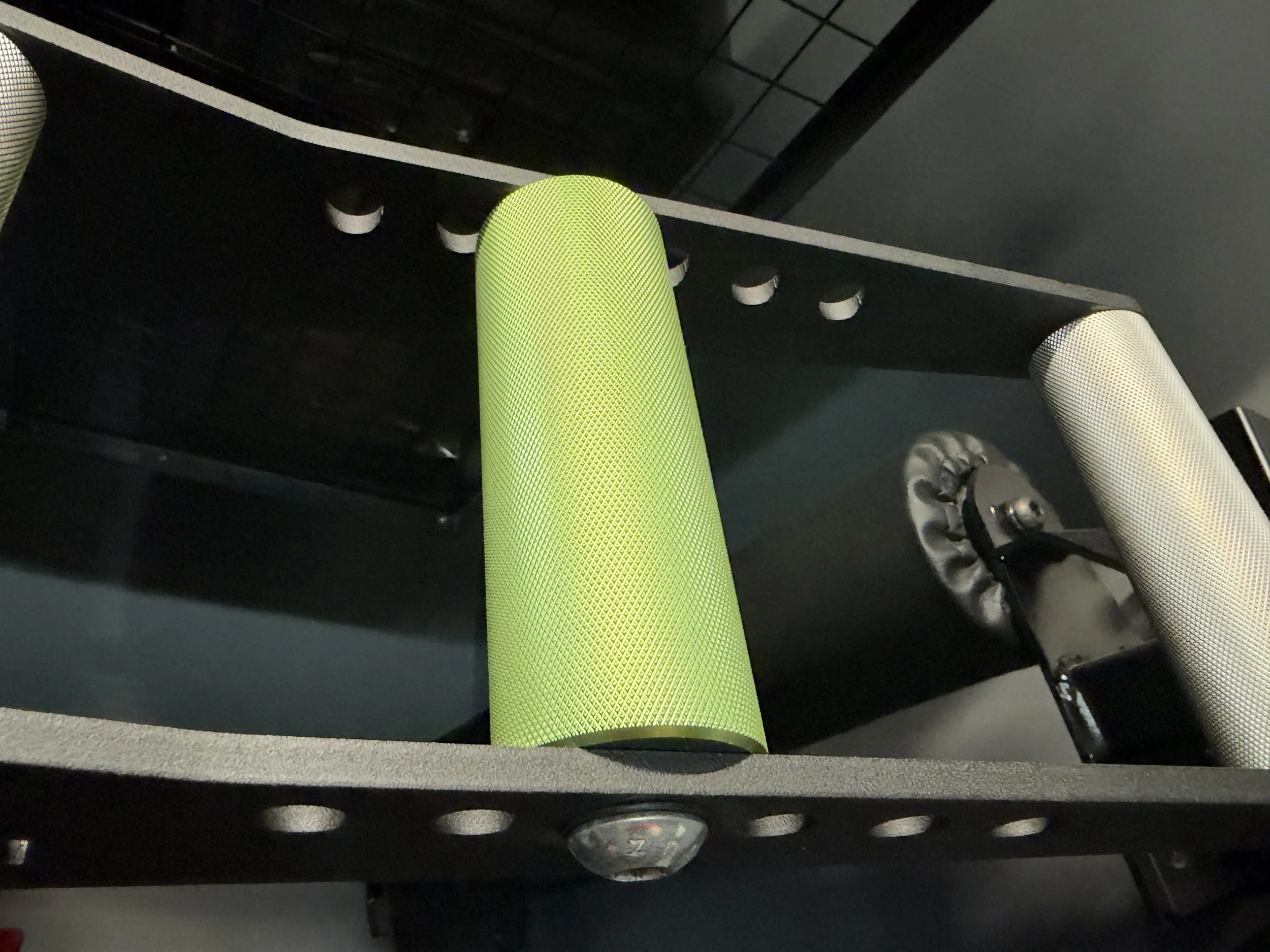
One of the features I appreciate most is the interchangeable H-5 handle system.
I've already spent considerable time using Rogue's H-5 handles through attachments like my CG-1C.
And I genuinely like the direction Rogue has taken with this ecosystem.
Instead of being stuck with whatever handle diameter a manufacturer permanently welded onto a bar, you can choose from multiple options and swap them as your preferences change.
The TB-3 offers four handle diameters: 28.5mm, 32mm, 34mm, and 45mm.
I purchased the dual-handle configuration with 34mm and 45mm grips.
In hindsight, I probably would've ordered two sets of 34mm handles because I already own 45mm H-5 handles for another attachment.
But having additional options isn't exactly a problem.
How Does the Knurling Feel?
Rogue uses its Ohio Bar knurling pattern on the H-5 handles.
If you've spent time with the Ohio Bar, that gives you a reasonable idea of the intended grip texture.
I find the knurling comfortable and useful without being excessively aggressive.
The anodized aluminum handles have a distinct feel compared with a traditional steel barbell, and I personally prefer the feel of my stainless steel Ohio Bar.
But that's not a major criticism of the H-5 system.
The handles still feel good, and I appreciate the variety of diameters.
One limitation worth mentioning is that while you can select different sizes and colors, you cannot choose a different knurling pattern.
If you want aggressive power-bar-style knurling, Rogue doesn't currently offer that as a TB-3 handle configuration.
My Experience Using the 45mm Handles for Heavy Deadlifts
This is something I specifically discovered during my first week.
During a heavier workout, I performed a set of five deadlifts with three 45-pound plates on each side while using the larger 45mm handles.
And my grip took a beating.
The problem wasn't necessarily that the handles were bad.
It's that the larger diameter made grip strength a much more significant part of the exercise than I intended.
When I'm doing heavy trap bar deadlifts, I generally want the limiting factor to be the muscles I'm training rather than my ability to maintain a grip on an unusually thick handle.
Now, I absolutely see value in using larger handles for grip training.
But when I'm trying to prioritize heavy pulling, I suspect I'll be happier with the 34mm handles or possibly one of the smaller options.
That's exactly why I like the modular system.
If I decide the 45mm handles aren't ideal for heavy deadlifts, I can swap them in a few minutes.
I don't need to replace the entire bar.
And for someone who grew up training on traditional commercial equipment, where the handles were whatever the manufacturer welded onto the machine, that level of customization is something I appreciate.
It's not necessary to get strong.
But it certainly is convenient.
Fixed Handle Width
One limitation of the TB-3 is its fixed 25-inch handle spacing.
You can change the grip diameter, but you cannot change the width between the handles.
For me, 25 inches has been comfortable.
However, if you're a particularly small or large lifter or have a strong preference for narrower or wider grips, that's something worth considering.
Where Are the Green H-5 Handles?
I do have one relatively minor complaint about the handle configuration.
Rogue doesn't offer green H-5 handles as an option when ordering the TB-3.
And that seems strange because Rogue already sells green H-5 handles separately.
I know because I've purchased them.
Considering the amount of lime-green equipment in my garage, I'd appreciate some consistency.
Now, I didn't let that stop me from ordering.
Instead, I went with crimson and blue handles.
I grew up in Kansas, so naturally, I had to show some love for the Jayhawks.
Rock Chalk Jayhawk.
The colors look excellent, and I'm happy with the way the finished bar turned out.
But I'd still like Rogue to offer all its available H-5 colors directly through the TB-3 configurator.
At this price point, customization is one of the selling points.
Let customers choose from the colors you're already manufacturing.
It's a small complaint, but I think it's reasonable.
Training Performance: Three Workouts Into Ownership
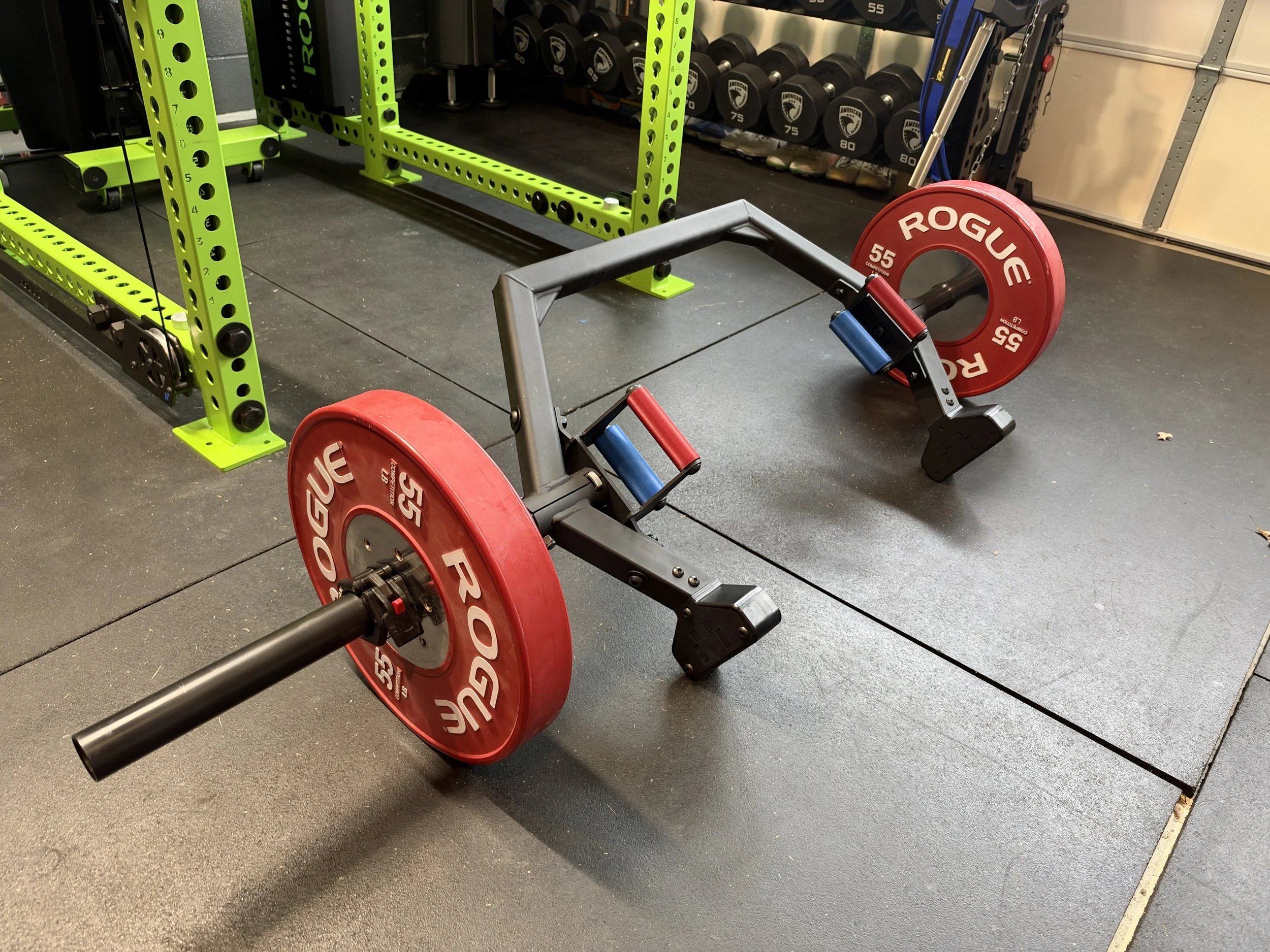
At the time of writing, I've completed three workouts with the TB-3 over approximately one week.
That's enough to establish some meaningful impressions, but certainly not enough to declare that I've fully tested every possible movement.
So far, the bar has performed extremely well.
The frame feels stable, the balance is excellent for traditional deadlifting, and I haven't noticed any concerning movement or flex during my workouts.
I've used several plates per side, but I haven't performed a maximum-capacity test or anything approaching the upper limits of what this bar might support.
My concern going into the purchase was whether the open-frame design would feel less stable than a traditional closed hex bar.
After using it, that concern has largely disappeared.
For deadlifts, the TB-3 feels remarkably familiar.
And I think that's an important achievement.
The Open Frame Is the Real Advantage
For years, I've used traditional hex bars from manufacturers like Sorinex and Rogue.
They've worked extremely well for deadlifting.
But the closed frame limits what else you can comfortably do.
With the TB-3, you have additional possibilities for:
Trap bar deadlifts
Romanian deadlifts
Loaded carries
Walking lunges
Reverse lunges
Bulgarian split squats
Step-ups
Rack-based pulls
Now, I haven't thoroughly tested every one of those movements.
And as I mentioned earlier, I'm still getting comfortable with how the bar feels during movements like walking lunges.
But the additional freedom provided by the open frame is immediately apparent.
It gives you more options without sacrificing the primary function of the trap bar.
And for a garage gym, that's valuable.
I don't have unlimited floor space.
If I'm going to dedicate space to another specialty bar, I want it to do more than one thing.
Otherwise, I'm just collecting increasingly expensive obstacles to walk around.
An Army Perspective: Why Trap Bars Matter
Having spent years in the Army, I've had quite a bit of exposure to traditional trap bars.
The Sorinex Diamond Hex Bar and Rogue's TB-1 and TB-2 are familiar designs in military training environments.
And one thing I think people sometimes overlook is how many service members are introduced to structured strength training through military physical fitness programs.
Not everybody grows up lifting.
Some Soldiers arrive at their first unit with very little experience using barbells or following a structured training program.
The Army's adoption of trap bar deadlifts through the former Army Combat Fitness Test helped expose a broader population of Soldiers to loaded strength training.
The Army Fitness Test, which replaced the ACFT in 2025, continues to include the three-repetition maximum deadlift.
I think that's a positive development for military fitness because strength training is an important component of physical readiness.
And I also think there's an opportunity for open trap bars to improve training convenience.
One thing I've seen during early-morning Army fitness testing is Soldiers struggling to load and unload traditional hex bars efficiently.
You have multiple people trying to hold or position the bar while swapping plates.
An integrated deadlift jack could make that process considerably more convenient.
And the open frame could provide additional versatility for unit physical training outside formal fitness testing.
Now, I'm not suggesting units should replace their standardized test equipment without considering official requirements.
But as a training tool, I think open trap bars deserve consideration.
For Soldiers building home gyms, especially those balancing early-morning training with family responsibilities, the TB-3's rackable configuration and integrated jack are particularly appealing.
Rogue TB-3 vs. Sorinex Diamond Hex Bar
This is probably the biggest indicator of how much I've enjoyed the TB-3 so far.
After owning my Sorinex Diamond Hex Bar for years, I've decided I'm going to sell it.
That's not something I say lightly.
The Sorinex has been an excellent bar.
It's incredibly well built, and I've had no meaningful complaints about its performance.
But the TB-3 offers everything I currently need from a conventional trap bar while providing additional functionality.
FeatureRogue TB-3, My SetupMy Sorinex Diamond Hex BarFrame designOpenClosedTraditional deadliftsYesYesInterchangeable handlesYesNoDual-height handle configurationYesFixed designIntegrated deadlift jackYesNoRackable configurationYesNoAdditional movement clearanceYesLimited by closed frameAdjustable handle diameterBy replacing handlesNo
The Sorinex still accomplishes its intended purpose.
But I simply don't need two bars performing essentially the same primary function when one offers significantly more versatility.
And in a garage gym, space matters.
I also recognize that selling equipment I no longer need allows me to reinvest that money into other equipment I'd like to test and review.
That's a more practical approach than keeping something expensive on a storage rack simply because I enjoy owning it.
Before selling the Sorinex, I plan to give it a dedicated review based on my years of ownership.
But as far as my personal training goes, the TB-3 has earned the primary trap bar position in my gym.
Pricing: Is the Rogue TB-3 Worth $625?
For my specific configuration, I paid approximately $625 including tax and shipping.
That's a lot of money for a trap bar.
There's no getting around it.
There are less expensive open trap bars available from companies like REP, Giant, Titan, and Bells of Steel.
And at the premium end, companies like Eleiko also offer open trap bar options.
I haven't used enough of those alternatives to give you a fair head-to-head comparison.
So I'm not going to claim Rogue is automatically superior simply because it's Rogue.
But there are several reasons I chose the TB-3.
First, I appreciate American manufacturing.
I like supporting companies producing quality equipment domestically, and Rogue has a strong history of doing exactly that.
Second, I already own several Rogue attachments that use the H-5 handle system.
Being able to integrate another piece of equipment into that ecosystem appeals to me.
Third, I wanted rackable sleeves.
And finally, I've generally had very positive experiences with the construction quality of premium manufacturers like Rogue, Sorinex, Hammer Strength, and Eleiko.
I'm willing to pay more for equipment when I believe the construction, design, and manufacturer support justify that investment.
That doesn't mean everyone should.
But for my training preferences and the way I've built my gym, those factors matter.
Configuration Upgrade Costs
One thing I think Rogue did reasonably well was the pricing of the different upgrades.
UpgradeAdditional CostStandard to Heavy-Duty frame$30Single to dual handles$20My complete configuration with shipping and tax$625
The upgrade prices represent differences between configurations and are already reflected in my total purchase price.
The dual handles were an easy decision.
For another $20, I appreciate the second pulling position.
The Heavy-Duty frame initially seemed just as obvious.
But after actually using the bar, I've changed my mind.
Standard vs. Heavy-Duty: Why I Would Order Differently
My Heavy-Duty configuration weighs approximately 68 pounds.
An equivalent Standard configuration would weigh approximately 58 pounds.
That's a 10-pound difference.
And while that might not sound significant, it's noticeable when you're repeatedly moving a specialty bar around the gym.
It also makes calculating training weights less convenient.
Most of us are accustomed to a standard 45-pound Olympic barbell.
With the TB-3 weighing approximately 68 pounds, you have to account for an additional 23 pounds compared with a conventional barbell.
For example, two 45-pound plates on each side produce a total of approximately 248 pounds rather than the familiar 225 pounds.
It's obviously not difficult math, but it does require a little adjustment.
And when you're moving the bar around your garage, that additional weight is something you notice.
I realize complaining that my Heavy-Duty trap bar is heavy is a little ridiculous.
I ordered it.
But there's something to be said for making equipment manageable without compromising the functionality you actually need.
A Lesson I Should Have Learned From My Rogue CG-1C
One thing I appreciate about Rogue's CG-1C attachment is that the company offers different material and weight options.
I chose the lighter aluminum configuration rather than the heavier steel option.
And I've been extremely happy with that decision.
The lighter weight makes the attachment more convenient to move and reposition.
I probably should have applied the same reasoning to the TB-3.
Instead, I focused on the idea that thicker steel meant a better long-term investment.
But after three workouts, I haven't experienced anything that makes me believe the Standard frame would be inadequate for my training.
I can't make definitive claims about relative strength without actual load-capacity information.
But I suspect the Standard configuration would meet my needs just fine.
And I would probably appreciate the lighter construction every time I move it.
Do I Regret Buying Heavy-Duty?
No.
I still think it's an exceptionally well-built bar.
And I'm certainly not going to sell it just to purchase the Standard version.
I'll be using this 68-pound beast for years.
But if someone asked me today which version I'd recommend for a serious home gym, I'd lean toward Standard unless they had a specific reason to prioritize heavier construction.
The additional $30 isn't the real issue.
It's whether the extra weight provides a benefit you'll actually appreciate.
For my training, I haven't found that benefit yet.
Maybe one day one of my kids or grandkids will be lifting enough weight to make me glad I bought Heavy-Duty.
Until then, I'll keep telling myself that was the plan all along.
Who Should Buy the Rogue TB-3?
I think the TB-3 makes the most sense for serious home gym owners who appreciate quality construction and want more versatility than a conventional closed-frame trap bar can offer.
If you plan to use the open frame for additional exercises, the design provides a meaningful advantage.
If you already own Rogue H-5 attachments, the interchangeable handle system becomes even more attractive.
And if you regularly train inside a power rack, the rackable sleeve configuration provides additional flexibility.
I also think the TB-3 is a compelling option for people who value American manufacturing and prefer buying equipment they intend to keep for years.
Who Probably Doesn't Need It?
If you're primarily interested in traditional hex bar deadlifts and don't care about interchangeable handles or rackable functionality, there are less expensive options that may meet your needs just fine.
Likewise, if you're working with a particularly tight budget, spending $625 on a trap bar may not be the best use of your equipment budget.
I would also think carefully before choosing the Heavy-Duty frame.
For most home gym owners, the Standard version is probably the more practical configuration.
Frequently Asked Questions
Is the Rogue TB-3 worth the money?
Based on my first three workouts, I think it offers strong value for buyers who specifically want the open frame, interchangeable handles, and rackable configuration. At $625 delivered for my setup, it isn't a budget option, and less expensive alternatives deserve consideration.
Should I buy Standard or Heavy-Duty?
For most home gym owners, I'd recommend considering Standard first. I purchased Heavy-Duty but would probably choose the lighter frame if ordering again. The extra steel hasn't provided a clear advantage for my training so far.
How much does the Rogue TB-3 weigh?
The weight depends on the selected configuration. My Heavy-Duty, open-frame, rackable, dual-handle setup weighs approximately 68 pounds.
Can you use regular barbell collars?
Yes. The TB-3 uses standard Olympic sleeves compatible with conventional Olympic barbell collars.
Are the H-5 handles interchangeable?
Yes. Rogue offers multiple grip diameters, and the handles can be changed without replacing the entire bar. I currently have 34mm and 45mm handles.
Is the 45mm handle good for heavy deadlifts?
That depends on your goals and grip strength. During a set of five with three 45-pound plates per side, I found that the 45mm handles significantly challenged my grip. For heavier pulling, I'm leaning toward the smaller handles.
Does the integrated deadlift jack work well?
It's convenient and provides good loading clearance. However, I experienced the bar tipping when I removed plates unevenly from one side. I recommend alternating sides and keeping the bar controlled during loading and unloading.
Will the modular connections loosen over time?
I haven't experienced any issues during my first week, but three workouts aren't enough to establish long-term hardware reliability. I'll continue inspecting the joints according to Rogue's maintenance guidance and revisit this in a future review.
Can the Rogue TB-3 replace a traditional hex bar?
For my training needs, absolutely. I'm planning to sell my Sorinex Diamond Hex Bar because the TB-3 covers my conventional trap bar needs while offering greater versatility.
Final Verdict: A Strong First Week, With More Testing Ahead
After three workouts and approximately one week of ownership, I'm extremely happy with the Rogue TB-3.
The construction is outstanding, the balance is impressive, and I appreciate the flexibility Rogue built into the modular design.
The integrated deadlift jack, standard Olympic sleeves, interchangeable H-5 handles, and rackable configuration all contribute to a product that feels thoughtfully engineered.
But the biggest advantage remains the open frame.
That's what makes this bar more useful to me than my traditional hex bars, and it's the reason I've decided to sell my Sorinex Diamond Hex Bar.
That decision probably says more about how much I like the TB-3 than anything else.
At the same time, I think there are legitimate questions worth revisiting.
I want to see how the modular connections hold up after months of heavy training and whether the hardware requires periodic tightening.
I want to monitor the sleeve treatment and textured powder coat.
I want more time comparing the different H-5 handle diameters, particularly for heavy deadlifts.
And I want to spend more time exploring the movements made possible by the open frame.
I'm also curious whether my initial discomfort with walking lunges disappears as I become more familiar with the bar.
Those are all things I plan to address in a longer-term review, ideally around the one-year mark.
But for now, the TB-3 has made an excellent impression.
Would I buy it again? Absolutely.
Would I buy the Heavy-Duty configuration again? Probably not.
And that's not really a criticism of Rogue.
It's simply me realizing that my concerns about the potential stability and durability of a lighter open trap bar may have been overstated when I placed the order.
The Heavy-Duty model is an excellent piece of equipment.
I just don't think I personally needed the additional steel.
At $625 delivered, this wasn't a small purchase, but I'm happy with the investment.
I appreciate buying equipment from established manufacturers that have built reputations for quality construction and standing behind their products.
For me, that has value beyond the initial purchase price.
And as someone who generally buys equipment with the intention of keeping it for years, I think the TB-3 has a strong chance of becoming a permanent part of my garage.
If you're considering one, I'd be interested to hear which configuration you're looking at.
Standard or Heavy-Duty?
And if you already own a TB-3, let me know what handles you chose, how you're using it, and whether you've experienced any issues with the modular connections.
I'm especially interested in hearing from anyone who went with the Standard frame and whether they've found a reason to wish they'd upgraded.
And Rogue, if you're reading this...
Green handles in the configurator, please.
Some of us have an Iron & Lime Fitness color scheme to maintain.
But until then, Rock Chalk Jayhawk.
Strength for Life. Fitness for All.
Shop the Equipment
Rogue TB-3 Open Trap Bar
View the Rogue TB-3 and available configurations
Purchases made through qualifying affiliate links may help support Iron & Lime Fitness at no additional cost to you.
Watch the Full Video Review
Rogue TB-3 Heavy Duty Review: Did I Buy Too Much Trap Bar?
Support the Garage Grind
If this review helped you make a decision or answered something you couldn't find on the product page, subscribing to Iron & Lime Fitness is one of the best ways to support what we're building.
This is a family-run operation, and everything here, from the equipment testing and filming to the writing and editing, is built around real life, a full-time career, and raising three kids.
The goal is simple: honest reviews, practical training, and helping people spend their money on equipment that actually makes sense for their gyms.
No fluff. No BS. Just real reviews from a real gym.
If you've got questions about the TB-3, other equipment, military fitness, or building a home gym, leave a comment or reach out on Instagram or Facebook at @IronAndLimeFitness.
Thanks for reading.
Drew
Iron & Lime Fitness
Barbells and Balance Things:
Watch the full video review on our YouTube channel
Rogue TR-2D Review: Great Attachment, But I Wouldn’t Buy It Again
More Articles here:
Rogue CG-1C Review: Is This $205 Cable Attachment Worth It?
Rogue Multi-Use Rack Roller Review: 18 Months Later…I Wouldn’t Buy It Again
MERACH UltraRow R60N Review: Is This Air + Magnetic Rower a Real Concept2 Alternative for Home Gyms?
Rogue Ohio Bar: Cerakote vs. Stainless Steel
Bumper Plate Showdown: Rogue Competition vs Training Bumpers | Which Rogue Plates Are Best?
Rogue Monster vs. Bells of Steel Manticore Safety Straps: An Honest Home Gym Comparison
Straydog Strength GOAT Attachment Review: What Nobody Tells You Before You Buy
Rogue Dual Indy Functional Trainer Review: The Honest Breakdown After Daily Use
Everything in This Gym Has a Reason to Be Here: A Complete Home Gym Tour
Rogue Sandwich J-Cup Too Tight? Here's How to Fix It (Calibration Kit Explained)
Home Gym Makeover: How We Transformed Our Home Gym - Paint, Layout, and a Long-Awaited Delivery
Kensui Sapporo Swiss Bar & Calibrated Gold Plates Review: Worth It for Home Gyms?
Rogue Fitness CTM-1 Review: Is it better than the Rep Adonis Cable Tower for Home Gyms?
Moving the FM-6: Why Garage Gyms Must Evolve (And How to Survive the Move)
American Barbell 10-Sided Urethane Dumbbells Review: Commercial Luxury or Financial Mistake?
Here's Why I Wouldn't Buy The Rogue FM-6 Again: Rogue FM-6 Long-Term Review
Rogue Mutant Metals Ultimate Dip Attachment Review (1 Year Later): Is It Really Worth $365?
Rogue Kabuki Transformer Bar Review
Rogue Manta Ray Adjustable Bench Review
Rogue FM-6 Twin Functional Trainer Review
American Barbell Dumbbell Set and Rack Review
“Best Budget Gear for Building a Garage Gym”
Bells of Steel Safety Straps Review: A Perfect Fit for the Rogue FM-6
Train hard. Live bold. Stay lime.